Capacity Planning for Freelancers: Managing Workload, Capacity and Utilization
Most freelancers don’t struggle with getting work.
They struggle with handling it.
At one point, there’s too little work.
At another, everything hits at once.
Projects overlap. Deadlines tighten. Work becomes reactive.
This is not a time management problem.
It’s a capacity problem.
Without clear capacity planning, freelancers:
- take on too much work
- underestimate delivery time
- create unstable workloads
This is where overbooking, missed deadlines, and burnout begin.
Key Questions About Freelance Capacity and Workload
Freelancers often struggle with practical questions around workload and capacity:
- How many clients should a freelancer have
- How to manage freelance workload without burnout
- How to distribute work across multiple clients
- How much work is too much as a freelancer
If you are trying to manage workload more effectively, these are the core questions that define how much work you can take on.
Freelancers rarely struggle with effort.
They struggle with limits.
Work increases, but capacity is not clearly defined.
Projects are accepted, but workload is not structured.
This creates cycles of overload and underutilization.
The Capacity Planning System addresses this problem by defining how much work can be delivered and how that work should be allocated over time.
Introduction
Capacity planning for freelancers determines how much client work can be delivered safely and sustainably.
Freelancers often struggle to understand how much work they can realistically take on. At one point, there is too little work. At another, workload increases quickly and becomes difficult to manage.
Most capacity problems do not occur when freelancers are already overloaded. They occur earlier — when work is accepted without a clear understanding of delivery capacity.
Generating demand does not create stability.
A strong pipeline can quickly become operational stress when delivery capacity is not defined.
Within the Processome operating model, the Capacity Planning System functions as the execution control engine of a freelance consulting business.
It converts revenue opportunities generated by the:
into realistic workload decisions.
Revenue creates opportunity.
Capacity determines feasibility.
What is Capacity Planning for Freelancers?
Capacity planning for freelancers is the process of defining how much work can be delivered and ensuring that client commitments remain within those limits.
It connects:
- available working time
- current workload
- future demand
- delivery constraints
Capacity planning answers:
- How much work can I take on?
- When should I decline new projects?
- Where is my workload becoming risky?
Without capacity planning, workload grows without control.
With it, freelancers operate within defined limits.
The Core Problem
Many freelancers operate without a clear understanding of their delivery capacity.
Typical assumptions include:
- estimating available hours informally
- assuming most hours can be billed
- ignoring non-billable work
- accepting work before evaluating impact
This creates a mismatch between revenue and delivery capability.
Several problems emerge.
Overcommitment
Multiple engagements are accepted without modeling workload.
Delivery Instability
Deadlines become difficult to maintain.
Margin Erosion
Hidden unpaid work reduces effective earnings.
Burnout Cycles
Overload is followed by recovery periods.
These are not motivation problems.
They are execution control problems.
The Capacity Planning Framework
Capacity planning consists of six interconnected components.
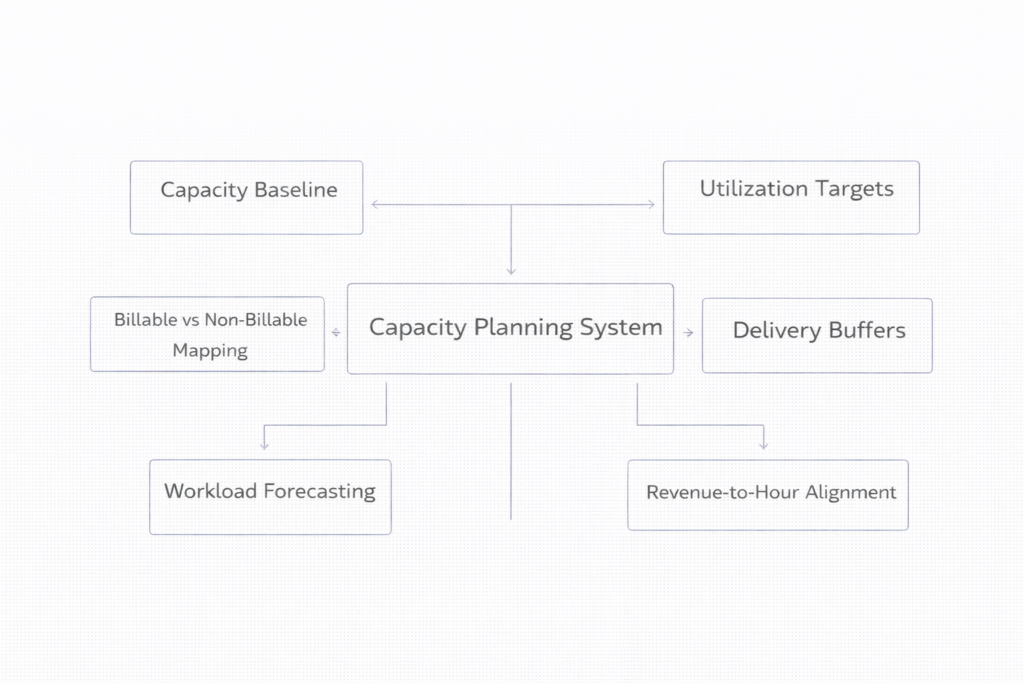
1. Capacity Baseline Calculation
Total working hours ≠ delivery capacity.
Subtract:
- admin work
- sales and marketing
- communication
- learning
- recovery and buffers
The remainder is your true capacity.
2. Utilization Target Model
Full utilization is not sustainable.
Typical ranges:
- 65–80% → healthy
- 80%+ → increasing risk
→ Utilization Rate for Solo Consultants
3. Billable vs Non-Billable Mapping
Time must be categorized:
- delivery
- sales
- admin
- coordination
- revisions
→ Effective Hourly Rate Calculation Framework
Without this, profitability is unclear.
4. Delivery Buffer Design
Buffers absorb variability:
- scope changes
- delays
- revisions
→ Delivery Buffer Design for Freelancers
Buffers protect stability.
5. Capacity Forecasting Model
Revenue must be translated into workload.
Example:
- €12,000 revenue
- €100/hour
- = 120 hours required
If capacity = 90 hours → overload risk.
→ Capacity Forecasting from Pipeline Data
6. Revenue-to-Hour Alignment
Not all revenue is equal.
Higher-efficiency work produces better margins.
Capacity determines which work is viable.
Operational Impact
Capacity planning improves:
Workload Stability
Future workload becomes visible.
Revenue Feasibility
Projects are evaluated before acceptance.
Margin Protection
Unprofitable work is avoided.
If you want to evaluate your workload and capacity directly:
→ Use the Freelance Capacity Planner
To maintain visibility across time, workload, and clients, tools that support:
- time tracking
- planning
- forecasting
can help structure your workflow.
→ Explore Time & Capacity Tools for Freelancers
System-Level Impact Across Processome
Capacity planning acts as a control layer.
- Client Pipeline System → generates demand
- Capacity Planning System → filters feasibility
- Profit Tracking System → evaluates quality
- Delivery & Operations System → executes
This prevents uncontrolled growth.
Common Failure Patterns
Overestimating Billable Capacity
Ignoring non-billable work.
Accepting Work Without Forecasting
No workload modeling.
Ignoring Buffers
Schedules become fragile.
Prioritizing Revenue Over Feasibility
Leads to overload.
Strategic Outcome
When capacity planning is implemented:
- Predictable workload
- Better pricing discipline
- Higher delivery quality
- Stable margins
Freelancers move from reactive work to controlled execution.
Final Perspective
Freelancers often focus on generating revenue.
But revenue does not determine stability.
Capacity does.
Within the Processome operating model, the Capacity Planning System ensures that opportunity remains deliverable.
Capacity planning converts growth into sustainable execution.
Capacity Planning System Frameworks
Core Capacity Models
→ Capacity Planning for Freelancers Explained
→ How Many Clients Can a Freelancer Handle
→ Freelance Capacity Model (Hours vs Revenue)
→ Utilization Rate for Solo Consultants
→ Overbooking Prevention Framework for Freelancers
Forecasting & Planning
→ Capacity Forecasting from Pipeline Data
→ Delivery Buffer Design for Freelancers
Structural Capacity Models
→ Retainer Capacity Planning Model
→ Time Tracking vs Capacity Planning
Practical
→ Freelance Capacity Planner
→ Time & Capacity Tools for Freelancers
Additional Capacity Frameworks
→ Weekly Capacity Planning Framework
→ Monthly Capacity Allocation Model
→ Sustainable Workload Design for Freelancers
→ Managing Multiple Clients as a Consultant
→ Capacity Planning vs Time Management
→ Workload Distribution Across Clients
→ Capacity Buffers Explained
→ Preventing Delivery Bottlenecks
→ Project Overlap Management
→ Freelance Workload Forecasting
→ Capacity Planning for Retainer Clients
→ Managing Delivery Peaks and Valleys
→ Capacity Planning Metrics for Consultants
→ Scaling Freelance Capacity Without Hiring
→ Workload Risk Management