Freelance Profit Tracking (How to Measure Margins & Profitability)
The Financial Intelligence Engine for Solo B2B Freelancers
Introduction
Freelance profit tracking helps consultants measure margins, evaluate profitability, and understand how revenue converts into real financial performance.
Many freelancers earn good revenue, but still struggle to understand how much profit they actually generate.
At first, everything looks successful.
Projects are delivered.
Clients are satisfied.
But over time, margins become unclear and financial performance becomes difficult to evaluate.
Projects can appear successful while profitability declines due to:
- underpricing
- unpaid work
- inefficient delivery
Revenue alone does not indicate financial health.
Many freelancers generate strong income while experiencing margin erosion due to hidden costs, inefficient projects, or untracked time.
Within the Processome operating model, the → Profit Tracking System functions as the financial intelligence engine of a freelance consulting business.
It connects revenue, time, and cost into a structured system that reveals how the business actually performs.
Revenue tells you how much money enters the business.
Profit determines whether the business works.
Key Questions About Freelance Profit and Margins
Freelancers often search for answers to questions such as:
- Why do freelancers earn well but make little profit?
- How should freelancers price their work?
- How do you know if a project is profitable?
- How can you increase profit without working more?
- What is a good profit margin for freelancers?
These questions reflect a common pattern:
Revenue is visible.
Profit is not.
What is Freelance Profit Tracking?
Freelance profit tracking is the process of measuring how revenue converts into profit across projects, clients, and the overall business.
Instead of evaluating revenue alone, the system analyzes:
- margins per project
- profitability per client
- revenue distribution
- cost structure
- pricing efficiency
This allows freelancers to answer critical financial questions:
- Which projects generate the strongest margins?
- Which clients are actually profitable?
- How efficiently does time convert into income?
- What revenue structures produce stable profit?
Financial intelligence transforms reactive income management into structured decision-making.
The Core Problem
Most freelancers make financial decisions based on revenue signals.
Typical indicators include:
- total monthly revenue
- project value
- client prestige
- short-term cash flow
While these metrics show activity, they do not reveal efficiency.
Several structural problems emerge.
Margin Blindness
Revenue is visible, but profitability remains unclear.
Time Leakage
Unpaid coordination and revisions reduce margins.
Client Inefficiency
Some clients consume more time than they generate in value.
Pricing Misalignment
Prices do not reflect real delivery effort.
These issues create a business that grows in revenue—but not in profit.
The Profit Tracking System Framework
The Profit Tracking System consists of six interconnected subsystems.
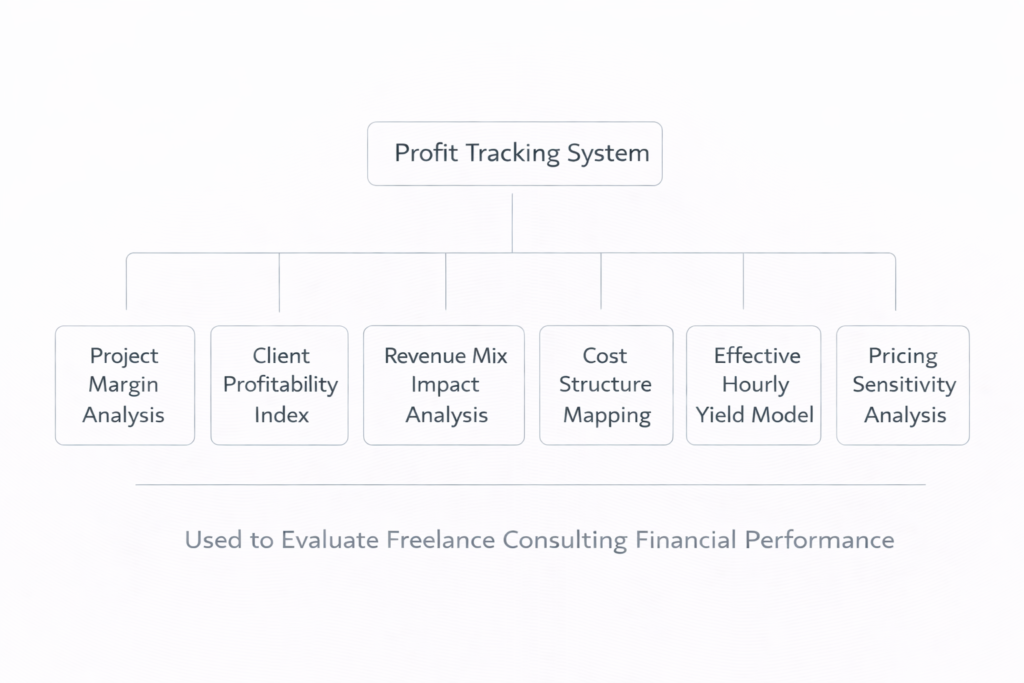
1. Project Margin Analysis
Every project should be evaluated based on its economic structure.
Contribution margin:
Revenue – Direct Cost – Time Cost
Time cost includes:
- delivery hours
- revisions
- coordination
- scope expansion
→ Contribution Margin in Freelance Businesses
2. Client Profitability Index
Clients differ significantly in financial value.
Evaluate:
- revenue generated
- hours required
- effective hourly yield
- coordination overhead
- reliability
→ Client Profitability Analysis for Freelancers
3. Revenue Mix Impact Analysis
Revenue structure determines stability and margin behavior.
Common models:
- project-heavy
- retainer-based
- hybrid
→ Retainer Profitability vs Projects
4. Cost Structure Mapping
Understand your full cost base:
- tools
- services
- subcontractors
- infrastructure
→ Break-Even Analysis for Freelancers
5. Effective Hourly Yield Model
Measure how efficiently time converts into revenue.
Revenue ÷ Total Hours
Includes:
- delivery
- communication
- admin
- sales
→ Effective Hourly Rate Calculation Framework
6. Pricing Sensitivity Analysis
Evaluate how pricing affects:
- margins
- workload
- revenue stability
→ Pricing Sensitivity Analysis
Operational Impact
A structured Profit Tracking System improves:
Margin Visibility
Understand how revenue converts into profit.
Pricing Discipline
Set prices based on real economics.
Client Portfolio Optimization
Focus on high-value clients.
Financial Forecasting
Improve planning accuracy.
System-Level Impact Across Processome
The Profit Tracking System connects all systems.
- Client Pipeline System → revenue quality
- Capacity Planning System → workload allocation
- Profit Tracking System → margin visibility
- Delivery & Operations System → execution efficiency
Financial intelligence becomes feedback that improves decisions.
Common Failure Patterns
Revenue-Focused Thinking
Success measured only by income.
Habitual Discounting
Pricing driven by uncertainty.
Hidden Time Leakage
Untracked effort reduces margins.
Client Dependency
Overreliance on a few clients.
Strategic Outcome
When implemented correctly:
- high-value clients become visible
- pricing improves
- capacity is allocated efficiently
- profit grows alongside revenue
Freelancers shift from revenue growth to profit optimization.
Practical Starting Point
If you want to evaluate your current profitability:
→ Freelance Client Profitability Calculator
This helps translate revenue and time into clear decisions.
Final Perspective
Freelance businesses often measure success through revenue.
But sustainability depends on profitability.
Within the Processome model, the → Profit Tracking System provides the financial intelligence required to evaluate real performance.
Revenue measures activity.
Profit intelligence ensures that activity creates value.
Profit Tracking System Frameworks
The Profit Tracking System includes the following financial intelligence frameworks.
Profit Fundamentals
→ Profit vs Revenue for Freelancers Explained
→ Contribution Margin in Freelance Businesses
→ Gross Margin for Freelancers
→ Freelance Business Unit Economics
Profitability Analysis
→ Client Profitability Analysis for Freelancers
→ Revenue per Client Metric
→ Profitability Metrics for Consultants
→ Consultant Profit Dashboard
Financial Risk & Forecasting
→ Revenue Concentration Risk Explained
→ Forecasting Profit from Pipeline Data
→ Financial Forecasting for Freelancers
Pricing Strategy
→ Pricing Models for Solo B2B Freelancers
→ Freelance Pricing Strategy Framework
→ Value-Based Pricing for Consultants
→ Hourly vs Project Pricing Models
→ Pricing Sensitivity Analysis
Financial Planning
→ Break-Even Analysis for Freelancers
→ Freelance Financial Planning System
→ Income Stability Models
→ Revenue Growth vs Profit Growth
Financial Diagnostics
→ Profit Leakage in Freelance Businesses
→ Consultant Revenue Benchmarks
→ Retainer Profitability vs Projects
Core Performance Metrics
→ Effective Hourly Rate Calculation Framework
Practical Tools
→ Freelance Client Profitability Calculator
→ Best Profit Tracking Tools for Freelancers