Project Overlap Management for Freelancers (Avoid Timeline Collisions)
Introduction
As freelance consulting businesses grow, managing multiple client engagements simultaneously becomes the operational norm. While working with several clients increases revenue stability, it also introduces a structural challenge: project overlap.
Project timelines rarely align neatly. Multiple clients may initiate projects within similar periods, and delivery phases often converge unexpectedly.
Project overlap management for freelancers ensures that these timelines remain balanced and do not create delivery congestion.
Within the Processome operating model, project overlap management belongs to the Capacity Planning System — the framework responsible for structuring how consulting capacity is allocated across concurrent engagements.
Without structured planning, project timelines collide and overwhelm delivery capacity. With it, freelancers maintain stable delivery even with multiple clients.
What is Project Overlap Management?
Project overlap management is the process of coordinating multiple project timelines to prevent workload congestion and delivery instability.
Instead of managing projects independently, freelancers evaluate:
- how project timelines interact
- when high-intensity phases occur
- how workload is distributed across weeks
Overlap occurs when multiple projects require significant effort at the same time.
This typically happens during:
- project kickoff
- analysis phases
- deliverable creation
- final delivery and revisions
Managing overlap means designing timelines so these phases do not collide.
The Core Problem
Many freelancers evaluate workload based on total booked hours.
However, delivery issues rarely occur because of total workload alone.
They occur when work is concentrated in the same time window.
Several patterns create project overlap.
Simultaneous Project Starts
Multiple projects begin at the same time, creating immediate workload pressure.
Deadline Convergence
Projects that started at different times reach critical deadlines simultaneously.
Feedback Cycles
Clients request revisions at overlapping moments, increasing workload unexpectedly.
Pipeline-to-Delivery Disconnect
New projects are accepted without evaluating how timelines interact.
→ Monthly Capacity Allocation Model
These patterns create workload congestion even when total capacity appears sufficient.
Project Overlap Management Framework
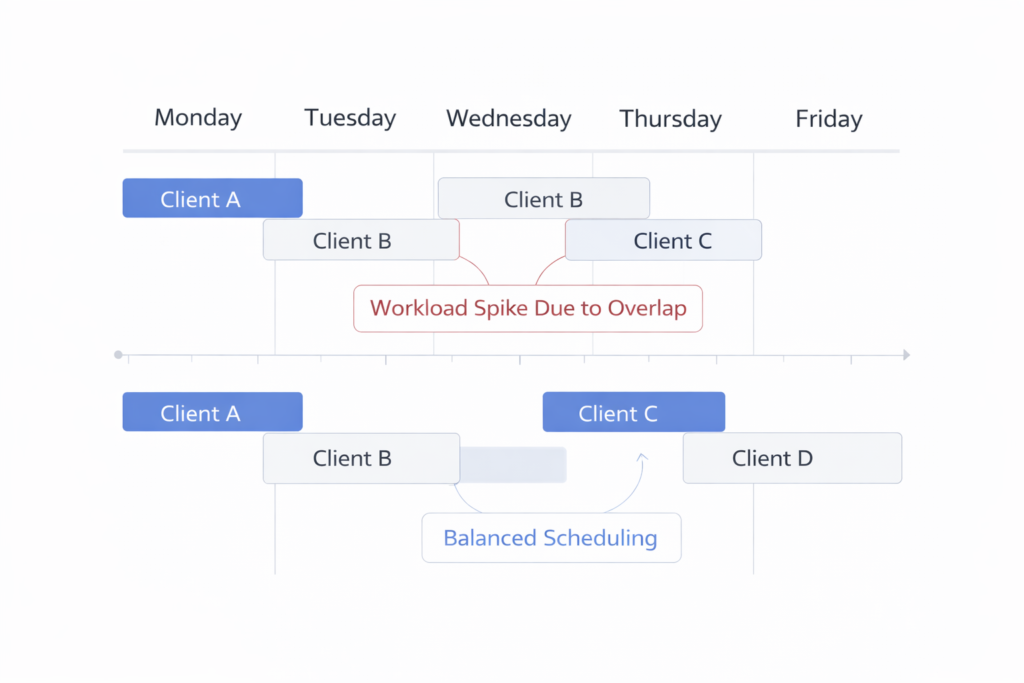
Managing overlap requires evaluating three key dimensions.
1. Timeline Distribution
Each project occupies a timeline across weeks or months.
If multiple timelines overlap heavily, workload spikes.
Spreading projects across different start dates reduces congestion.
2. Delivery Phase Alignment
Projects include phases with different intensity levels.
| Project Phase | Workload Intensity |
|---|---|
| Discovery | Medium |
| Analysis | High |
| Deliverable Creation | High |
| Feedback & Revision | Medium |
If multiple projects enter high-intensity phases simultaneously, delivery pressure increases.
Balancing phase timing prevents overload.
3. Buffer Integration
Project timelines are rarely static.
Buffers absorb:
- delayed feedback
- scope changes
- timeline shifts
Without buffers, small delays create cascading overlap issues.
Operational Impact
Structured overlap management improves several operational dimensions.
Delivery Predictability
Timelines remain realistic and achievable.
Workload Stability
Work intensity is distributed more evenly.
Client Experience
Clients receive more consistent delivery and communication.
Capacity Visibility
Freelancers understand how projects interact across time.
If you’re unsure whether your current projects overlap in a risky way:
→ Use the Freelance Capacity Planner
To maintain visibility into timelines, workload distribution, and scheduling, tools that support:
- project planning
- scheduling
- time tracking
can help structure your workflow.
→ Explore Time & Capacity Tools for Freelancers
System-Level Impact Across Processome
Project overlap connects multiple systems.
- Client Pipeline System → intake affecting timelines
- Capacity Planning System → workload distribution
- Profit Tracking System → revenue stability
- Delivery & Operations System → execution flow
Balanced timelines improve coordination across systems.
Common Failure Patterns
Freelancers often struggle with overlap due to recurring mistakes.
Independent Project Planning
Projects are planned in isolation without considering others.
Overcommitting During Sales
New work is accepted without timeline evaluation.
Ignoring Phase Intensity
High-effort phases are clustered together.
No Timeline Buffers
Schedules lack flexibility to absorb delays.
These patterns create unstable delivery systems.
Strategic Outcome
When project overlap is managed deliberately, freelancers gain control over delivery timelines.
- Stable delivery schedules
Work progresses predictably - Balanced workload
Intensity remains manageable - Improved operational control
Timeline interactions become visible
Over time, scheduling shifts from reactive to structured.
Final Perspective
Freelancers often view projects as independent.
In reality, all projects compete for the same limited capacity.
Within the Processome operating model, the Capacity Planning System ensures that project timelines remain aligned with delivery capacity.
Project overlap management transforms scheduling from reactive coordination into structured capacity planning.
Balanced timelines create stable delivery.