Scaling Freelance Capacity Without Hiring
Introduction
Freelancers often associate business growth with increasing workload. As demand grows, the default assumption is that scaling requires hiring employees or subcontractors.
However, many solo consultants reach capacity limits long before hiring becomes necessary.
Scaling freelance capacity without hiring focuses on increasing output and revenue by restructuring how capacity is used, rather than adding more people.
Within the Processome operating model, capacity scaling belongs to the Capacity Planning System — the framework responsible for structuring how consulting capacity is allocated, optimized, and expanded.
Without structured scaling, freelancers hit a delivery ceiling. With it, consultants can grow revenue while remaining solo operators.
What is Scaling Freelance Capacity Without Hiring?
Scaling freelance capacity without hiring is the process of increasing delivery output without increasing working hours or team size.
Instead of adding resources, freelancers optimize:
- service structure
- client portfolio design
- delivery systems
- workload allocation
The goal is to increase value delivered per unit of capacity, not total hours worked.
The Core Problem
Most freelancers try to grow by increasing hours or clients.
This approach quickly reaches structural limits.
Time-Based Capacity Limits
Weekly delivery capacity is finite.
Once fully booked, no additional work can be absorbed.
Client Portfolio Saturation
More clients increase coordination complexity and workload pressure.
Revenue Growth Plateau
Revenue tied directly to time eventually stops growing.
Delivery Risk
Accepting work beyond capacity destabilizes delivery quality.
These issues occur when scaling is treated as a time problem instead of a structural one.
Capacity Scaling Framework
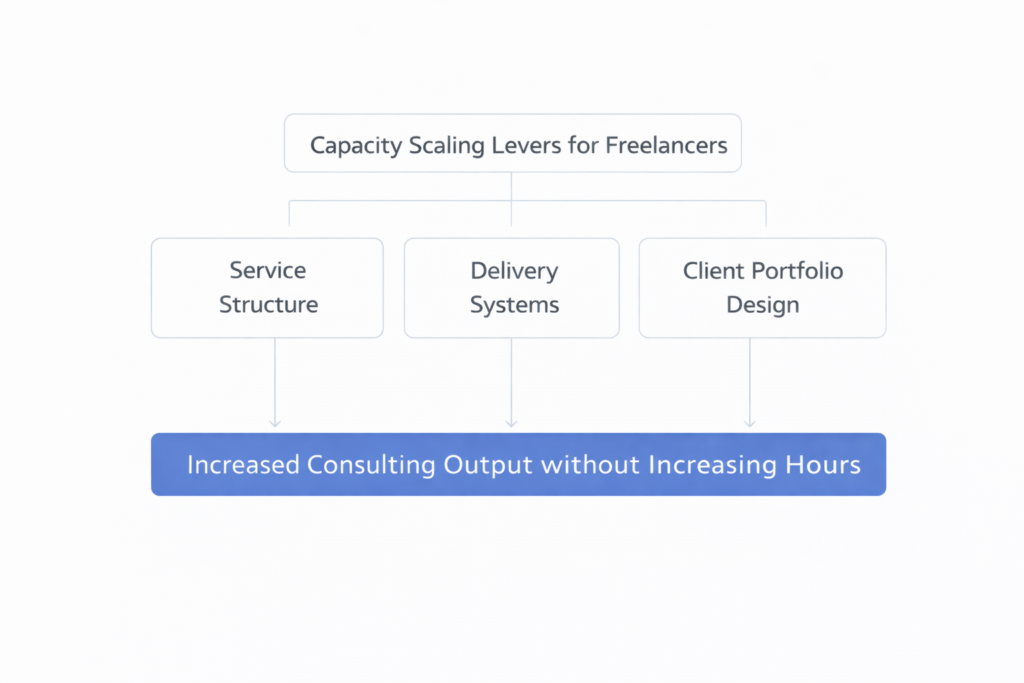
Scaling without hiring relies on three key levers.
1. Service Structure Optimization
The way services are designed determines capacity consumption.
| Service Type | Capacity Impact |
|---|---|
| Custom projects | High variability |
| Structured retainers | Predictable workload |
| Standardized offers | Lower delivery effort |
More structured services reduce variability and increase efficiency.
2. Client Portfolio Design
Capacity scaling depends on how clients are structured.
A balanced portfolio may include:
- a small number of retainers
- selective project work
- advisory engagements
This stabilizes workload while maintaining flexibility.
→ Workload Distribution Across Clients
→ Freelance Client Portfolio Strategy
3. Operational Efficiency
Operational systems reduce non-delivery workload.
Examples include:
- standardized onboarding
- proposal templates
- delivery workflows
- automated scheduling
Reducing overhead frees capacity for higher-value work.
Operational Impact
Scaling capacity without hiring improves several dimensions.
Revenue Growth
Freelancers increase income without increasing hours.
Delivery Stability
Structured services reduce workload variability.
Capacity Flexibility
More room to accept new opportunities.
Operational Control
Greater visibility into how capacity is used.
If you want to evaluate whether your current workload is already at capacity:
→ Use the Freelance Capacity Planner
To improve efficiency, reduce admin time, and better manage workload across clients, tools that support:
- time tracking
- planning
- automation
can help structure your operations.
→ Explore Time & Capacity Tools for Freelancers
System-Level Impact Across Processome
Capacity scaling connects multiple systems.
- Client Pipeline System → demand aligned with scalable services
- Capacity Planning System → optimized workload allocation
- Profit Tracking System → improved revenue per hour
- Delivery & Operations System → efficient workflows
Scaling improves coordination across systems.
Common Failure Patterns
Freelancers often struggle with scaling due to recurring mistakes.
Working More Hours
Leads to burnout and instability.
Accepting Too Many Clients
Increases complexity without improving efficiency.
Ignoring Operational Systems
Admin work grows with client count.
Delaying Structural Changes
Scaling is postponed until overload occurs.
These patterns limit growth potential.
Strategic Outcome
When capacity is scaled structurally, freelancers gain sustainable growth.
- Higher revenue per unit of capacity
More output without more hours - Sustainable workload structure
Capacity remains manageable - Greater business flexibility
Ability to grow without hiring
Over time, consulting evolves beyond time-based limitations.
Final Perspective
Freelancers often assume growth requires hiring.
In reality, significant scaling is possible through better capacity design.
Within the Processome operating model, the Capacity Planning System ensures that consulting capacity evolves alongside the business.
Scaling freelance capacity without hiring transforms consulting from time-bound work into a more structured, scalable operation.
Growth comes from design, not just effort.