Delivery & Operations System
The Stability Engine for Solo B2B Freelancers
Key Questions About Freelance Delivery and Operations
→ How to manage freelance projects without chaos
→ Why freelance projects become chaotic
→ How to prevent scope creep in freelance projects
→ How to structure freelance project workflows
→ How to improve freelance delivery quality
These questions reflect a common pattern.
Freelancers often focus on winning work, but struggle to manage how that work is delivered.
Projects become harder to control over time.
Scope expands.
Communication becomes fragmented.
Delivery becomes reactive instead of structured.
The Delivery & Operations System addresses this problem by defining how consulting work progresses from onboarding to completion.
It connects workflows, scope control, communication, and execution into a structured system that creates delivery stability.
Instead of improvising delivery, freelancers can design systems that produce consistent outcomes.
Introduction
Revenue growth alone does not create a sustainable consulting business.
This system explains how freelancers can structure delivery operations to reduce chaos, control scope, and improve execution consistency.
A strong pipeline generates opportunities.
Capacity planning protects workload feasibility.
Profit tracking ensures margin visibility.
But without structured delivery operations, these systems gradually degrade.
Many freelancers experience operational instability despite strong client demand. Projects become increasingly difficult to manage, timelines slip, and workloads expand beyond expectations.
Common failure patterns include:
- scope creep
- repeated revision cycles
- unclear client expectations
- delivery delays
- operational friction
- hidden rework hours
Within the Processome operating model, the Delivery & Operations System functions as the stability engine of the consulting business.
It ensures that client work progresses through structured processes that protect execution quality and margin integrity.
Stability is not the absence of problems. It is the result of systems that absorb variability and maintain control as complexity increases.
It is the presence of structure.
The Delivery & Operations System forms the final operational layer of the broader Processome architecture, alongside:
→ Client Pipeline System
→ Capacity Planning System
→ Profit Tracking System
Together these systems create a controlled operating model for solo B2B consulting businesses.
Revenue creates opportunity.
Operations protect sustainability.
The Core Problem
Many freelancers manage delivery operations informally.
Projects may be coordinated through:
- email threads
- ad-hoc scope adjustments
- verbal agreements
- loosely defined onboarding processes
- reactive communication
While these methods may function in early stages of freelancing, they introduce increasing operational risk as the business grows.
Several problems commonly emerge.
Hidden Time Leakage
Unstructured processes allow small additional tasks to accumulate without being tracked.
Margin Erosion
Uncontrolled scope changes increase delivery effort without increasing revenue.
Client Friction
Misaligned expectations may create repeated revisions or confusion about deliverables.
Delivery Instability
Projects become more difficult to coordinate when milestones and workflows remain undefined.
These problems rarely originate from technical consulting work.
They typically result from missing operational architecture.
Execution must be designed, not improvised.
Informality scales chaos faster than revenue.
Concept Explanation
The Delivery & Operations System is the operational framework that governs how consulting engagements are executed from onboarding through completion and follow-up.
Instead of coordinating delivery through informal processes, freelancers implement structured systems that manage:
- onboarding alignment
- scope boundaries
- delivery milestones
- communication rhythms
- feedback cycles
- post-project evaluation
These systems ensure that consulting engagements progress through predictable operational stages.
Operational discipline reduces the likelihood of delivery disruptions and protects both client relationships and business sustainability.
The Delivery & Operations System Framework
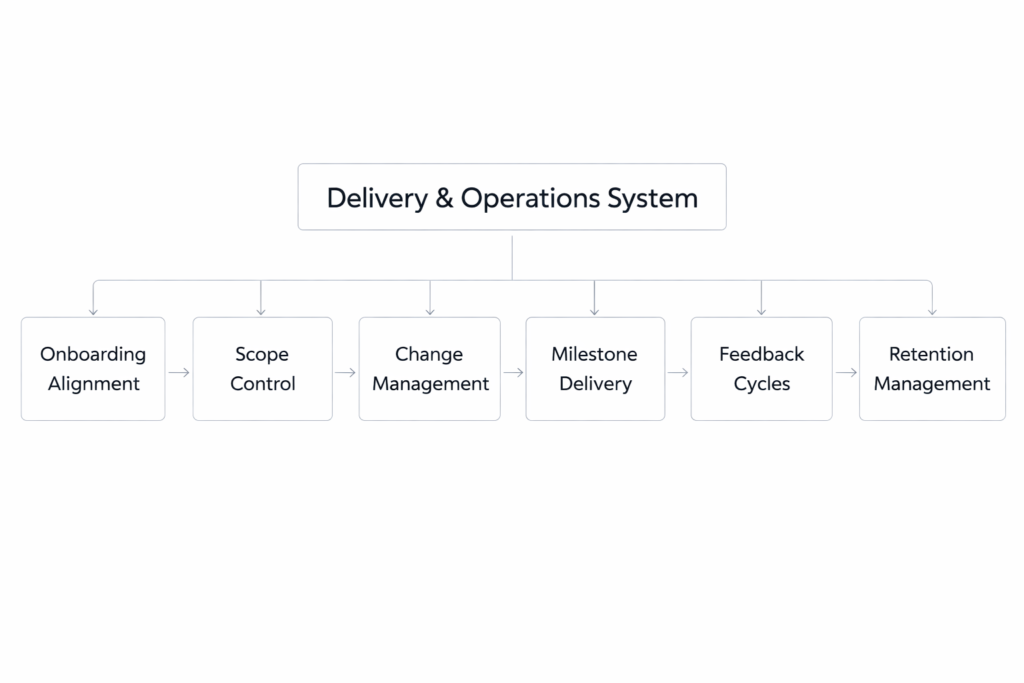
The stability engine of freelance consulting operations can be structured across six interconnected operational components.
1. Structured Onboarding Protocol
Every consulting engagement should begin with structured onboarding.
Onboarding establishes operational clarity before delivery begins.
Typical onboarding activities include:
- confirming scope and deliverables
- mapping project timelines
- defining communication cadence
- clarifying responsibilities
- confirming change boundaries
Clear onboarding reduces downstream friction.
Onboarding is therefore a risk-reduction mechanism, not administrative overhead.
This subsystem is explored in:
→ Client Onboarding System for Freelancers
→ Project Kickoff Framework for Consultants
→ Freelance Client Onboarding Checklist
2. Scope Definition Framework
Scope creep is rarely intentional.
It usually emerges from ambiguous deliverable definitions.
A scope framework defines:
- expected deliverables
- milestone outputs
- revision limits
- out-of-scope conditions
Clear scope boundaries protect both workload and profitability.
Scope control directly supports:
→ Capacity Planning System
→ Profit Tracking System
Because uncontrolled scope expands workload without increasing revenue.
Ambiguity is the root cause of unpaid work.
This subsystem is explored in:
→ Scope Control Framework for Solo Consultants
→ Preventing Scope Creep in Freelance Projects
→ Change Request Management for Freelancers
3. Delivery Milestone Architecture
Complex consulting work should be structured into milestones.
Each milestone represents a defined delivery phase that includes:
- a clear outcome
- a review checkpoint
- client approval triggers
- where possible, aligned payment events
Milestones create delivery rhythm and reduce end-stage surprises.
They function as operational control points, not bureaucratic project management.
This subsystem is explored in:
→ Delivery Milestones & Payment Alignment
→ Project Planning for Freelancers
→ Delivery Workflow Systems
4. Communication and Feedback Systems
Unstructured communication frequently produces excessive revision cycles and misaligned expectations.
Delivery operations should therefore define:
- communication channels
- meeting cadence
- feedback windows
- revision limits
- review structures
Structured feedback reduces revision creep and protects margin.
Feedback without structure converts opinions into cost.
This subsystem is explored in:
→ Client Communication Systems
→ Managing Client Expectations
→ Quality Assurance for Freelancers
5. Operational Risk Management
Consulting engagements contain inherent delivery risks.
These may include:
- delayed client feedback
- evolving project requirements
- scheduling conflicts
- unexpected analytical complexity
Operational systems must anticipate these risks.
Risk management frameworks help freelancers:
- identify potential delivery disruptions
- create contingency planning
- maintain stable delivery schedules
This subsystem is explored in:
→ Delivery Risk Management Framework
→ Reducing Client Chaos with Better Operations
6. Retention and Expansion Systems
Operational stability also supports long-term client relationships.
Satisfied clients frequently generate additional opportunities when consulting engagements are well managed.
Retention systems monitor signals such as:
- client satisfaction
- renewal timing
- potential follow-up engagements
- opportunities for advisory retainers
These systems connect operational delivery with future revenue growth.
This subsystem is explored in:
→ Client Retention Strategies for Freelancers
→ Retention Systems for Solo B2B Freelancers
→ Upselling Consulting Services
→ Retainer Client Management
Retention reduces pipeline pressure and stabilizes revenue patterns.
Operational Impact
A structured Delivery & Operations System influences several dimensions of freelance consulting businesses.
Delivery Stability
Projects progress through defined operational structures.
Reduced Rework
Structured feedback cycles reduce unnecessary revision effort.
Stronger Client Relationships
Clear expectations and communication improve collaboration.
Margin Protection
Controlled scope and workflow discipline reduce hidden delivery costs.
Operational structure therefore protects both delivery quality and profitability.
System-Level Impact Across Processome
The Delivery & Operations System coordinates with every other Processome pillar.
Client Pipeline System → qualified opportunities transition into structured delivery processes
Capacity Planning System → workload feasibility determines realistic delivery timelines
Profit Tracking System → controlled scope protects contribution margins
Delivery & Operations System → execution systems ensure reliable project outcomes
Together these systems form a closed operational loop governing freelance consulting performance.
Common Failure Patterns
Freelancers frequently experience operational instability because delivery systems remain informal.
Several patterns appear repeatedly.
Reactive Project Management
Freelancers respond to tasks as they arise instead of following structured workflows.
Undefined Scope Boundaries
Clients request additional work because deliverables were unclear.
Excessive Revision Cycles
Unstructured feedback produces repeated rework.
Missing Operational Reviews
Projects end without reviewing delivery performance.
These patterns gradually erode both margin and client satisfaction.
Strategic Outcome
When the Delivery & Operations System is implemented effectively, consulting operations become significantly more stable.
Several strategic advantages emerge.
Predictable delivery
Projects progress through structured operational stages.
Controlled scope
Workload remains aligned with agreed deliverables.
Improved client experience
Clear processes create reliable collaboration.
Stronger retention
Satisfied clients generate repeat engagements.
Operational systems transform freelance consulting from reactive execution into controlled delivery.
Final Perspective
Freelance consulting businesses often focus heavily on revenue growth and client acquisition.
However, sustainable growth requires operational stability.
Within the Processome operating model, the Delivery & Operations System ensures that consulting engagements follow structured execution processes.
Rather than improvising delivery, freelancers implement operational systems that guide how work progresses from onboarding to completion.
Strong operations protect both reputation and profitability.
Growth without operational structure eventually collapses under its own complexity.
Operational systems create durability.
Delivery & Operations System Frameworks
The Delivery & Operations System includes the following operational stability frameworks:
Delivery Structure
→ Delivery System for Freelancers Explained
→ Scope Control Framework for Solo Consultants
→ Client Onboarding System for Freelancers
→ Change Request Management for Freelancers
→ Delivery Milestones & Payment Alignment
Operational Infrastructure
→ SOP Library Structure for Freelancers
→ Reducing Client Chaos with Better Operations
→ Delivery Risk Management Framework
Retention & Relationship Management
→ Retention Systems for Solo B2B Freelancers
→ Client Retention Strategies for Freelancers
→ Upselling Consulting Services
→ Retainer Client Management
Execution Systems
→ Freelance Client Onboarding Checklist
→ Project Kickoff Framework for Consultants
→ Preventing Scope Creep in Freelance Projects
→ Delivery Workflow Systems
→ Project Planning for Freelancers
Communication & Quality Control
→ Managing Client Expectations
→ Client Communication Systems
→ Quality Assurance for Freelancers
→ Project Retrospectives for Consultants
Operational Infrastructure & Monitoring
→ Freelance Operations Dashboard
→ Workflow Automation for Freelancers
→ Documentation Systems for Consultants