Delivery Buffer Design for Freelancers: How to Build Stable Workload Capacity
Introduction
Freelance consulting work rarely unfolds exactly as planned.
Project timelines shift, client feedback arrives later than expected, and revisions often expand beyond initial estimates.
Without structured flexibility in the delivery schedule, these small variations accumulate into delivery pressure.
Within the Processome operating model, delivery buffer design belongs to the Capacity Planning System — the execution framework responsible for maintaining stability across the consulting workload.
For solo consultants, buffers function as operational shock absorbers. They absorb variability and prevent minor disruptions from cascading into schedule failures.
Without buffers, delivery plans become fragile.
With buffers, workload remains resilient.
Buffer capacity is not unused time.
It is structural protection for execution stability.
What is a Delivery Buffer?
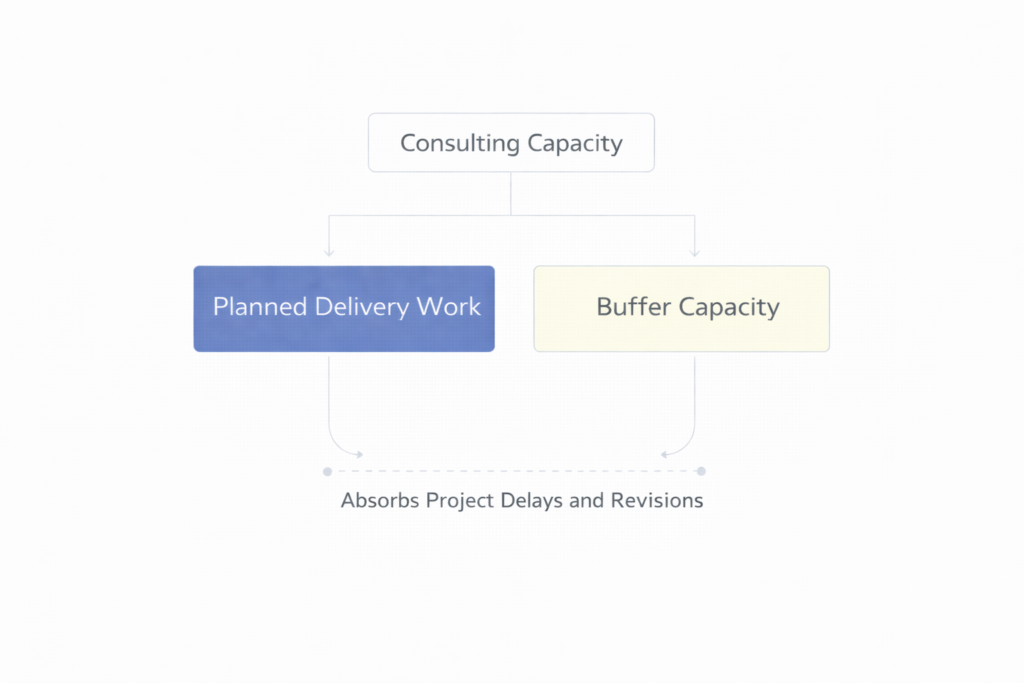
A delivery buffer for freelancers is a portion of consulting capacity intentionally reserved to absorb variability in project execution.
Instead of allocating all available time to client work, freelancers reserve capacity that can accommodate:
- client revisions
- coordination delays
- unexpected complexity
- timeline shifts
This buffer acts as a stability margin within the delivery schedule.
For example:
| Capacity Category | Allocation |
|---|---|
| Planned client work | 90 hours |
| Delivery buffer | 30 hours |
This structure allows workload variation to be absorbed without disrupting other commitments.
Delivery buffers protect:
- delivery reliability
- schedule stability
- consulting quality
This concept connects closely with:
→ Utilization Rate for Solo Consultants
→ Capacity Buffers Explained
The Core Problem
Many freelancers plan delivery schedules close to full utilization.
Projects are scheduled sequentially, timelines are compressed, and available working hours are allocated almost entirely to billable work.
This appears efficient but introduces structural instability.
Several operational problems emerge.
Timeline Compression
When projects are scheduled back-to-back, even small delays push deadlines into each other.
Revision Overload
Client feedback cycles often require more time than initially planned.
Coordination Delays
Communication, stakeholder alignment, and scheduling frequently take longer than expected.
Cascading Delivery Pressure
When one project expands, other projects must absorb the delay.
Without buffers, these variations create systemic delivery stress.
Delivery Buffer Design Framework
Designing effective delivery buffers requires evaluating three operational dimensions.
1. Structural Buffer Capacity
The first step is defining how much capacity should remain unallocated.
Typical buffer ranges include:
| Buffer Range | Operational Effect |
|---|---|
| 10–15% | Minimal protection against variability |
| 15–25% | Balanced delivery stability |
| Above 25% | High flexibility but lower utilization |
Buffer size should reflect the volatility of the consulting workload.
2. Project Timeline Buffers
In addition to overall capacity buffers, individual projects require timeline flexibility.
These buffers allow time for:
- client feedback cycles
- revisions and adjustments
- coordination across stakeholders
Timeline buffers prevent delays from spreading across the delivery schedule.
Timeline coordination is discussed further in:
3. Workload Variability Protection
Different service models create different levels of delivery variability.
Project-based consulting
- unpredictable revisions
- complex deliverables
- multi-stakeholder coordination
Requires larger buffers.
Retainer-based work
- more predictable workload cadence
- ongoing coordination overhead
Allows smaller buffers but may introduce long-term fatigue.
Buffer design must reflect service model volatility.
Operational Impact
Structured delivery buffers improve several aspects of freelance consulting operations.
Delivery Reliability
Projects progress more consistently because schedule variations can be absorbed.
Workload Stability
Freelancers avoid sudden workload spikes caused by compressed timelines.
Client Experience
Clients receive more predictable delivery timelines and response times.
Execution Quality
Buffer capacity allows time for thoughtful analysis and revisions.
To maintain delivery buffers consistently over time, tools that support:
- time tracking
- workload planning
- capacity visibility
can help structure your workflow.
→ Explore Time & Capacity Tools for Freelancers
System-Level Impact Across Processome
Delivery buffer design influences coordination between workload planning, revenue expectations, and consulting execution.
- Client Pipeline System → project timing aligned with delivery flexibility
- Capacity Planning System → workload allocation including buffer capacity
- Profit Tracking System → margin stability through reduced delivery overruns
- Delivery & Operations System → schedule resilience during execution variability
Buffer design improves coordination between sales activity, capacity planning, and delivery execution.
Common Failure Patterns
Freelancers often remove buffers when demand increases.
Several recurring mistakes appear.
Planning at Full Utilization
All capacity is allocated to client work, eliminating flexibility.
Eliminating Buffers Under Pressure
Buffer time is repurposed for additional projects during busy periods.
Ignoring Revision Cycles
Projects are scheduled based on initial estimates without accounting for revisions.
Treating Buffer Time as Inefficiency
Unused time is seen as lost productivity rather than operational protection.
These behaviors reduce delivery resilience.
Strategic Outcome
When delivery buffers are designed deliberately, consulting operations become more stable and predictable.
Instead of reacting to delays, freelancers maintain structured flexibility.
This produces several advantages.
- Stable delivery timelines
Projects progress without cascading delays - Reduced operational stress
Workload remains manageable during complex phases - Improved consulting quality
Time is available for analysis, revisions, and thoughtful execution
Over time, delivery buffers transform consulting operations from fragile schedules into resilient execution systems.
Final Perspective
Freelancers often view buffer time as inefficiency.
In reality, buffers are the mechanism that protects delivery stability.
Within the Processome operating model, the Capacity Planning System ensures that consulting capacity remains aligned with realistic execution conditions. Delivery buffer design ensures that inevitable variations in consulting work do not destabilize the schedule.
Efficiency comes from controlled pressure — not from eliminating flexibility.
Buffers create that control.