Preventing Delivery Bottlenecks for Freelancers (Avoid Workload Congestion)
Introduction
As freelance consulting businesses grow, delivery complexity increases. Managing multiple clients, overlapping projects, and changing priorities can create operational pressure on limited capacity.
One of the most common risks is the emergence of delivery bottlenecks — points where workload congestion slows progress and disrupts delivery schedules.
Preventing delivery bottlenecks for freelancers requires more than working faster. It requires structuring workload across time to avoid concentration of effort.
Within the Processome operating model, bottleneck prevention belongs to the Capacity Planning System — the framework responsible for structuring how consulting capacity is allocated across engagements.
Without structured planning, delivery problems appear reactively. With it, workload remains balanced even with multiple clients.
What are Delivery Bottlenecks?
A delivery bottleneck occurs when too much work accumulates at the same point in time, temporarily exceeding available capacity.
This does not necessarily mean total workload is too high.
Instead, it means workload is poorly distributed.
Bottlenecks typically occur when:
- multiple projects reach critical phases simultaneously
- high-intensity tasks overlap
- coordination and feedback cycles accumulate
- deadlines cluster within short timeframes
Preventing bottlenecks requires understanding when work happens, not just how much work exists.
The Core Problem
Many freelancers evaluate workload primarily through total booked hours.
However, delivery issues rarely occur because of total workload alone.
They occur when work concentrates in the same time window.
Several patterns create these bottlenecks.
Project Overlap
Multiple projects reach high-intensity phases at the same time.
Examples include:
- major deliverables
- revisions
- launch preparation
Client Priority Conflicts
Several clients require attention simultaneously, forcing constant switching.
Hidden Workload Peaks
Activities such as meetings, feedback, and coordination expand unexpectedly.
Lack of Capacity Planning
Projects are accepted without evaluating how timelines interact.
→ Weekly Capacity Planning Framework
These issues emerge from poor workload distribution across time.
Delivery Bottleneck Prevention Framework
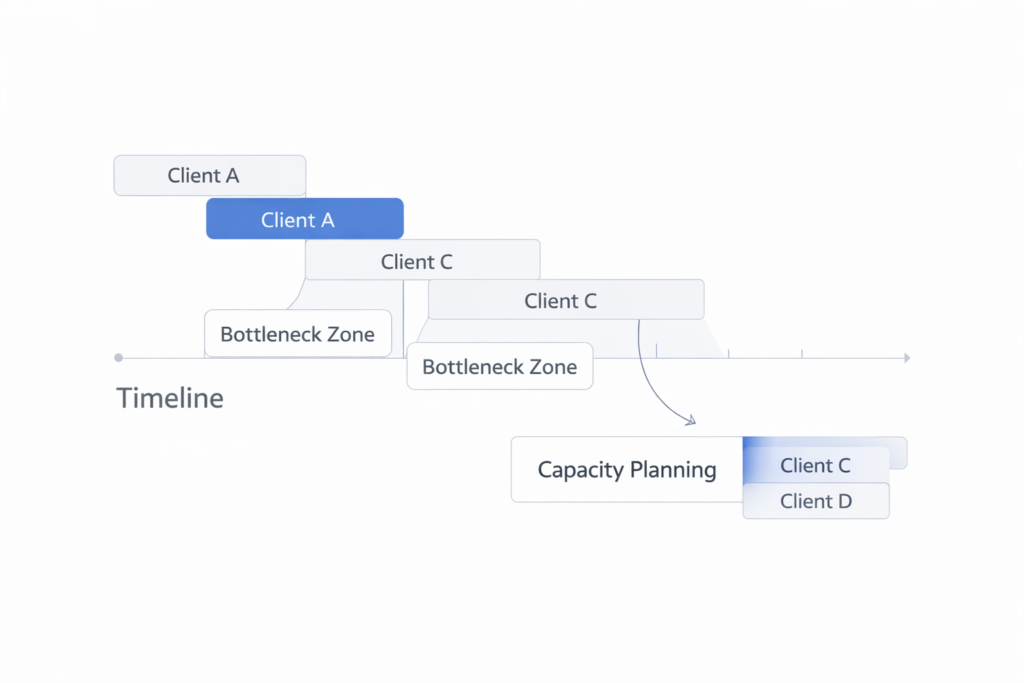
Preventing bottlenecks requires managing three key dimensions.
1. Delivery Timeline Distribution
Each project includes high-intensity phases.
Examples:
- project kickoff
- strategy development
- final delivery
If these phases overlap, workload spikes.
Spreading projects across different time windows reduces risk.
→ Monthly Capacity Allocation Model
2. Activity-Type Balancing
Not all tasks require equal effort.
High-intensity tasks include:
- strategy work
- deep analysis
- presentations
- workshops
If several occur together, delivery slows down.
Balancing task types across the week prevents overload.
3. Capacity Buffer Integration
Buffers absorb unexpected workload.
Without buffers:
- small delays create congestion
- revisions disrupt schedules
Buffers are essential for preventing bottlenecks.
Operational Impact
Preventing bottlenecks improves several operational dimensions.
Delivery Reliability
Deadlines are met without last-minute overload.
Workload Stability
Work is distributed more evenly across time.
Client Experience
Clients receive more predictable delivery and faster responses.
Capacity Visibility
Freelancers understand how projects interact.
If you’re unsure whether your current workload creates hidden bottlenecks:
→ Use the Freelance Capacity Planner
To maintain visibility into scheduling, workload distribution, and project timelines, tools that support:
- time tracking
- scheduling
- planning
can help structure your workflow.
→ Explore Time & Capacity Tools for Freelancers
System-Level Impact Across Processome
Bottleneck prevention connects multiple systems.
- Client Pipeline System → intake affecting workload timing
- Capacity Planning System → distribution across timelines
- Profit Tracking System → revenue stability
- Delivery & Operations System → execution flow
Balanced workload timing improves system coordination.
Common Failure Patterns
Freelancers often create bottlenecks due to recurring mistakes.
Accepting Overlapping Projects
Projects are accepted without timeline coordination.
Ignoring Activity Intensity
High-effort tasks are clustered together.
No Capacity Buffers
Schedules have no flexibility.
Reactive Scheduling
Adjustments happen after congestion appears.
These patterns create unstable delivery systems.
Strategic Outcome
When bottlenecks are prevented proactively, consulting operations become more stable.
- Predictable delivery schedules
Work progresses consistently - Reduced operational stress
Workload remains balanced - Improved client satisfaction
Fewer delays and better communication
Over time, workload shifts from reactive to structured.
Final Perspective
Freelancers often assume delivery problems are caused by too much work.
In reality, they are often caused by poor timing.
Within the Processome operating model, the Capacity Planning System ensures that workload is distributed across time, not just limited in volume.
Preventing delivery bottlenecks transforms freelance work from reactive execution into structured operational planning.
Balanced timing creates stable delivery.