Capacity Planning for Retainer Clients (Freelancer Guide)
Introduction
Retainer agreements create a different capacity dynamic than project-based consulting work. Instead of delivering a defined scope within a limited timeframe, freelancers commit to ongoing availability and continuous service delivery.
While retainers stabilize revenue, they also introduce a structural constraint: recurring commitments that permanently occupy consulting capacity.
Capacity planning for retainer clients ensures that these ongoing commitments remain predictable, sustainable, and aligned with total delivery capacity.
Within the Processome operating model, retainer capacity planning belongs to the Capacity Planning System — the framework responsible for structuring how consulting capacity is allocated across active clients.
Without structured planning, retainers quietly consume capacity and reduce flexibility. With it, freelancers maintain control over both workload and client portfolio.
What is Capacity Planning for Retainer Clients?
Capacity planning for retainer clients is the process of allocating a defined portion of consulting capacity to ongoing client agreements.
Instead of treating retainers as flexible work, freelancers:
- reserve fixed capacity for each client
- define expected delivery workload
- control how retainers interact with project work
This ensures that retainers remain predictable operational commitments rather than expanding workloads.
The Core Problem
Many freelancers evaluate retainers primarily as stable revenue sources.
However, this often overlooks their impact on delivery capacity.
Several structural problems emerge.
Undefined Capacity Commitment
Retainers may lack clear limits on hours or deliverables.
This allows workload to expand beyond expectations.
Gradual Capacity Expansion
Client requests increase over time, consuming more capacity.
Portfolio Imbalance
Multiple retainers accumulate without evaluating total capacity usage.
Delivery Congestion
Retainer requests cluster unpredictably, creating workload spikes.
These issues occur when retainer commitments are not translated into capacity allocation.
Retainer Capacity Planning Framework
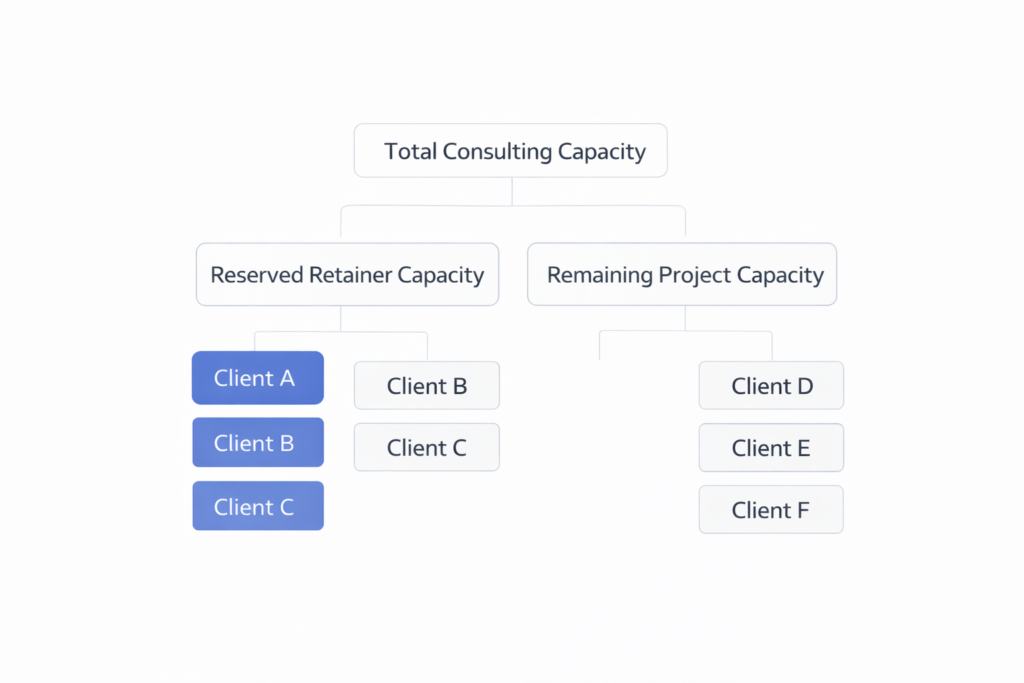
A structured retainer model evaluates three key dimensions.
1. Retainer Capacity Allocation
Each retainer should have a defined capacity share.
| Client | Retainer Allocation | Capacity Share |
|---|---|---|
| Client A | 12h/week | 30% |
| Client B | 8h/week | 20% |
| Client C | 6h/week | 15% |
In this example, 65% of capacity is allocated to retainers.
The remaining capacity is available for:
- project work
- buffers
- new opportunities
Explicit allocation prevents hidden overload.
2. Retainer Portfolio Balance
Freelancers must evaluate how retainers fit within their overall workload.
Balanced portfolios typically include:
- several retainers
- project-based work
- limited advisory engagements
If retainers dominate capacity, flexibility decreases.
→ Workload Distribution Across Clients
→ Freelance Capacity Model (Hours vs Revenue)
3. Retainer Workload Variability
Retainer demand fluctuates.
Some weeks require minimal effort, others require more.
Buffers are required to absorb this variability.
Without buffers, retainer work creates unpredictable workload spikes.
Operational Impact
Structured retainer capacity planning improves several operational dimensions.
Revenue Stability
Recurring retainers provide predictable income without overloading capacity.
Capacity Visibility
Freelancers understand how much capacity remains available.
Delivery Reliability
Defined limits prevent retainer work from expanding uncontrollably.
Portfolio Flexibility
Balanced allocation allows acceptance of new opportunities.
If you want to evaluate how your retainers affect total capacity:
→ Use the Freelance Capacity Planner
To manage ongoing client work, track workload, and maintain visibility across retainers, tools that support:
- time tracking
- workload planning
- client management
can help structure your operations.
→ Explore Time & Capacity Tools for Freelancers
System-Level Impact Across Processome
Retainer planning connects multiple systems.
- Client Pipeline System → retainer intake
- Capacity Planning System → recurring allocation
- Profit Tracking System → predictable revenue
- Delivery & Operations System → ongoing scheduling
Structured allocation improves coordination across systems.
Common Failure Patterns
Freelancers often encounter problems due to recurring mistakes.
Unlimited Retainer Scope
Loosely defined agreements allow unlimited requests.
Too Many Retainers
Capacity becomes dominated by recurring work.
Ignoring Workload Variability
Fluctuations are not accounted for.
Mixing Retainers and Projects Without Planning
Timelines collide and create overload.
These patterns reduce delivery stability.
Strategic Outcome
When retainer capacity is planned deliberately, freelancers gain both stability and flexibility.
- Predictable revenue streams
Recurring income becomes reliable - Controlled workload
Retainers stay within limits - Balanced client portfolio
Projects and retainers coexist
Over time, retainers become structured operational assets.
Final Perspective
Retainers are often viewed as financial tools.
In reality, they are capacity allocation decisions.
Within the Processome operating model, the Capacity Planning System ensures that recurring commitments remain aligned with delivery capacity.
Capacity planning for retainer clients transforms retainers from flexible agreements into controlled workload structures.
Stability requires structure.