Capacity Forecasting for Freelancers: How to Predict Workload from Your Pipeline
Introduction
Freelancers often evaluate capacity based only on active client work.
While this provides visibility into current workload, it ignores a critical source of future delivery demand: the sales pipeline.
Pipeline opportunities represent potential future workload. If several deals close within a short period, delivery capacity may suddenly become constrained.
Within the Processome operating model, capacity forecasting belongs to the Capacity Planning System — the execution framework responsible for aligning expected demand with delivery feasibility.
For solo consultants, capacity forecasting translates pipeline activity into projected delivery workload. Instead of reacting when new projects begin, freelancers anticipate how pipeline conversions may affect capacity weeks or months in advance.
Without forecasting, delivery pressure appears unexpectedly.
With forecasting, capacity constraints become visible before commitments are made.
Capacity forecasting connects sales expectations with execution reality.
The Core Problem
Many freelancers manage sales activity and delivery planning as separate processes.
The pipeline is treated as a sales tool, while workload planning focuses only on active projects.
This separation creates several operational risks.
Sudden Delivery Overload
Multiple deals may close around the same time, creating unexpected workload spikes.
Unrealistic Start Dates
Project start dates are promised without evaluating existing commitments.
Pipeline Blindness
Pipeline opportunities are ignored when evaluating future workload.
Reactive Scheduling
Delivery plans are adjusted only after deals close rather than before.
These problems occur because pipeline activity is not translated into capacity forecasts.
What is Capacity Forecasting from Pipeline Data?
Capacity forecasting from pipeline data is the process of estimating future delivery workload based on sales pipeline activity.
Instead of focusing only on confirmed projects, freelancers evaluate how potential deals may convert into active work.
This requires combining:
- current delivery commitments
- pipeline opportunities and their probabilities
- expected project timelines
The result is a forward-looking view of consulting capacity.
For example:
| Week | Confirmed Work | Forecasted Work | Total Capacity Use |
|---|---|---|---|
| Week 1 | 65% | 10% | 75% |
| Week 2 | 60% | 20% | 80% |
| Week 3 | 55% | 25% | 80% |
This forecast shows how workload may evolve before projects begin.
Forecasting relies on pipeline metrics such as:
→ Weighted Revenue Forecasting for Freelancers
→ Pipeline Velocity for Freelancers
These metrics estimate when deals are likely to convert into active work.
Capacity Forecasting Framework
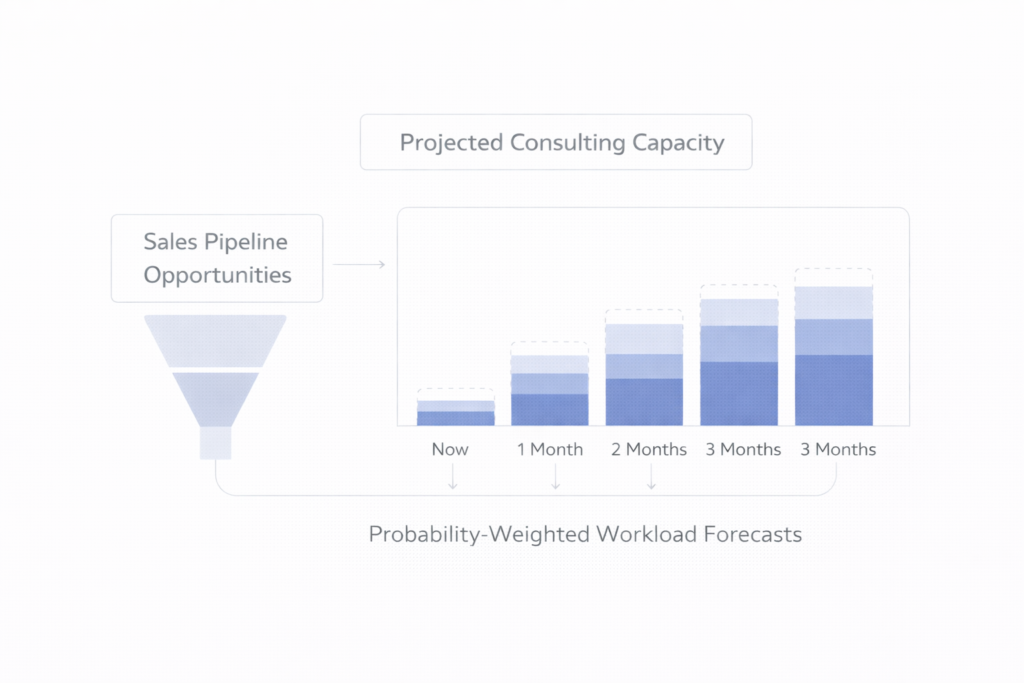
A structured forecasting model evaluates three operational components.
1. Current Delivery Commitments
The first step is mapping the workload from active client engagements.
This includes:
- ongoing retainers
- active projects
- scheduled deliverables
These commitments define the baseline delivery workload.
2. Probability-Weighted Pipeline Demand
Pipeline opportunities represent potential future projects.
Each opportunity is assigned a probability of closing based on its pipeline stage.
Example:
| Deal | Stage | Probability | Expected Workload |
|---|---|---|---|
| Deal A | Proposal | 60% | 30 hours |
| Deal B | Discovery | 40% | 20 hours |
| Deal C | Negotiation | 80% | 40 hours |
Probability weighting converts pipeline opportunities into expected workload estimates.
3. Timeline Translation
Once expected workload is calculated, the final step is mapping that workload across future time periods.
This allows freelancers to evaluate whether forecasted workload will exceed safe capacity levels.
Timeline coordination is discussed further in:
→ Freelance Workload Forecasting
Forecasting makes future delivery demand visible before commitments are finalized.
To evaluate how this forecasted workload compares to your actual capacity:
→ Use the Freelance Capacity Planner
This helps determine whether projected workload will exceed your available delivery capacity.
Operational Impact
Capacity forecasting significantly improves the stability of freelance consulting operations.
Delivery Predictability
Freelancers gain visibility into how pipeline activity may affect future workload.
Controlled Client Intake
If forecasted workload exceeds safe capacity levels, projects can be delayed or declined.
Revenue Planning
Forecasting connects pipeline activity with realistic revenue expectations.
Strategic Scheduling
Projects can be distributed more evenly across the delivery calendar.
System-Level Impact Across Processome
Capacity forecasting influences coordination between pipeline demand, delivery capacity, and financial planning within the Processome operating architecture.
- Client Pipeline System → pipeline data translated into expected delivery demand
- Capacity Planning System → forecasting future workload constraints
- Profit Tracking System → revenue expectations based on weighted pipeline forecasts
- Delivery & Operations System → preparation for upcoming project execution
Forecasting improves coordination between sales activity, capacity planning, and consulting delivery.
Common Failure Patterns
Freelancers often struggle with capacity forecasting because pipeline data is not integrated into delivery planning.
Several recurring mistakes appear.
Ignoring Pipeline Probabilities
Pipeline opportunities are treated as certain rather than probabilistic.
Overestimating Conversion Rates
Freelancers assume most deals will close, leading to inflated workload forecasts.
Missing Timeline Estimates
Forecasting requires estimating when projects will begin and how long they will last.
Without this, forecasts remain vague.
Reactive Forecasting
Capacity is evaluated only weekly rather than projected across multiple weeks or months.
This reduces the ability to anticipate delivery pressure.
Strategic Outcome
When capacity forecasting becomes part of the consulting workflow, freelancers gain greater control over delivery planning.
Instead of reacting to sudden workload increases, consultants anticipate how pipeline activity will affect future capacity.
This produces several advantages.
- Early visibility into delivery pressure
Potential overload becomes visible before projects begin - Improved intake decisions
Pricing, qualification, and timing can be adjusted - Balanced workload distribution
Projects are scheduled to avoid delivery congestion
Over time, capacity forecasting transforms freelance consulting from reactive workload management into forward-looking execution planning.
Final Perspective
Sales pipelines generate future demand for consulting capacity.
Without forecasting, that demand appears suddenly when deals close.
Within the Processome operating model, the Capacity Planning System ensures that pipeline demand is evaluated against delivery feasibility. Capacity forecasting allows freelancers to anticipate how sales activity will translate into future workload.
Forecasting connects opportunity with execution.
Capacity planning ensures that opportunity remains deliverable.