Capacity Planning for Freelancers: How to Plan Workload and Delivery Capacity
Introduction
Freelancers often assume capacity problems start when they become “too busy.”
In practice, capacity failures begin much earlier — when work is accepted without a clear understanding of available delivery capacity.
Capacity planning is the system that defines how much client work can be delivered without overloading operations, reducing quality, or eroding margins.
Within the Processome model, capacity planning belongs to the Capacity Planning System — the layer responsible for aligning incoming demand with actual execution capability.
For solo consultants, this is not a planning exercise. It is an operational constraint.
Revenue creates opportunity.
Capacity determines whether that opportunity can be delivered.
Without explicit capacity planning, freelance operations become reactive, unstable, and difficult to scale.
What is Capacity Planning for Freelancers?
Capacity planning for freelancers is the process of determining how much client work can be delivered reliably within a given time period.
It goes beyond tracking available hours. Instead, it defines true execution capacity by accounting for:
- total working time
- non-billable operational work
- client communication and coordination
- sales and pipeline activities
- buffer capacity for uncertainty
What remains after these constraints is the actual delivery capacity available for client work.
Any workload accepted beyond this limit creates operational strain — typically resulting in delays, reduced quality, or hidden margin loss.
Capacity planning therefore acts as a decision filter.
It determines whether new work should be accepted before delivery pressure occurs, not after.
This operational distinction becomes clearer when comparing capacity planning with time tracking:
→ Time Tracking vs Capacity Planning
Capacity planning becomes actionable when capacity is measured explicitly.
For a structured way to evaluate your available capacity and current workload:
→ Use the Freelance Capacity Planner
This tool helps determine whether new work can be accepted safely based on your actual capacity.
The Core Problem
Most freelancers never calculate their true delivery capacity.
Instead, they operate on implicit assumptions such as:
- available hours equal billable hours
- productivity remains constant
- buffers are optional
- overload can be handled later
These assumptions create an illusion of capacity that does not exist in practice.
Assumed capacity leads to several structural problems.
Chronic Overcommitment
Freelancers accept work based on optimistic estimates rather than realistic delivery limits.
Delivery Instability
Projects compete for limited attention, forcing constant reprioritization.
Margin Leakage
Unplanned rework and unpaid effort reduce the effective yield of billable work.
Burnout Cycles
When delivery pressure increases, freelancers compensate by extending working hours rather than restructuring capacity.
These problems emerge when capacity is assumed rather than designed.
Capacity Planning Framework
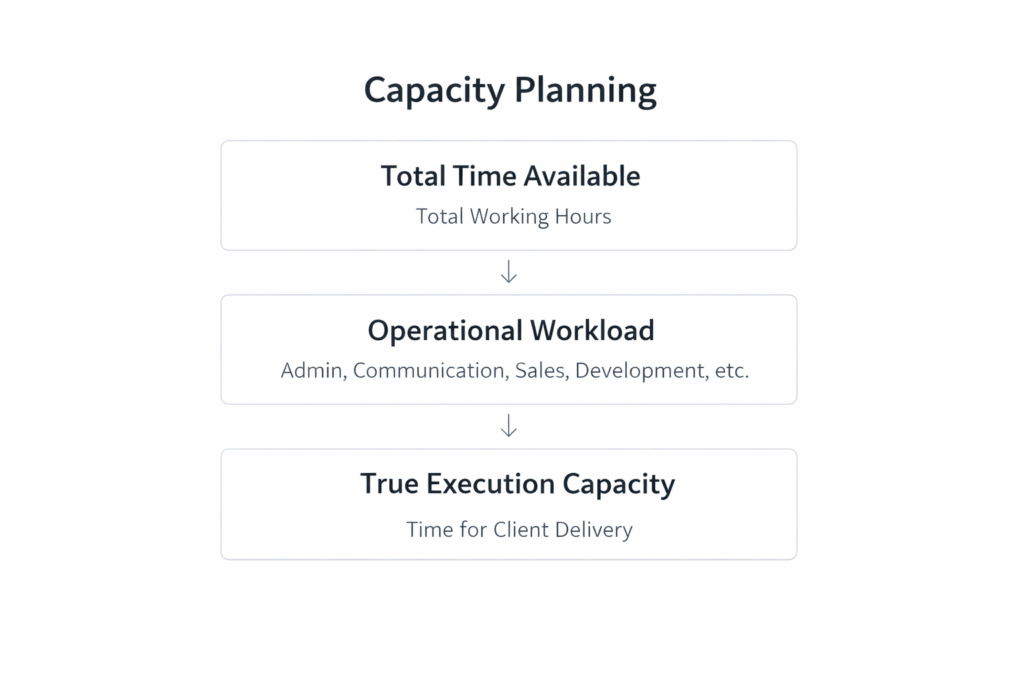
A structured capacity model separates total working time into three operational layers.
1. Total Available Time
This represents the theoretical working time available each week or month.
For many freelancers this ranges between 35–45 working hours per week.
However, this figure does not represent actual delivery capacity.
2. Operational Workload
A portion of time is consumed by activities that support the consulting business but do not directly produce billable delivery.
These include:
- administration
- client communication
- sales and pipeline development
- learning and skill development
These activities are structurally necessary and must be included in capacity calculations.
3. True Execution Capacity
Once operational activities and buffer capacity are subtracted, the remaining time represents true delivery capacity.
This capacity determines how much client work can be executed safely.
Capacity modeling methods are explored further in:
→ Freelance Capacity Model (Hours vs Revenue)
Operational Impact
Structured capacity planning improves several operational dimensions of a freelance consulting business.
Delivery Feasibility
Capacity constraints ensure that accepted work can realistically be delivered within the available schedule.
Workload Stability
Explicit capacity limits prevent uncontrolled workload accumulation.
Pricing Confidence
Freelancers gain clarity about the delivery cost of new work, enabling stronger pricing decisions.
Margin Protection
When capacity is respected, hidden delivery costs such as unpaid rework and scope absorption decrease.
To maintain capacity planning consistently over time, tools that support:
- time tracking
- workload planning
- capacity visibility
can help structure your workflow.
→ Explore Time & Capacity Tools for Freelancers
System-Level Impact Across Processome
Capacity planning influences the coordination between client demand, delivery feasibility, and financial stability within the Processome operating architecture.
- Client Pipeline System → opportunity inflow aligned with delivery feasibility
- Capacity Planning System → execution capacity constraints and workload allocation
- Profit Tracking System → margin protection through realistic delivery commitments
- Delivery & Operations System → stable execution scheduling
Structured capacity planning improves coordination between client acquisition, delivery planning, and consulting operations.
Common Failure Patterns
Freelancers frequently encounter capacity failures because planning assumptions remain implicit.
Several patterns appear repeatedly.
Planning at 100% Utilization
Freelancers attempt to allocate every available hour to billable work.
This removes operational flexibility and creates immediate overload when unexpected tasks appear.
Ignoring Non-Billable Work
Administrative work, coordination, and sales activities are often excluded from capacity calculations.
Removing Buffers Under Pressure
When demand increases, freelancers often eliminate buffer capacity instead of adjusting intake decisions.
Optimistic Forecasting
Project timelines and workload estimates are frequently underestimated.
Utilization dynamics are explored further in:
→ Utilization Rate for Solo Consultants
Strategic Outcome
When capacity planning becomes a structured system, freelance consulting operations become significantly more stable.
Instead of reacting to workload pressure, freelancers control delivery feasibility before commitments are made.
This produces several structural advantages.
- Predictable workload
Delivery commitments remain aligned with realistic capacity limits. - Stable execution
Project timelines become more reliable. - Improved pricing confidence
Freelancers understand the true delivery cost of client work. - Reduced burnout cycles
Capacity buffers absorb workload volatility.
Capacity planning does not limit growth.
It enables controlled growth.
Final Perspective
A freelancer without capacity planning operates reactively.
Client demand determines workload, and delivery feasibility is evaluated only after commitments have been made.
Within the Processome operating model, the Capacity Planning System functions as the execution governance layer between sales and delivery. It ensures that revenue opportunities are filtered through realistic capacity constraints before commitments are made.
Execution success is not determined by effort alone.
It is determined by how intelligently finite consulting capacity is allocated.