The operating system behind stable freelance consulting businesses
Most freelance businesses are built on skill.
But skill alone does not create a stable consulting business.
Revenue fluctuates.
Workload becomes unpredictable.
Projects overlap or disappear.
Many freelancers experience these patterns even when demand is strong.
This is not a talent problem.
It is a systems problem.
Stable freelance businesses are not built through isolated improvements.
They are designed as systems.
Processome documents the operational architecture behind stable freelance consulting businesses — the structures that control client flow, workload, profitability, and delivery stability.
Instead of relying on improvisation, successful solo operators design their work as a coherent operating system.
Processome explains how those systems work.
Key Questions About Freelance Consulting
→ How to get freelance clients consistently?
→ How many clients should a freelancer have?
→ How to manage freelance workload without burnout?
→ Why do freelancers earn good money but make little profit?
→ How to manage freelance projects without chaos?
The Processome Perspective
Processome approaches freelance consulting as an operational system design problem.
Most independent professionals attempt to improve their business through isolated activities such as marketing, productivity tools, or pricing changes.
While these improvements can help, they rarely address the structural problems that create volatility in freelance businesses.
Unstable revenue, unpredictable workload, margin erosion, and delivery stress usually originate from missing operational architecture.
Processome documents the systems used by stable consulting micro-firms to control these variables.
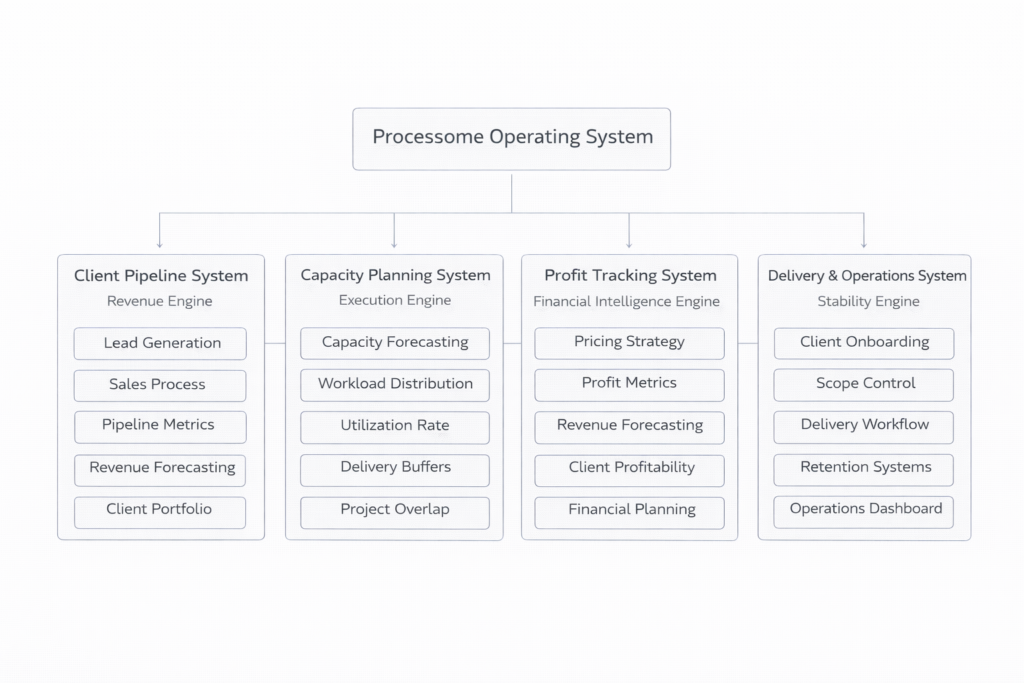
The model organizes freelance operations around four operational engines:
Revenue generation
Execution capacity
Financial intelligence
Operational delivery
Together these systems create an environment in which freelance consulting businesses can operate predictably. They transform freelance work from reactive execution into a controlled operating system.
Rather than improvising month to month, solo operators can design their business as a coherent operating system.
The Processome Framework
The Processome Framework explains the operational architecture behind stable solo consulting businesses.
It defines how freelance consulting can be organized as a structured operating model built around four interconnected systems.
Each system controls a critical operational dimension of the business: revenue generation, workload capacity, financial intelligence, and delivery stability.
Understanding the framework provides the conceptual foundation for the systems documented on this site.
→ Explore the Processome Framework
From Framework to Implementation
Understanding the Processome Framework is the first step.
Applying it consistently is the second.
Freelance consulting businesses become stable not when systems are understood, but when they are implemented consistently.
This requires translating system concepts into a practical operational setup.
Learn how to build your consulting system and structure your tools accordingly:
→ Build Your Freelance Consulting System
The Structural Problem With Most Freelance Businesses
Many freelancers operate without a structured operational model.
Revenue depends on inconsistent lead flow.
Workload fluctuates between overload and idle periods.
Margins erode through hidden time leakage.
Delivery becomes reactive under pressure.
These problems rarely originate from lack of talent.
They are usually caused by missing systems.
Without structural controls, freelance businesses remain fragile and unpredictable.
Processome addresses this problem by documenting the operational systems behind stable solo consulting businesses.
The Processome Operating Model
Processome organizes freelance operations into four interconnected systems.
Each system governs a different dimension of the freelance business.
Together they form a complete operating architecture for solo B2B professionals.
Client Pipeline System
The Revenue Engine
Controls how consulting opportunities enter and convert within the business.
Key areas include:
- lead qualification
- pipeline stage architecture
- proposal conversion mechanics
- revenue forecasting
- client portfolio strategy
The goal is predictable revenue inflow rather than reactive deal chasing.
Capacity Planning System
The Execution Engine
Controls how much work can actually be delivered.
Key areas include:
- structural capacity modeling
- utilization thresholds
- workload forecasting
- delivery buffers
- overbooking prevention
Revenue only becomes sustainable when capacity constraints are respected.
Profit Tracking System
The Financial Intelligence Engine
Controls margin quality and financial sustainability.
Key areas include:
- effective hourly yield
- client profitability analysis
- pricing model design
- revenue concentration risk
- financial forecasting
Revenue is only meaningful when effort converts into durable profit.
Delivery & Operations System
The Stability Engine
Controls execution quality and operational discipline.
Key areas include:
- client onboarding systems
- scope control frameworks
- change request management
- delivery workflows
- retention and expansion systems
Operational stability protects reputation and long-term client relationships.
→ Delivery & Operations System
Why Systems Matter
Freelancers often assume growth requires:
- more clients
- more hours
- more marketing
In reality, sustainable freelance growth comes from better operational structure.
When the four systems operate together:
Revenue becomes predictable.
Workload becomes manageable.
Margins stabilize.
Delivery quality improves.
Freelancing stops feeling chaotic and begins to resemble the operation of a small consulting firm.
How to Use This Site
Processome is structured as a system documentation library for solo B2B freelancers.
Each operational system contains:
- a pillar page explaining the system architecture
- cluster articles describing specific frameworks and models
You can explore the systems sequentially or focus on the operational constraint currently limiting your business.
For example:
Revenue instability → explore the Client Pipeline System
Work overload → explore the Capacity Planning System
Margin pressure → explore the Profit Tracking System
Delivery chaos → explore the Delivery & Operations System
From Systems to Implementation
After understanding the systems, the next step is applying them in practice.
Processome provides guidance on how to translate systems into a working setup:
→ How to Build a Freelance Consulting Tool Stack
Who Processome Is For
Processome is designed for independent professionals who operate as solo B2B consulting businesses.
The frameworks documented on this site are most relevant for professionals whose work resembles consulting rather than gig-based freelancing.
Typical readers include:
Independent consultants
Professionals providing strategic or advisory services to organizations.
Interim professionals
Specialists temporarily embedded in organizations to lead projects or initiatives.
Solo B2B freelancers
Independent operators delivering expertise in areas such as marketing, product, design, engineering, or strategy.
Fractional specialists
Professionals providing ongoing part-time leadership or advisory roles for multiple companies.
In all of these cases, the business model shares similar operational characteristics:
- projects or retainers with organizations
- complex problem-solving work
- relationship-driven client acquisition
- multi-stage sales cycles
- capacity-limited delivery
These characteristics create operational challenges that require structured systems.
Who Processome Is Not For
Processome is less relevant for freelance models based primarily on:
- gig marketplaces
- short transactional tasks
- hourly labor platforms
- high-volume micro-projects
These environments operate under different economic structures and require different operational models.
The systems documented in Processome are designed for consulting-style freelance businesses, where expertise, relationships, and long-term engagements shape revenue.
Why This Distinction Matters
Solo consulting businesses behave differently from typical freelance marketplaces.
They involve:
- longer sales cycles
- larger project values
- limited delivery capacity
- relationship-driven client acquisition
- higher operational complexity
Without structured systems, these businesses often become unstable despite strong demand.
Processome exists to document the operational architecture required to manage these dynamics effectively.
Start With the Systems
If you’re new to Processome, begin with the four core systems:
→ Client Pipeline System
→ Capacity Planning System
→ Profit Tracking System
→ Delivery & Operations System
Together they form a complete operating model for solo B2B consultants.
Final Perspective
Freelancing without systems leads to constant improvisation.
Freelancing with systems creates control.
Processome documents the operational structures that transform independent professionals into disciplined consulting operators.