Utilization Rate for Freelancers: What’s a Sustainable Level?
Introduction
Many solo consultants misunderstand the purpose of utilization.
Utilization is often interpreted as a measure of productivity:
- How busy am I?
- How many hours can I bill?
- How efficient is my schedule?
This interpretation is misleading.
Within the Processome operating model, utilization belongs to the Capacity Planning System — the execution framework responsible for maintaining delivery stability as consulting demand fluctuates.
Utilization is not designed to maximize output.
It is designed to control operational pressure within finite delivery capacity.
For solo consultants, utilization functions as a stability metric. It determines how much of structural capacity should be allocated to client work without degrading quality, margins, or long-term sustainability.
Utilization controls pressure.
Pressure determines sustainability.
What is Utilization Rate for Solo Consultants?
The utilization rate measures how much of your available delivery capacity is allocated to client work.
It is calculated as:
Billable Delivery Hours
÷ Structural Capacity
= Utilization Rate
Structural capacity represents the portion of working time available for client delivery after subtracting operational obligations.
This concept is explained in:
→ Capacity Planning for Freelancers Explained
Utilization should therefore be applied to structural capacity, not theoretical working hours.
For example:
| Structural Capacity | Billable Work | Utilization |
|---|---|---|
| 120 hours/month | 84 hours | 70% |
This ratio shows how much of your delivery capacity is currently committed.
Utilization is not a productivity target.
It is a measure of operational pressure within your consulting system.
The relationship between capacity and revenue is explored further in:
→ Freelance Capacity Model (Hours vs Revenue)
The Core Problem
Many freelancers implicitly plan their workload close to 100% utilization.
The reasoning often follows a simple logic:
- If 120 delivery hours are available, all 120 hours should be sold
- Empty time represents lost revenue
- A full calendar indicates efficiency
This mindset creates structural fragility.
At near-full utilization, even minor disruptions destabilize delivery operations.
No Buffer Capacity
Unexpected events such as revisions, coordination delays, or urgent client requests cannot be absorbed.
Cascading Delays
When small delays occur, deadlines compress rapidly across multiple projects.
Cognitive Fatigue
High workload pressure reduces decision quality and increases the likelihood of delivery errors.
Hidden Margin Loss
Revisions and coordination work expand silently when schedules are overloaded.
High utilization may appear efficient in the short term.
Operationally, it is unstable.
Utilization Planning Framework
Utilization planning evaluates three operational dimensions.
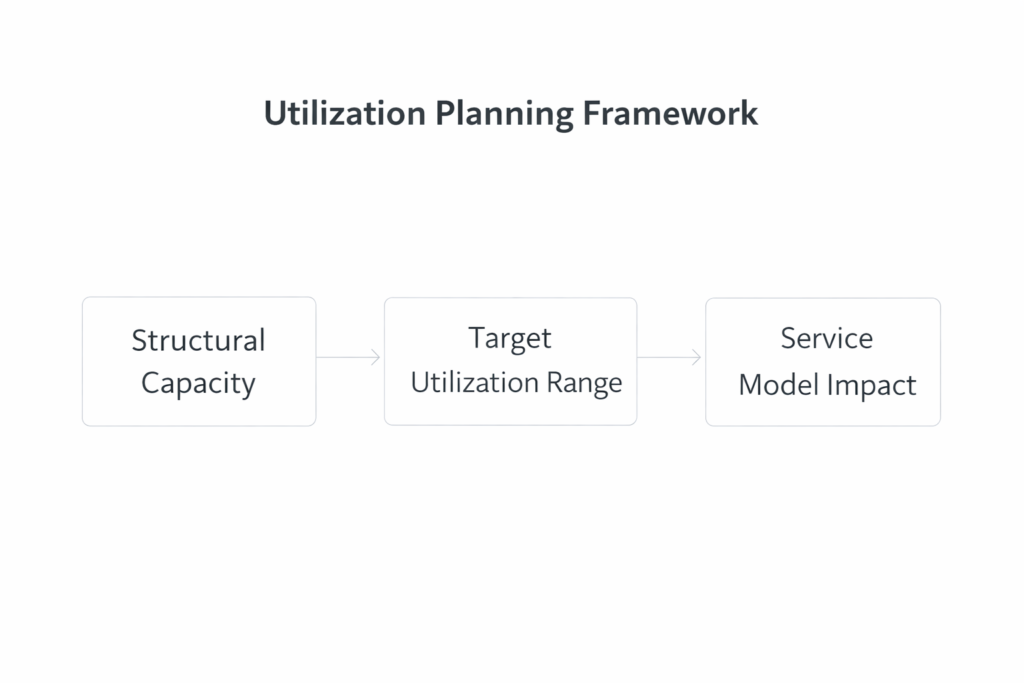
1. Structural Capacity
Structural capacity defines the total amount of delivery time available within a given period.
This capacity is determined after subtracting:
- administrative work
- sales and pipeline development
- client communication
- learning and professional development
- recovery and buffer time
Structural capacity represents the true delivery ceiling of the consulting operation.
2. Target Utilization Range
Healthy utilization levels vary depending on service intensity.
Typical ranges include:
| Utilization Range | Operational Effect |
|---|---|
| 60–65% | High flexibility, lower revenue pressure |
| 65–75% | Stable workload for project-heavy consulting |
| 70–80% | Sustainable utilization in retainer environments |
| Above 80% | Increasing delivery instability |
Higher utilization reduces tolerance for variability.
Balanced utilization protects delivery stability.
To evaluate your current utilization and workload pressure:
→ Use the Freelance Capacity Planner
This helps determine whether your workload is within a sustainable utilization range.
3. Service Model Impact
The type of consulting services delivered influences safe utilization levels.
Project-based work
- higher intensity
- unpredictable revisions
- greater workload variance
Requires lower utilization to maintain delivery stability.
Retainer-based work
- more predictable workload cadence
- ongoing coordination overhead
Allows slightly higher utilization but may increase long-term fatigue.
Service model design is discussed further in:
→ Retainers vs Projects: Which Model Creates Stable Freelance Income
Operational Impact
Deliberate utilization planning improves several operational dimensions of freelance consulting businesses.
Delivery Stability
Balanced utilization levels prevent overload and reduce scheduling pressure.
Quality Control
Consultants retain sufficient capacity to handle revisions and complex problem-solving.
Workload Sustainability
Moderate utilization protects cognitive capacity and reduces burnout risk.
Revenue Predictability
Stable utilization supports consistent income without requiring constant workload escalation.
To monitor utilization and workload distribution consistently, tools that support:
- time tracking
- workload analysis
- capacity visibility
can help maintain sustainable utilization levels.
→ Explore Time & Capacity Tools for Freelancers
System-Level Impact Across Processome
Utilization planning influences coordination between client demand, delivery capacity, and revenue expectations within the Processome operating architecture.
- Client Pipeline System → opportunity qualification aligned with utilization limits
- Capacity Planning System → workload allocation within sustainable utilization ranges
- Profit Tracking System → revenue stability through controlled delivery pressure
- Delivery & Operations System → reliable execution schedules
Balanced utilization improves coordination between client acquisition, delivery planning, and consulting operations.
Common Failure Patterns
Freelancers frequently misunderstand utilization because the metric appears simple but carries structural implications.
Several recurring mistakes appear.
Selling Full Structural Capacity
Freelancers attempt to sell all available delivery hours.
This eliminates operational buffers.
Increasing Utilization Instead of Increasing Price
Revenue growth is pursued by adding more workload rather than improving pricing.
Removing Buffers During Strong Months
Periods of strong demand lead to reduced buffer capacity, increasing future delivery risk.
Ignoring Coordination Overhead
Communication, meetings, and feedback cycles expand as client portfolios grow.
Treating Downtime as Failure
Lower utilization is interpreted as inefficiency rather than strategic buffer capacity.
Strategic Outcome
When utilization is managed deliberately, freelance consulting operations become more stable and sustainable.
Instead of maximizing workload intensity, consultants maintain balanced delivery pressure within their capacity constraints.
This produces several advantages.
- Stable delivery schedules
Workload remains manageable across weeks and months - Improved consulting quality
Time remains available for analysis, problem-solving, and strategic thinking - Reduced margin volatility
Fewer revisions and emergency efforts protect effective hourly yield - Lower burnout risk
Delivery pressure remains aligned with sustainable working patterns
Utilization becomes a safety mechanism rather than a productivity target.
Final Perspective
Utilization is often misunderstood as a measure of efficiency.
In reality, it is a mechanism for controlling operational pressure within finite consulting capacity.
Within the Processome operating model, the Capacity Planning System ensures that delivery capacity remains aligned with incoming client demand. Utilization planning defines how much of that capacity can safely be committed to client work.
High utilization may appear productive.
Balanced utilization builds durability.