Freelance Capacity Model: How to Convert Hours into Revenue
Introduction
Many freelancers set revenue targets before understanding the delivery capacity required to support them.
Typical goals include statements such as:
“I want to earn €10,000 per month.”
“I want to double my freelance income.”
However, revenue targets set without capacity modeling often create structural problems. Freelancers attempt to close the gap by accepting more work, compressing timelines, or extending working hours.
Within the Processome operating model, the capacity model belongs to the Capacity Planning System — the execution framework responsible for translating available consulting capacity into realistic delivery and revenue constraints.
For solo consultants, revenue should not be defined independently from execution capacity. Instead, revenue potential must be derived from the capacity available to deliver client work.
Capacity determines the ceiling.
Revenue must operate within that constraint.
What is a Freelance Capacity Model?
A freelance capacity model converts available consulting hours into a realistic revenue ceiling.
Instead of starting with revenue goals, freelancers first determine how much client work can be delivered sustainably.
This process combines three variables:
- structural delivery capacity
- target utilization rate
- effective hourly yield
Together, these define how much revenue your delivery capacity can support.
If revenue targets exceed modeled capacity, structural changes are required — such as:
- increasing pricing
- reducing workload intensity
- restructuring services
Capacity modeling therefore acts as a constraint system.
It prevents revenue targets from exceeding what can realistically be delivered.
This concept builds directly on:
→ Capacity Planning for Freelancers Explained
→ Utilization Rate for Solo Consultants
The Core Problem
Many freelancers set revenue goals without evaluating how much consulting capacity is required to deliver that revenue.
When revenue targets are disconnected from delivery capacity, several structural problems emerge.
Overcommitment
Freelancers accept additional projects in order to reach revenue targets, even when delivery capacity is already constrained.
Discounting Under Pressure
When capacity becomes overloaded, freelancers may reduce prices to secure shorter projects or quicker payments.
Burnout Cycles
Excessive delivery pressure often leads to extended working hours, creating unsustainable workload patterns.
Margin Instability
Overload increases revision cycles, unpaid work, and operational friction.
These effects occur because revenue planning happens independently from capacity constraints.
Capacity modeling exists to align revenue ambition with execution reality.
Freelance Capacity Model Framework
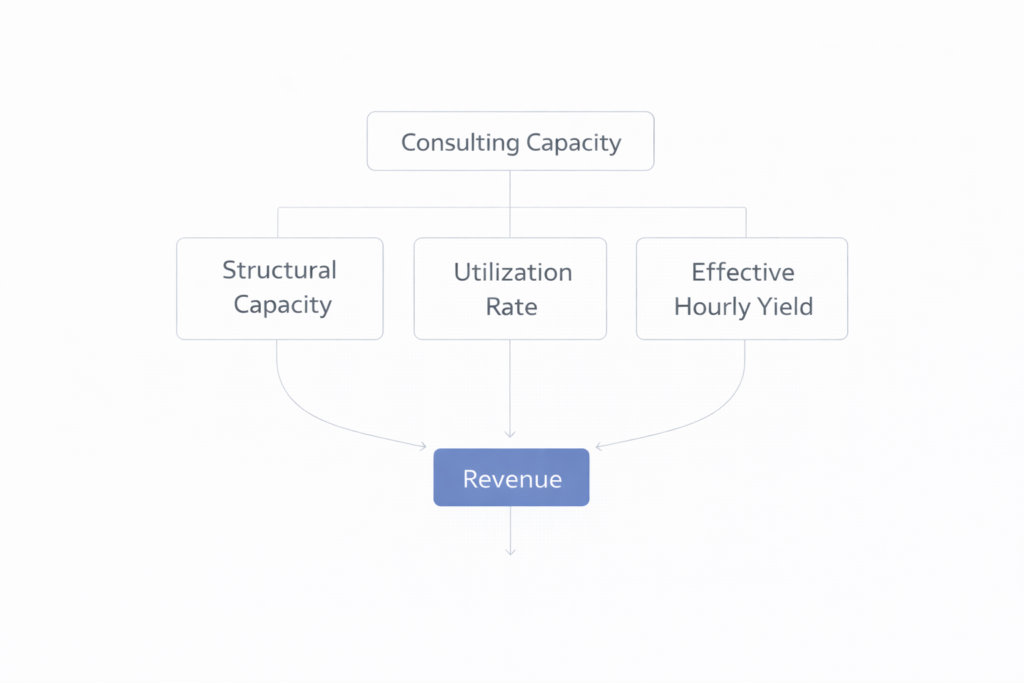
A structured capacity model evaluates three operational variables.
1. Structural Capacity
Structural capacity represents the portion of working time available for client delivery after subtracting operational obligations.
Typical deductions include:
- administration
- sales and pipeline work
- client communication
- learning and skill development
- recovery and buffer time
What remains is the true execution capacity of the consulting business.
Structural capacity is explained in:
→ Capacity Planning for Freelancers Explained
2. Target Utilization
Utilization measures the percentage of structural capacity allocated to client work.
Healthy utilization typically ranges between:
65% – 80%, depending on service intensity
Utilization should never reach 100%.
Delivery operations include variability:
- revisions occur
- feedback cycles take time
- coordination delays appear
- personal energy fluctuates
Target utilization protects delivery stability.
Utilization planning is explored further in:
→ Utilization Rate for Solo Consultants
3. Effective Hourly Yield
Effective hourly yield measures how much revenue is generated per hour of delivery capacity.
This differs from the listed hourly rate because it reflects:
- discounts
- scope expansion
- unpaid work
- pricing structure
Effective yield is analyzed in:
→ Effective Hourly Rate Calculation Framework
Revenue Capacity Formula
Once these variables are defined, a revenue ceiling can be calculated:
Structural Capacity
× Target Utilization
× Effective Hourly Yield
= Realistic Revenue Capacity
This formula converts delivery capacity into a measurable revenue constraint.
To apply this in practice, capacity and workload need to be evaluated explicitly:
→ Use the Freelance Capacity Planner
This helps determine whether your current workload aligns with your available capacity before translating it into revenue targets.
Operational Impact
Capacity modeling significantly improves several operational aspects of freelance consulting.
Revenue Realism
Revenue targets become grounded in execution capacity rather than aspirational goals.
Workload Stability
Freelancers avoid accepting work that exceeds their delivery capacity.
Pricing Clarity
Consultants gain a clearer understanding of how pricing affects revenue potential.
Margin Protection
Capacity modeling prevents hidden workload increases that erode profitability.
To maintain visibility into capacity, workload, and effective delivery over time, tools that support:
- time tracking
- workload monitoring
- capacity planning
can help structure your consulting operations.
→ Explore Time & Capacity Tools for Freelancers
System-Level Impact Across Processome
Capacity modeling influences coordination between revenue expectations, delivery feasibility, and financial planning within the Processome operating architecture.
- Client Pipeline System → opportunity qualification aligned with capacity constraints
- Capacity Planning System → conversion of delivery capacity into revenue limits
- Profit Tracking System → revenue forecasting based on effective hourly yield
- Delivery & Operations System → workload stability through controlled intake
Capacity modeling improves coordination between revenue planning, client acquisition, and delivery execution.
Common Failure Patterns
Freelancers often attempt to increase revenue without adjusting their capacity model.
Several recurring mistakes appear.
Modeling at 100% Utilization
Planning for full utilization removes operational flexibility and increases delivery risk.
Ignoring Non-Billable Time
Operational work is frequently excluded from capacity calculations.
Using Theoretical Hourly Rates
Revenue is modeled using list prices rather than effective hourly yield.
Adding Work Instead of Increasing Price
Revenue growth is pursued by increasing workload rather than improving pricing structure.
Adjusting Targets Instead of Structure
Revenue targets are repeatedly changed instead of addressing underlying capacity constraints.
Strategic Outcome
When a capacity model is implemented correctly, freelance consulting operations become more predictable and sustainable.
Instead of pursuing revenue targets blindly, freelancers design revenue potential around delivery capacity.
This produces several structural advantages.
- Realistic revenue planning
Income targets align with execution feasibility - Improved pricing decisions
Consultants understand how pricing affects revenue potential - Reduced overcommitment
Client intake remains aligned with available capacity - Stable delivery operations
Workload remains manageable over time
Revenue stops being aspirational.
It becomes engineered.
Final Perspective
Revenue ambition without capacity modeling is speculation.
Freelancers who understand their capacity constraints gain a clearer view of the operational limits of their consulting business.
Within the Processome operating model, the Capacity Planning System ensures that revenue ambition remains aligned with delivery feasibility. The freelance capacity model translates structural working capacity into realistic revenue potential.
Capacity defines reality.
Revenue must follow it.