Time Tracking vs Capacity Planning: What Freelancers Need to Manage Workload
Introduction
Many freelancers use time tracking tools to monitor how their work hours are spent. While this provides useful visibility into daily activities, time tracking alone does not prevent workload overload or delivery instability.
Tracking time explains what already happened.
Capacity planning determines what should be allowed to happen.
Within the Processome operating model, this distinction belongs to the Capacity Planning System — the execution framework responsible for ensuring that consulting capacity is allocated in a sustainable way.
For solo consultants, confusing time tracking with capacity planning often leads to reactive workload management. Work is accepted first, then hours are measured afterward.
Operational stability requires the opposite approach.
Capacity planning must define the limits of execution before commitments are made.
What is Time Tracking vs Capacity Planning?
Time tracking and capacity planning serve different roles in managing freelance workload.
Time tracking records how working hours were spent in the past.
Capacity planning determines how much work can be accepted in the future.
Time tracking typically captures:
- client work hours
- administrative tasks
- meetings and communication
- project activities
Capacity planning evaluates:
- structural delivery capacity
- current commitments
- forecasted workload
- buffer requirements
The relationship can be summarized as:
Time tracking → descriptive measurement
Capacity planning → prescriptive control
Capacity planning principles are explained in:
→ Capacity Planning for Freelancers Explained
The Core Problem
Many freelancers assume that tracking time is equivalent to managing capacity.
This creates a fundamental operational gap.
Time tracking is retrospective.
Capacity planning is prospective.
When freelancers rely exclusively on time tracking, several problems emerge.
Reactive Workload Management
Delivery pressure becomes visible only after the schedule is already overloaded.
Hidden Overcommitment
Freelancers continue accepting work because past reports do not reveal future constraints.
Incomplete Capacity Visibility
Time tracking shows hours spent but not whether future commitments exceed delivery capacity.
Delayed Decision-Making
By the time overload becomes visible, corrective action may be too late.
These issues occur because time tracking measures activity, while capacity planning governs feasibility.
Time Tracking vs Capacity Planning Framework
The difference can be evaluated across three operational dimensions.
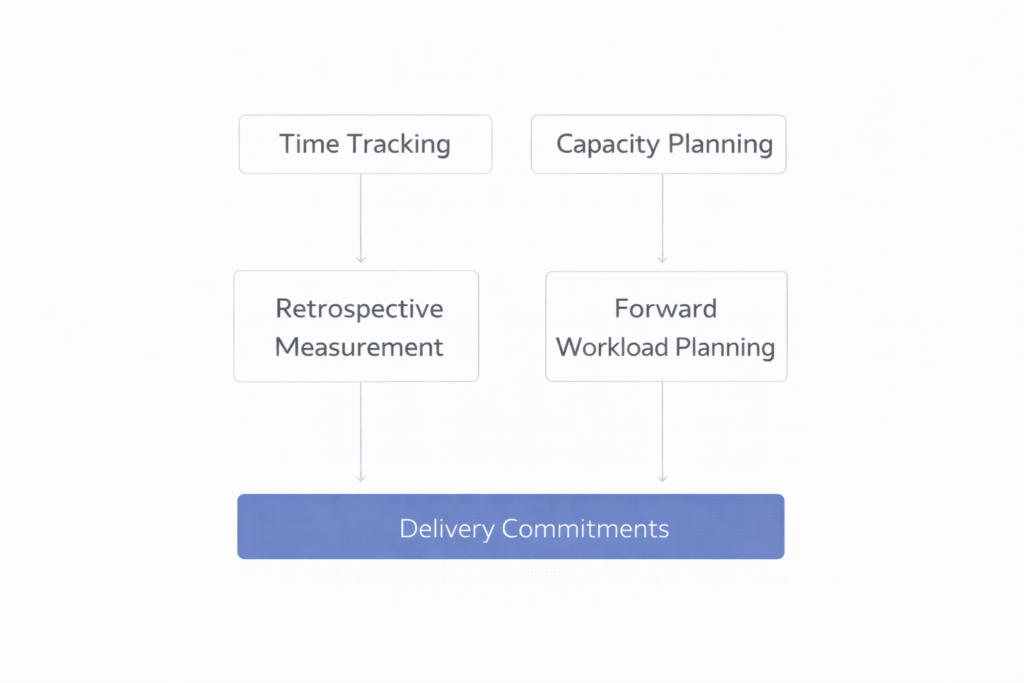
1. Time Orientation
Time tracking focuses on past activity.
Examples include:
- hours recorded during the previous week
- time spent on a specific project
- billable vs non-billable breakdown
Capacity planning focuses on future workload feasibility.
It evaluates whether upcoming work fits within available capacity.
2. Operational Purpose
Time tracking is used to:
- invoice clients
- analyze past productivity
- estimate project costs
Capacity planning is used to:
- control client intake
- prevent delivery overload
- stabilize workload distribution
Capacity planning ensures commitments remain aligned with delivery limits.
3. Decision Impact
Time tracking influences decisions after work has occurred.
Capacity planning influences decisions before work begins.
| Scenario | Time Tracking | Capacity Planning |
|---|---|---|
| Project completed late | Identifies time spent | Prevents overload beforehand |
| Schedule overloaded | Records excessive hours | Limits commitments earlier |
| Workload spikes | Measures effort | Anticipates pressure |
This distinction highlights why capacity planning must guide intake decisions.
Operational Impact
Understanding the difference between time tracking and capacity planning improves several aspects of freelance consulting operations.
Delivery Stability
Capacity planning prevents overload before it occurs.
Workload Visibility
Freelancers gain a clearer view of how upcoming commitments affect their schedule.
Pricing Confidence
Consultants understand delivery cost before accepting work.
Operational Control
Capacity constraints ensure incoming work aligns with execution limits.
To maintain visibility into time usage and workload over time, tools that support:
- time tracking
- workload monitoring
- capacity visibility
can help structure your workflow.
→ Explore Time & Capacity Tools for Freelancers
System-Level Impact Across Processome
The distinction between time tracking and capacity planning influences how measurement and planning interact across the Processome operating architecture.
- Client Pipeline System → intake decisions informed by capacity constraints
- Capacity Planning System → forward planning of workload feasibility
- Profit Tracking System → revenue analysis informed by actual time usage
- Delivery & Operations System → structured execution scheduling
Separating measurement from planning improves coordination between sales, delivery planning, and execution.
Common Failure Patterns
Freelancers frequently confuse time tracking with capacity planning because both involve measuring working hours.
Several patterns contribute to this confusion.
Treating Time Reports as Capacity Limits
Historical data does not define future delivery capacity.
Tracking Without Planning
Hours are recorded while workload continues to exceed capacity.
Ignoring Structural Capacity
Non-billable obligations are excluded when evaluating feasibility.
Using Time Tracking as a Diagnostic Tool Only
Time reports highlight inefficiencies but do not prevent overload.
Capacity planning must complement time tracking.
Strategic Outcome
When freelancers separate time tracking from capacity planning, their operations become more stable.
Instead of reacting to past workload patterns, consultants design future commitments within defined capacity constraints.
This produces several advantages.
- Controlled client intake
Work is accepted only when capacity exists - Improved delivery reliability
Schedules remain realistic - Better operational visibility
Freelancers understand both past time usage and future capacity
Over time, consulting operations evolve from reactive time measurement to proactive capacity governance.
Final Perspective
Time tracking answers:
“How was time spent?”
Capacity planning answers:
“How much work can be delivered safely?”
Within the Processome operating model, the Capacity Planning System defines execution limits before work begins. Time tracking remains useful as a measurement tool, but it cannot replace forward-looking capacity planning.
Operational stability emerges when freelancers plan capacity first and measure time second.