Workload Distribution Across Clients (How to Balance Your Freelance Capacity)
Introduction
For solo consultants, total workload is only part of the capacity equation. The distribution of that workload across clients determines how stable, flexible, and resilient the consulting business actually is.
Many freelancers evaluate workload primarily through total hours rather than through client capacity distribution. However, this view ignores how client concentration affects operational risk.
When a large portion of capacity is tied to a single client, the business becomes structurally fragile. A single project change or pause can destabilize both revenue and scheduling.
Within the Processome operating model, workload distribution across clients belongs to the Capacity Planning System — the subsystem responsible for structuring how consulting capacity is allocated across active engagements.
When structured correctly, workload distribution creates a balanced client portfolio that supports predictable delivery and sustainable operations.
What is Workload Distribution Across Clients?
Workload distribution across clients is the process of allocating delivery capacity across multiple client engagements in a balanced and controlled way.
Instead of measuring workload only as total hours, freelancers evaluate:
- how much capacity each client consumes
- how concentrated the workload is
- how much capacity remains available
Each client represents a share of total capacity.
For example:
| Client | Weekly Hours | Capacity Share |
|---|---|---|
| Client A | 16h | 40% |
| Client B | 10h | 25% |
| Client C | 8h | 20% |
| Client D | 6h | 15% |
This distribution determines how resilient the business is to change.
A balanced distribution supports:
- revenue diversification
- delivery stability
- flexibility for new work
The Core Problem
Most freelancers manage workload on a project-by-project basis rather than as a structured portfolio.
Client work often accumulates as:
- one large anchor client
- one or two smaller engagements
- occasional short-term projects
While manageable initially, this creates structural problems.
Client Dependency
A single client may consume a large portion of capacity.
If that client reduces scope, revenue drops immediately.
Scheduling Rigidity
High concentration limits flexibility.
New opportunities cannot be accepted.
Capacity Shock
Unexpected scope expansion disrupts the entire schedule.
Portfolio Instability
Without structure, workload becomes unpredictable.
These issues emerge when capacity distribution is not managed explicitly.
→ Capacity Planning for Freelancers Explained
Client Workload Distribution Framework
A structured model evaluates three key dimensions.
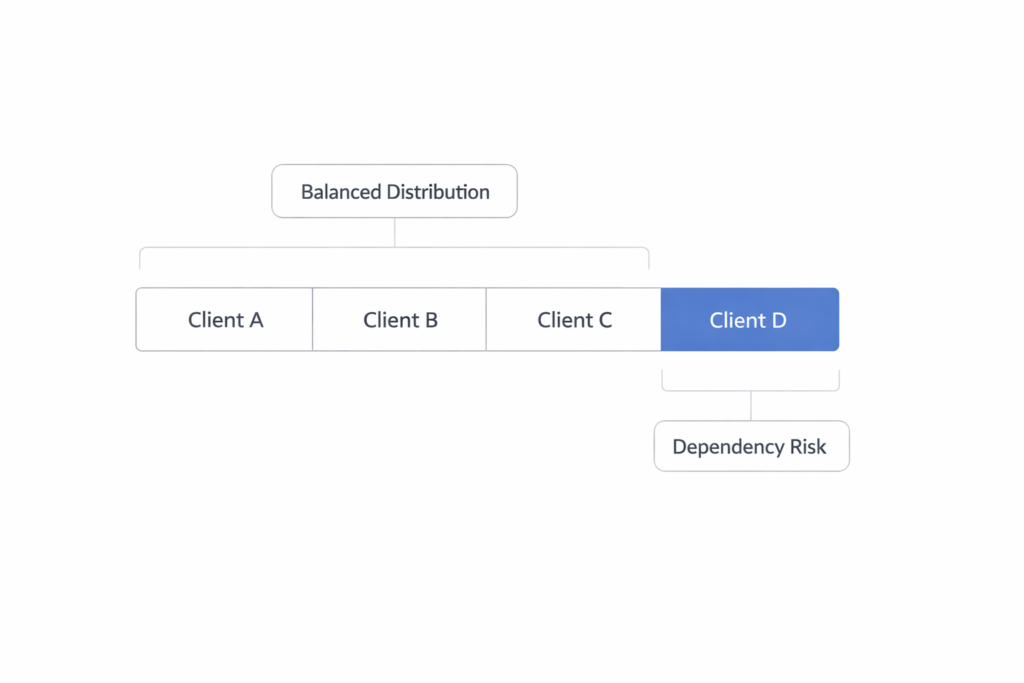
1. Capacity Share per Client
Capacity share measures how much of total capacity is assigned to each client.
| Client | Hours | Capacity Share |
|---|---|---|
| Client A | 16h | 40% |
| Client B | 12h | 30% |
| Client C | 8h | 20% |
| Client D | 4h | 10% |
Typical thresholds:
- Above 50% → high dependency risk
- 30–50% → moderate concentration
- Below 30% → balanced distribution
Tracking this prevents hidden dependency.
2. Client Portfolio Size
Portfolio size refers to the number of active clients.
| Portfolio Type | Client Count | Operational Impact |
|---|---|---|
| Single Client | 1 | Maximum dependency |
| Dual Client | 2 | Limited resilience |
| Balanced Portfolio | 3–5 | Stable distribution |
| Fragmented Portfolio | 6+ | High coordination overhead |
Most sustainable freelance businesses operate with 3–5 clients.
3. Capacity Buffer
Capacity buffer is the portion of capacity left unallocated.
Typical range:
→ 10–20% buffer
Buffers allow freelancers to:
- absorb scope changes
- handle urgent requests
- onboard new clients
→ Delivery Buffer Design for Freelancers
Without buffers, workload becomes rigid.
Operational Impact
Structured workload distribution improves several operational dimensions.
Delivery Stability
Balanced allocation prevents overload from dominant clients.
Revenue Stability
Income is distributed across multiple clients.
Opportunity Flexibility
Freelancers can accept new work without disruption.
If you’re unsure whether your current client mix is sustainable:
→ Use the Freelance Capacity Planner
To maintain visibility into client workload, time allocation, and capacity distribution over time, tools that support:
- time tracking
- workload monitoring
- project organization
can help structure your workflow.
→ Explore Time & Capacity Tools for Freelancers
System-Level Impact Across Processome
Workload distribution connects multiple systems.
- Client Pipeline System → intake affecting balance
- Capacity Planning System → allocation across clients
- Profit Tracking System → revenue concentration visibility
- Delivery & Operations System → scheduling stability
Balanced portfolios improve coordination across the system.
Common Failure Patterns
Freelancers often struggle with distribution due to recurring mistakes.
Single Client Dominance
One client consumes most capacity.
Reactive Client Accumulation
New clients are added without evaluating distribution.
Zero Capacity Buffer
No flexibility for change or growth.
Ignoring Capacity Metrics
Capacity share is not tracked.
These patterns create instability.
Strategic Outcome
When workload distribution is managed deliberately, freelancers gain a stable structure.
- Reduced dependency risk
Revenue is diversified - Improved capacity control
Allocation becomes visible - Greater opportunity flexibility
New work can be accepted safely
Over time, freelance work becomes portfolio-driven rather than project-driven.
Final Perspective
Freelancers often measure workload only by total hours.
However, consulting businesses are defined by how work is distributed across clients.
Within the Processome operating model, the Capacity Planning System structures how capacity is allocated across engagements.
Workload distribution ensures that freelancers build balanced portfolios rather than fragile dependencies.
Structuring client capacity deliberately transforms freelance work into a stable consulting system.