Managing Multiple Clients as a Consultant (Without Overload or Chaos)
Introduction
As freelance consultants grow their client base, managing multiple concurrent engagements becomes inevitable. While serving multiple clients can increase revenue and diversify income, it also introduces operational complexity.
Without structured workload management, freelancers may experience:
- overlapping project deadlines
- competing client priorities
- fragmented focus
- delivery stress
Learning how to manage multiple clients as a consultant requires more than handling requests as they arise. It requires structuring client work within clear capacity limits.
Within the Processome operating model, managing multiple clients belongs to the Capacity Planning System — the execution engine responsible for aligning delivery commitments with available capacity.
The objective is not simply to increase the number of clients, but to manage client concurrency in a way that preserves delivery quality and operational stability.
What is Managing Multiple Clients?
Managing multiple clients as a freelancer is the process of allocating delivery capacity across concurrent engagements while maintaining control over workload, priorities, and execution quality.
Instead of treating each client independently, freelancers manage their client portfolio as an integrated workload system.
This includes:
- defining how much capacity each client consumes
- balancing delivery intensity across engagements
- structuring communication and scheduling
- preventing overload from overlapping commitments
Effective client management ensures that all engagements remain compatible with structural capacity.
The Core Problem
Many freelancers begin working with multiple clients without adapting their operational structure.
Typical patterns include:
- accepting new clients whenever opportunities arise
- handling requests reactively
- scheduling work based on urgency rather than planning
While manageable with a small number of clients, this approach becomes unstable as the portfolio grows.
Several operational problems emerge.
Conflicting Deadlines
Multiple clients request deliverables at the same time.
Context Switching Overload
Frequent switching reduces focus and increases cognitive fatigue.
Uneven Capacity Allocation
Some clients receive excessive attention while others are delayed.
Reduced Delivery Quality
Divided attention leads to weaker execution.
These issues occur when client concurrency increases without structured capacity allocation.
The Multi-Client Management Framework
Managing multiple clients effectively requires four structural control mechanisms.
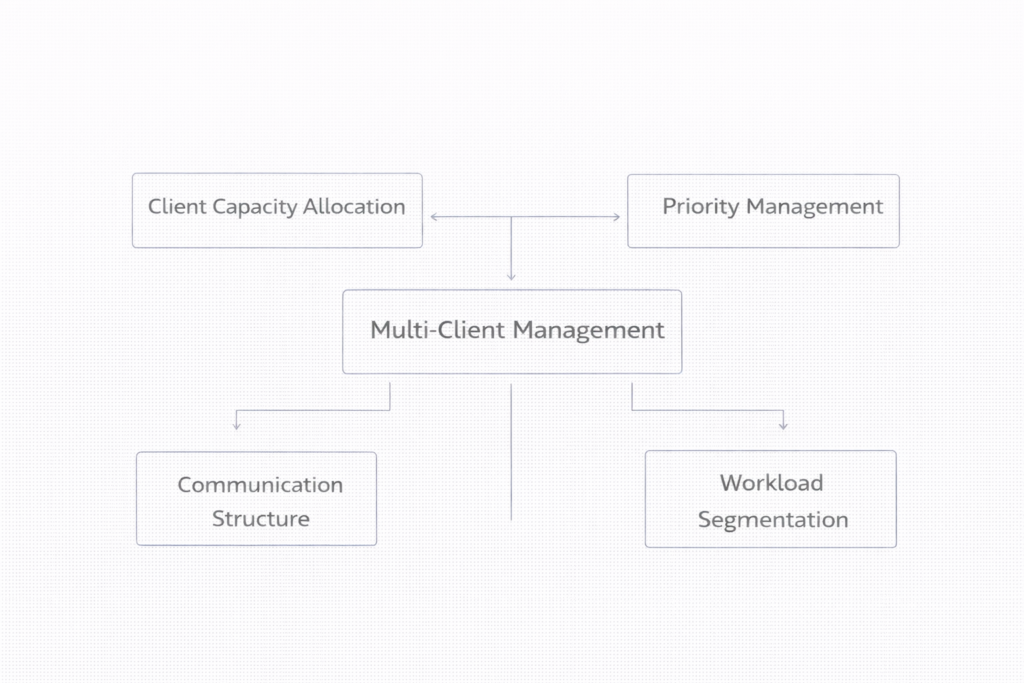
1. Client Capacity Allocation
Each client consumes a portion of delivery capacity.
Freelancers should define:
- expected hours per client
- peak delivery periods
- retainer obligations
→ Workload Distribution Across Clients
Explicit allocation prevents hidden overload.
2. Priority Management
When multiple clients are active, competing requests are inevitable.
Priority should be defined based on:
- contractual deadlines
- scope commitments
- strategic importance
Clear rules reduce decision stress and reactive scheduling.
3. Communication Structure
Structured communication prevents constant interruptions.
Examples include:
- scheduled update meetings
- defined response times
- consistent reporting formats
This reduces reactive work and improves client confidence.
→ Delivery & Operations System
4. Workload Segmentation
Segmenting work reduces context-switching fatigue.
Freelancers may:
- dedicate specific days to certain clients
- group similar tasks
- schedule deep work blocks
This improves focus and execution quality.
Operational Impact
Structured multi-client management improves several operational dimensions.
Improved Delivery Reliability
Schedules remain controlled and deadlines are met.
Better Capacity Visibility
Freelancers understand how much work each client consumes.
If you’re unsure whether your current client load is sustainable:
→ Use the Freelance Capacity Planner
Reduced Cognitive Overload
Segmented work reduces constant switching.
To support ongoing coordination, scheduling, and workload visibility, tools that help manage:
- time tracking
- project organization
- workload planning
can improve execution consistency.
→ Explore Time & Capacity Tools for Freelancers
System-Level Impact Across Processome
Managing multiple clients connects several systems.
- Client Pipeline System → intake discipline
- Capacity Planning System → workload allocation
- Profit Tracking System → revenue balance
- Delivery & Operations System → execution management
Balanced client portfolios improve overall stability.
Common Failure Patterns
Freelancers often struggle due to recurring mistakes.
Accepting Too Many Clients
Exceeding capacity creates delivery pressure.
Lack of Time Allocation Discipline
Without clear allocation, workload becomes unpredictable.
Reactive Communication
Immediate responses interrupt focused work.
Ignoring Cognitive Load
Complex work requires mental bandwidth beyond hours.
These patterns destabilize client management.
Strategic Outcome
When freelancers manage multiple clients structurally, several advantages emerge.
- Balanced client portfolios
Workload is distributed deliberately - Stable delivery performance
Fewer scheduling conflicts - Improved client relationships
Consistent communication and attention - Reduced operational stress
Workload remains manageable
Managing multiple clients effectively allows freelancers to scale revenue without sacrificing execution quality.
Final Perspective
Freelancers often assume that serving more clients automatically increases revenue.
In reality, the challenge lies in managing client concurrency within capacity limits.
Within the Processome operating model, structured client management ensures that delivery commitments remain aligned with available capacity.
Effective consulting is not defined by how many clients you serve.
It is defined by how well you manage the clients you accept.