Freelance Business Systems: The Processome Framework Explained
The Operating Model for Solo B2B Freelancers
Introduction
Many freelancers struggle with unstable income, unpredictable workload, and inconsistent client flow.
At times there is too little work. At other times, too much work creates pressure and delivery instability.
These problems are rarely caused by lack of expertise.
They are caused by lack of structure.
This page explains how to structure a freelance consulting business using a system-based operating model.
The Processome Framework defines how solo B2B freelancers can design their business as a set of interconnected systems that control revenue, workload, profitability, and delivery stability.
Instead of operating reactively, freelancers can build a structured consulting system that produces predictable outcomes.
The Core Problem: Freelancing Without Systems
Most freelancers attempt to improve their business in fragments.
Typical improvements include:
- improving lead generation
- raising prices
- experimenting with productivity tools
- working longer hours
These improvements are rarely connected.
Without operational architecture, optimization creates complexity rather than stability.
Revenue may increase temporarily.
But workload, margins, and delivery quality remain unstable.
Freelancing without systems is structured chaos.
What “Systems” Actually Means
Within the Processome model, a system is not a tool.
A system is:
A repeatable operational structure that produces predictable outcomes.
Every operational system contains four elements:
Inputs → Decisions → Outputs → Feedback
When systems are designed correctly:
- demand becomes predictable
- capacity becomes manageable
- profit becomes measurable
- delivery becomes stable
Systems convert freelance work into structured operations.
The Processome Operating Model
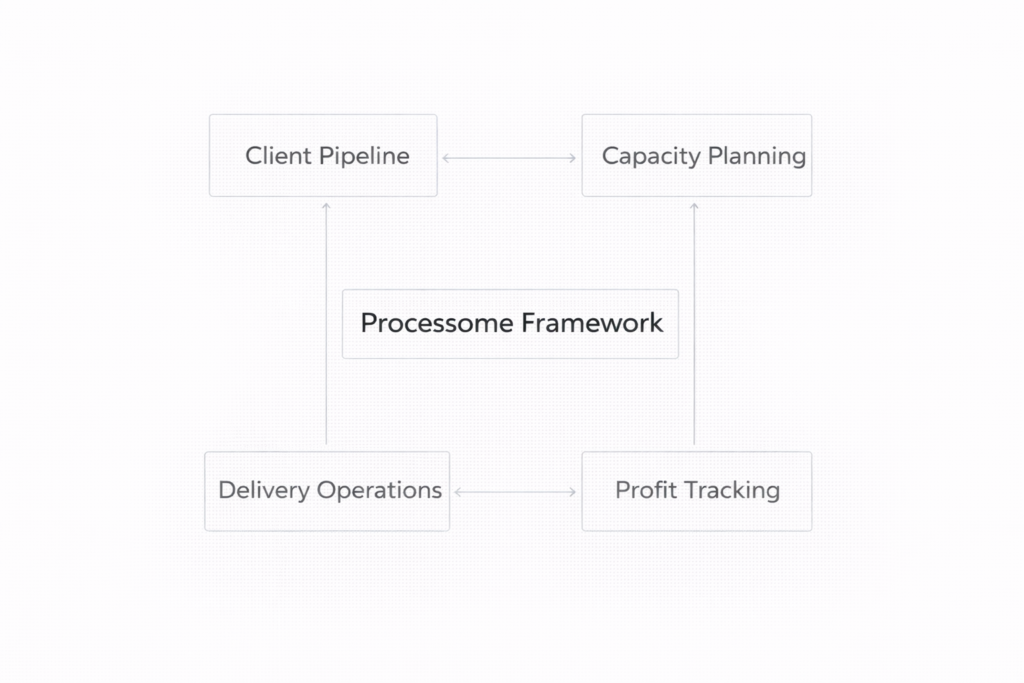
The Processome framework defines freelance consulting as a four-system operating architecture.
Each system governs one critical layer of the business.
Together they form a closed operational loop.
How the Framework Is Implemented
The Processome Framework is implemented through a set of operational systems that control the core performance drivers of a freelance consulting business.
While the framework defines the architecture of a stable freelance business, the systems define how that architecture operates in practice.
Each system manages a specific layer of performance, from revenue generation to workload control, financial intelligence, and operational stability.
To understand how the framework works in practice, explore the systems that power it.
→ Explore the Processome Systems
From Framework to Application
Understanding the Processome Framework provides the architectural foundation.
Applying it requires translating systems into a working operational setup.
This includes defining processes, structuring workflows, and selecting tools that support each system.
To move from framework to implementation, see:
→ Build Your Freelance Consulting System
The Four Core Systems
Client Pipeline System
The Revenue Engine
The Client Pipeline System controls demand quality and revenue predictability.
It governs:
- lead generation
- client qualification
- sales pipeline structure
- revenue forecasting
- client portfolio design
Without this system, freelancers depend on referrals, ad-hoc outreach, and unpredictable opportunities.
Capacity Planning System
The Execution Engine
Revenue without workload control creates overload.
The Capacity Planning System ensures that accepted work can actually be delivered.
It defines:
- capacity limits
- utilization targets
- capacity buffers
- workload allocation
Time becomes a strategic resource.
Profit Tracking System
The Financial Intelligence Engine
Revenue alone does not reveal business performance.
The Profit Tracking System measures:
- contribution margin
- client profitability
- effective hourly yield
- revenue concentration risk
It converts freelancing from income generation into margin design.
Delivery & Operations System
The Stability Engine
Operational structure protects long-term client relationships.
The Delivery & Operations System governs:
- client onboarding
- scope control
- milestone planning
- change management
- client retention systems
It ensures that revenue remains profitable and sustainable.
→ Delivery & Operations System
How the Systems Work Together
The four systems are interconnected.
Changes in one system influence the others.
Examples of system feedback loops include:
- Weak pipeline → unstable workload
- Capacity overload → declining delivery quality
- Delivery instability → reduced client retention
- Retention decline → increased pipeline pressure
These loops either compound instability or reinforce stability.
The Processome framework ensures that the systems strengthen each other.
Tools vs Systems
Freelancers often attempt to solve operational problems with tools.
But tools are not systems.
Examples:
- CRM software is not a pipeline system
- Time tracking software is not capacity planning
- Accounting software is not financial intelligence
Tools execute tasks.
Systems govern decisions.
Processome focuses on operational architecture first.
Who the Processome Framework Is Built For
The framework is designed specifically for:
- solo B2B freelancers
- independent consultants
- interim professionals
- specialized service providers
It is not designed for:
- influencers
- content creators
- e-commerce sellers
- hobby freelancers
The model assumes a business built around selling expertise and consulting capacity.
Why Systems Matter Before Growth
Many freelancers attempt to grow revenue before stabilizing operations.
This amplifies problems.
Before scaling, freelancers must install:
- client qualification filters
- capacity planning discipline
- margin visibility
- delivery structure
Systems come first.
Growth follows.
Strategic Outcome
When the Processome framework is implemented, freelance consulting businesses become structurally different.
Several improvements emerge:
- revenue becomes more predictable
- workload becomes manageable
- margins become visible
- client relationships become stable
Freelancing transforms from reactive work into a structured micro-firm.
Final Perspective
Freelancing is often portrayed as unstable.
In reality, instability is usually the result of missing systems.
The Processome framework provides the operational architecture required to transform solo consulting into a structured and sustainable business.
Systems create stability.
Stability creates profit.
Profit creates freedom.