Freelance Workload Forecasting (Plan Future Capacity & Avoid Overload)
Introduction
Freelancers often experience workload volatility. Periods of intense delivery activity are followed by weeks with limited client work, creating operational instability and unpredictable schedules.
These fluctuations rarely occur because freelancers lack opportunities. Instead, they occur because future workload is not forecasted systematically.
Freelance workload forecasting allows consultants to anticipate upcoming demand and align it with available capacity before commitments are made.
Within the Processome operating model, workload forecasting belongs to the Capacity Planning System — the framework responsible for anticipating future delivery demand and aligning it with consulting capacity.
Without forecasting, delivery schedules evolve reactively. With it, freelancers gain visibility into upcoming workload and can plan more stable operations.
What is Freelance Workload Forecasting?
Freelance workload forecasting is the process of estimating future delivery demand based on:
- current client commitments
- pipeline opportunities
- expected project timelines
Instead of relying only on confirmed work, freelancers evaluate how potential deals may translate into future workload.
Forecasting answers questions such as:
- How busy will I be in 2–4 weeks?
- Can I accept new work safely?
- When will capacity become constrained?
This transforms capacity planning from reactive scheduling into forward-looking decision-making.
The Core Problem
Many freelancers evaluate workload based only on active projects.
This provides visibility into current commitments, but not future demand.
Several structural problems emerge.
Reactive Capacity Planning
Schedules are adjusted only after new work is confirmed.
Pipeline Blindness
Potential workload in the pipeline is ignored until deals close.
Delivery Overload
Multiple deals may convert at the same time, creating sudden workload spikes.
Missed Opportunities
Freelancers may decline work unnecessarily due to unclear future capacity.
These issues occur when pipeline activity is not translated into delivery planning.
Freelance Workload Forecasting Framework
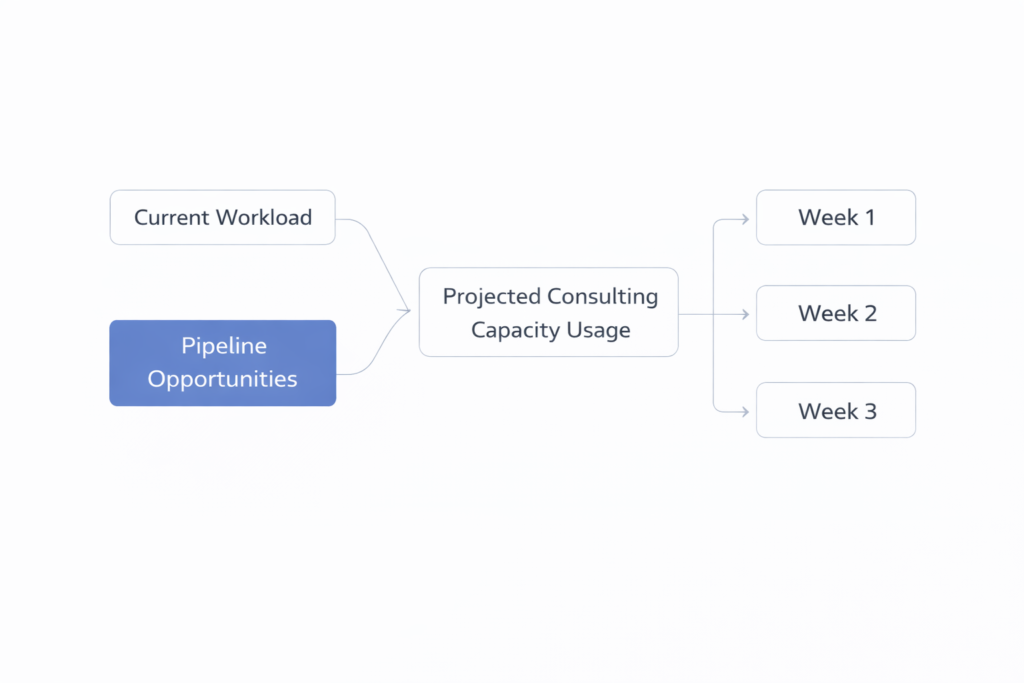
A structured workload forecasting model evaluates three operational components.
1. Current Delivery Commitments
The first step is identifying baseline workload.
This includes:
- ongoing retainers
- active projects
- scheduled deliverables
This defines the current capacity usage.
2. Pipeline Conversion Potential
The pipeline contains future workload.
Forecasting requires estimating:
- which deals are likely to close
- when they may start
- how much work they require
This is supported by:
→ Pipeline Velocity for Freelancers
→ Forecasting Revenue from Your Pipeline
These metrics help translate pipeline activity into expected workload.
3. Future Capacity Utilization
The final step is mapping projected work across time.
This creates a forward-looking capacity view.
| Week | Confirmed Work | Forecasted Work | Total Capacity Usage |
|---|---|---|---|
| Week 1 | 70% | 10% | 80% |
| Week 2 | 65% | 20% | 85% |
| Week 3 | 50% | 30% | 80% |
This reveals when capacity may become constrained.
Operational Impact
Workload forecasting improves several operational dimensions.
Capacity Visibility
Freelancers understand how workload may evolve over time.
Delivery Stability
Future overload becomes visible before it occurs.
Strategic Decision-Making
New work can be evaluated based on future capacity.
Revenue Planning
Sales activity aligns with realistic delivery capability.
If you want to evaluate whether your current and future workload fits within your capacity:
→ Use the Freelance Capacity Planner
To maintain visibility into workload, pipeline activity, and future scheduling, tools that support:
- time tracking
- planning
- forecasting
can help structure your workflow.
→ Explore Time & Capacity Tools for Freelancers
System-Level Impact Across Processome
Workload forecasting connects multiple systems.
- Client Pipeline System → future demand
- Capacity Planning System → workload allocation
- Profit Tracking System → revenue forecasting
- Delivery & Operations System → project readiness
Forecasting improves coordination across systems.
Common Failure Patterns
Freelancers often struggle with forecasting due to recurring mistakes.
Ignoring the Sales Pipeline
Only confirmed work is considered.
Overestimating Conversion Rates
Pipeline opportunities are treated as certain.
Missing Timeline Estimates
Projects are not mapped across time.
No Forward Planning Horizon
Capacity is evaluated only weekly, not ahead.
These patterns reduce forecasting accuracy.
Strategic Outcome
When workload forecasting is implemented, freelancers gain control over future workload.
- Predictable delivery schedules
Future demand becomes visible - Improved opportunity selection
Work is accepted based on capacity - Balanced workload growth
New projects integrate smoothly
Over time, consulting operations shift from reactive to proactive.
Final Perspective
Freelancers often focus on current workload.
However, stable consulting operations depend on anticipating future demand.
Within the Processome operating model, the Capacity Planning System connects pipeline activity with delivery capacity.
Freelance workload forecasting ensures that opportunity remains aligned with execution.
Planning ahead creates stability.