Retainer vs Project Profitability for Freelancers (Which Model Is More Profitable?)
Introduction
Retainer vs project profitability for freelancers explains why stable income does not always mean higher profit.
Retainers are often seen as the ideal freelance model. They promise predictable income, long-term relationships, and reduced sales pressure.
Projects, in contrast, are viewed as less stable due to irregular revenue.
However, this comparison often ignores a critical factor: profitability.
Retainers and projects can produce very different financial outcomes depending on delivery effort, coordination overhead, and scope management.
Within the Processome operating model, financial analysis belongs to the → Profit Tracking System—the framework responsible for evaluating how revenue structures influence profitability.
Revenue stability and profit quality are not always aligned.
What is Retainer vs Project Profitability?
Retainer vs project profitability compares how different engagement models convert revenue into profit.
Retainers provide recurring income in exchange for ongoing services or availability.
Projects define a fixed scope with a clear start and end.
These structures influence:
- delivery workload patterns
- coordination intensity
- margin stability
- capacity allocation
Profitability must therefore be evaluated based on both revenue structure and delivery effort.
Key frameworks include:
→ Contribution Margin in Freelance Businesses
→ Effective Hourly Rate Calculation Framework
These reveal how efficiently each model generates financial return.
The Core Problem
Freelancers often prefer stability.
A €3,000/month retainer may feel safer than a €6,000 project every two months.
However, recurring work often introduces hidden costs.
These include:
- recurring meetings
- incremental requests
- ongoing availability expectations
- gradual scope expansion
Over time, these increase delivery effort without increasing revenue.
Projects, by contrast, often have clearer boundaries.
The perceived stability of retainers can mask declining profitability.
Retainers vs Projects Profitability Framework
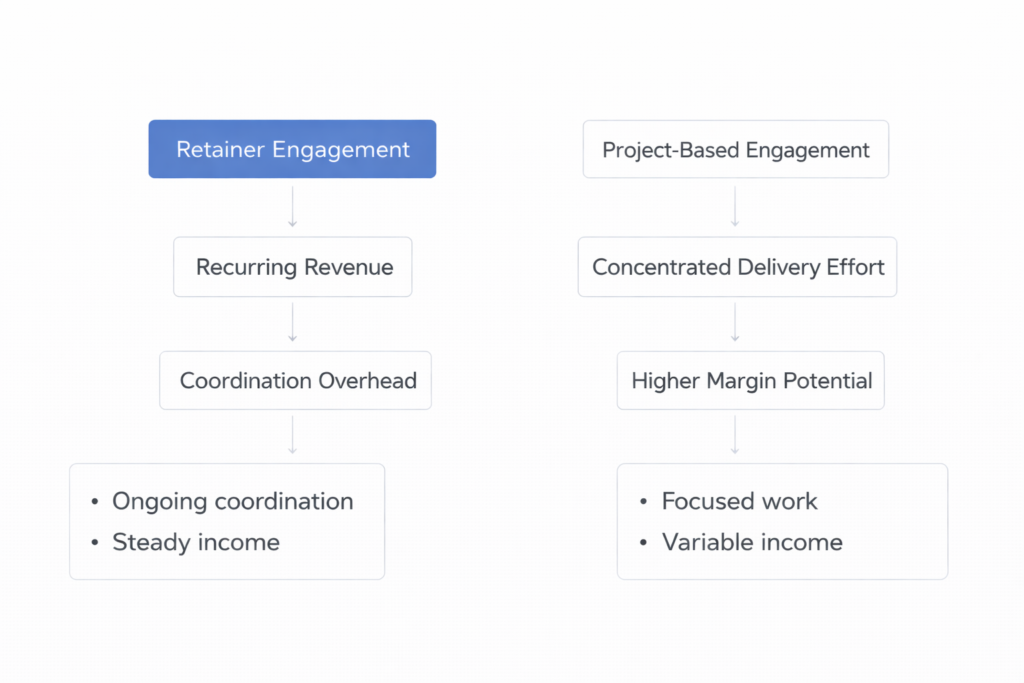
Retainers and projects differ across several operational dimensions.
1. Revenue Structure
Retainers:
- predictable recurring income
- ongoing engagement
- long-term relationships
Projects:
- fixed project fees
- defined timelines
- episodic revenue
Retainers improve predictability.
Projects create revenue spikes.
2. Coordination Overhead
Retainers often include:
- recurring meetings
- continuous communication
- incremental requests
Projects typically involve:
- defined kickoff
- milestone reviews
- structured feedback
Retainers distribute coordination over time.
Projects concentrate it.
This directly impacts effective hourly yield.
3. Capacity Allocation
Retainers:
- reserve recurring capacity
- increase concurrent clients
- reduce flexibility
Projects:
- concentrate effort temporarily
- release capacity after completion
- allow scheduling resets
Revenue structure and capacity structure are closely linked.
4. Margin Patterns
Retainers:
- stable but often moderate margins
- predictable revenue
Projects:
- higher margin potential
- greater variability
Neither model is inherently better.
Profitability depends on pricing, scope control, and efficiency.
Operational Impact
Understanding this difference improves key decisions.
Revenue Structure Design
Combine models to balance stability and margin.
Capacity Allocation
Understand how recurring work limits flexibility.
Client Portfolio Management
Avoid overreliance on one model.
Financial Planning
Balance stable income with higher-margin work.
Evaluate Your Retainers vs Projects
To understand which model is actually more profitable in your business:
→ Client Profitability Calculator
This helps compare how different engagements convert time into financial return.
System-Level Impact Across Processome
Engagement models influence multiple systems.
- Client Pipeline System → targeting appropriate opportunities
- Capacity Planning System → workload allocation
- Profit Tracking System → margin analysis
- Delivery & Operations System → structuring execution
Revenue structure connects financial performance with operations.
Common Failure Patterns
Overvaluing Retainer Stability
Recurring income may hide declining margins.
Ignoring Coordination Overhead
Ongoing communication reduces profitability.
Underestimating Project Margins
Well-scoped projects can outperform retainers.
Mixing Models Without Structure
Combining both without planning creates instability.
Strategic Outcome
When freelancers evaluate retainers and projects properly, revenue structures become more deliberate.
Instead of relying on assumptions, consultants design balanced portfolios.
This produces:
- improved income stability
- stronger margin opportunities
- better capacity control
Over time, freelancers adopt hybrid models combining stability with profitability.
Final Perspective
Retainers provide stability.
Projects provide leverage.
Within the Processome operating model, the → Profit Tracking System evaluates how engagement models influence profitability and capacity.
Freelancers who understand both structures can design more sustainable consulting businesses.
Financial intelligence turns pricing models into strategic decisions.