Revenue per Client for Freelancers (How to Structure Your Client Portfolio)
Introduction
Revenue per client for freelancers reveals how revenue is distributed across your client portfolio—not just how much you earn.
Freelancers often measure business performance through total revenue. While revenue growth can indicate business expansion, it does not reveal how efficiently that revenue is distributed across the client portfolio.
A freelancer generating €120,000 annually could achieve that income through many small clients or through a smaller number of larger engagements. These two structures create very different operational dynamics.
Within the Processome operating model, portfolio-level financial analysis belongs to the → Profit Tracking System—the financial intelligence layer responsible for understanding how revenue structure affects profitability and stability.
The revenue per client metric evaluates the average revenue generated from each client relationship.
This metric provides insight into the economic structure of the client portfolio and helps freelancers assess whether their revenue model relies on a large number of small engagements or a smaller set of larger clients.
Revenue size measures scale.
Revenue per client reveals portfolio structure.
What is Revenue per Client for Freelancers?
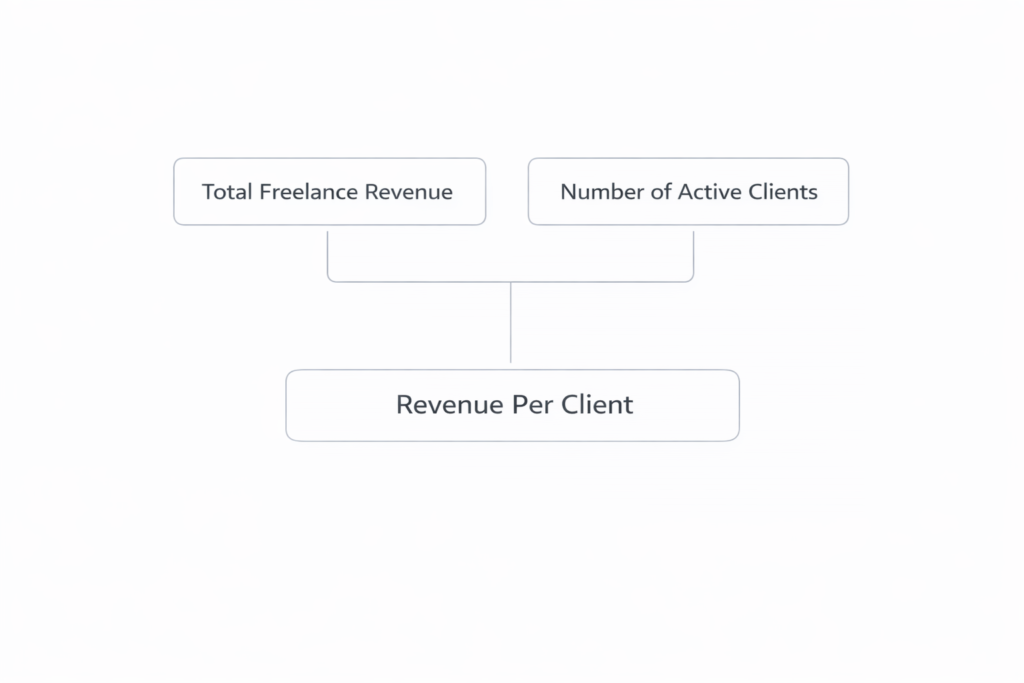
The revenue per client metric calculates the average revenue generated by each client within a given period.
The formula is simple:
Revenue per Client = Total Revenue ÷ Number of Active Clients
For example:
| Total Annual Revenue | Active Clients | Revenue per Client |
|---|---|---|
| €120,000 | 12 | €10,000 |
| €120,000 | 4 | €30,000 |
Although total revenue remains identical in both scenarios, the operational structure differs significantly.
Higher revenue per client often indicates:
- larger engagements
- deeper client relationships
- lower coordination overhead
Lower revenue per client may indicate:
- fragmented client portfolios
- smaller engagements
- higher administrative workload
Revenue per client helps freelancers evaluate the economic structure of their client base.
The Core Problem
Many freelancers focus on total income without evaluating how that revenue is distributed across clients.
For example:
- €100,000 annual revenue
- €8,000 monthly revenue
- €10,000 project engagements
While these figures indicate business activity, they do not reveal the underlying structure of the client portfolio.
Several operational issues emerge when portfolio structure remains invisible.
Excessive Client Fragmentation
Managing too many small clients increases coordination overhead and context switching.
Hidden Dependency
A small number of large clients may dominate revenue without clear visibility.
Inefficient Capacity Allocation
Time may be distributed across low-value engagements rather than concentrated on higher-value relationships.
Limited Strategic Planning
Without portfolio metrics, freelancers may struggle to design a sustainable client mix.
The revenue per client metric makes these patterns visible.
Revenue per Client Framework
The revenue per client metric can be interpreted through three dimensions.
1. Portfolio Concentration
Higher revenue per client often indicates that income comes from fewer, larger engagements.
This structure can increase efficiency but may introduce concentration risk.
→ Revenue Concentration Risk Explained
Balancing revenue size and diversification is important for portfolio stability.
2. Coordination Overhead
Client relationships require coordination effort.
This may include:
- meetings
- communication cycles
- reporting requirements
Freelancers managing many small clients often experience higher coordination overhead compared to those managing fewer large engagements.
Coordination effort directly affects effective hourly yield.
3. Capacity Allocation
Revenue per client also influences how delivery capacity is distributed.
Higher-value engagements may allow freelancers to concentrate delivery effort on fewer clients.
Lower revenue per client may require managing many simultaneous engagements.
Capacity planning frameworks are discussed in:
Portfolio structure interacts directly with workload sustainability.
Operational Impact
Tracking revenue per client improves several strategic decisions within a freelance consulting business.
Client Portfolio Design
Freelancers gain visibility into whether their revenue structure relies on many small clients or fewer strategic relationships.
Workload Management
Client portfolios with higher revenue per client often reduce coordination overhead.
Revenue Stability
Balanced portfolios reduce both fragmentation and concentration risk.
Strategic Positioning
Higher revenue per client may indicate stronger positioning within a specialized consulting niche.
Portfolio metrics support more deliberate client selection.
System-Level Impact Across Processome
The revenue per client metric influences several systems within the Processome architecture.
- Client Pipeline System → targeting opportunities that align with desired client value
- Capacity Planning System → workload allocation across the client portfolio
- Profit Tracking System → evaluation of revenue structure and portfolio efficiency
- Delivery & Operations System → coordination requirements across client relationships
Portfolio structure connects revenue generation with operational workload.
Common Failure Patterns
Freelancers sometimes misinterpret revenue per client metrics without considering broader context.
Several patterns frequently appear.
Pursuing Larger Clients Exclusively
Higher revenue per client can increase dependency risk if diversification declines.
Ignoring Profitability
Large clients may still produce weak margins if delivery effort expands.
Underestimating Coordination Overhead
Multiple small clients may consume significant non-billable time.
Evaluating Revenue Without Capacity Context
Portfolio structure must align with realistic delivery capacity.
These factors highlight the importance of combining portfolio metrics with profitability analysis.
Strategic Outcome
When freelancers monitor revenue per client, client portfolio design becomes more deliberate.
Instead of accumulating clients randomly, consultants evaluate how each relationship contributes to revenue structure and operational sustainability.
This produces several advantages.
- More balanced client portfolios → improved stability and efficiency
- Reduced coordination complexity → fewer, higher-value engagements
- Improved financial clarity → better visibility into revenue structure
Over time, freelancers develop client portfolios aligned with both financial goals and operational capacity.
Final Perspective
Total revenue reveals the scale of a freelance business.
Revenue per client reveals its structure.
Within the Processome operating model, the → Profit Tracking System provides the financial metrics required to analyze how client portfolios influence profitability and stability.
Freelancers who monitor portfolio structure gain greater control over both workload and financial outcomes.
Revenue size matters.
Revenue structure matters just as much.