Financial Forecasting for Freelancers (How to Predict Revenue and Profit)
Introduction
Financial forecasting for freelancers helps predict future revenue and profit based on pipeline activity, capacity, and cost structure.
Freelancers often operate in environments where revenue fluctuates from month to month. Projects begin and end, client demand changes, and pipeline activity varies over time.
Without structured forecasting, these fluctuations create uncertainty in financial planning.
Financial forecasting introduces a forward-looking perspective to freelance business management.
Within the Processome operating model, financial forecasting belongs to the → Profit Tracking System—the financial intelligence layer responsible for translating operational activity into future financial expectations.
Financial forecasting integrates revenue projections, cost structures, and profitability metrics to estimate future financial performance.
Revenue describes past activity.
Forecasting evaluates future outcomes.
What is Financial Forecasting for Freelancers?
Financial forecasting estimates the future financial performance of a freelance business by combining multiple operational indicators.
Typical forecasting inputs include:
- pipeline opportunities
- expected revenue from active projects
- recurring income from retainers
- operational cost structures
- delivery capacity constraints
These inputs allow freelancers to estimate both revenue and profit for upcoming periods.
Several frameworks within the Processome system contribute to financial forecasting:
→ Forecasting Profit from Pipeline Data
→ Break-Even Analysis for Freelancers
These frameworks provide the building blocks required for financial projections.
Financial forecasting integrates multiple financial signals into a forward-looking model.
The Core Problem
Many freelancers rely primarily on historical revenue to evaluate financial performance.
Typical questions include:
- How much did I earn last month?
- How much revenue did the previous project generate?
- How many invoices were issued this quarter?
While historical data is useful, it does not help freelancers anticipate future financial conditions.
Several operational challenges arise when forecasting is absent.
Revenue Uncertainty
Freelancers may not know whether upcoming months will produce sufficient income.
Limited Planning Horizon
Financial decisions may focus on immediate revenue rather than long-term sustainability.
Pipeline Misinterpretation
Sales pipeline activity may not be translated into realistic financial projections.
Reactive Decision-Making
Freelancers may respond to financial pressure only after revenue declines.
Financial forecasting addresses these challenges by projecting future financial conditions.
Freelance Financial Forecasting Framework
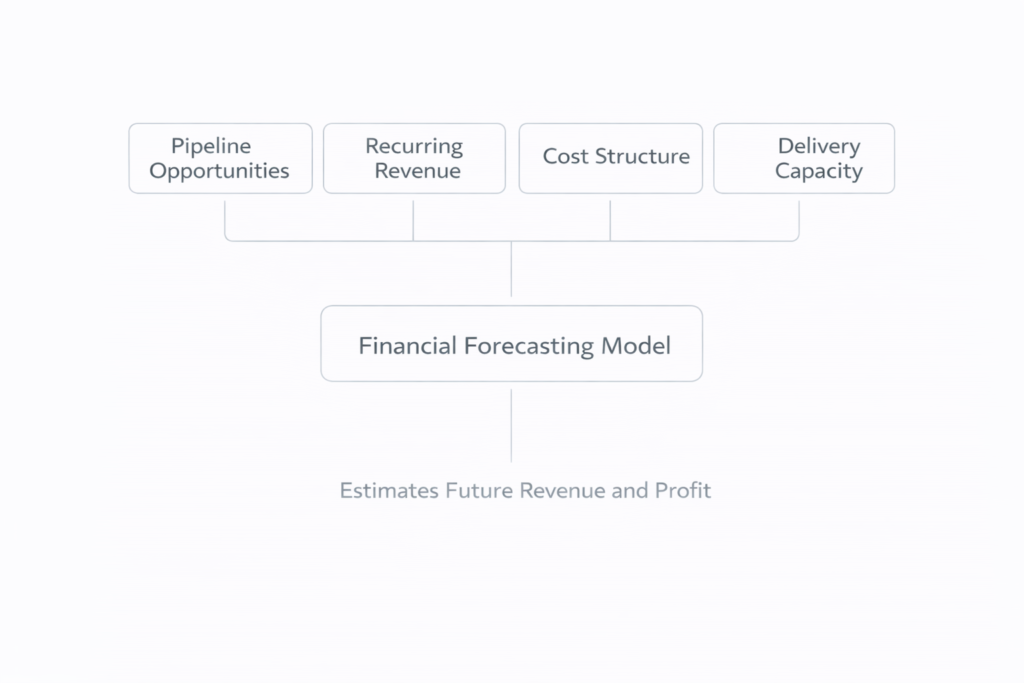
Financial forecasting typically integrates four analytical components.
1. Pipeline Revenue Forecast
Sales pipeline visibility provides the starting point for revenue projections.
Forecasting methods often rely on weighted probability models:
→ Weighted Revenue Forecasting for Freelancers
Pipeline forecasting estimates how much new revenue may be generated in upcoming periods.
2. Recurring Revenue
Recurring revenue from retainers or long-term engagements improves forecasting reliability.
These revenue streams often include:
- monthly consulting retainers
- ongoing advisory contracts
- subscription-style services
Recurring income reduces forecasting uncertainty.
3. Cost Structure Projection
Financial forecasts must incorporate the expected cost structure of the business.
Typical cost categories include:
- fixed operating expenses
- variable project costs
- subcontractor payments
- infrastructure expenses
Cost projections determine how much forecasted revenue converts into profit.
4. Capacity Constraints
Forecasts must account for delivery capacity.
Revenue projections that exceed realistic workload limits may not be achievable.
Financial forecasts must remain consistent with operational feasibility.
Operational Impact
Financial forecasting improves several operational decisions within a freelance consulting business.
Revenue Planning
Freelancers gain visibility into whether upcoming work will meet financial targets.
Pricing Strategy
Weak revenue forecasts may indicate the need for pricing adjustments.
Client Acquisition Strategy
Pipeline activity can be adjusted to address forecasted revenue gaps.
Investment Planning
Forecasting supports decisions about tools, training, or business investments.
Forecasting transforms financial planning from reactive management into proactive strategy.
System-Level Impact Across Processome
Financial forecasting integrates signals across multiple systems within the Processome architecture.
- Client Pipeline System → pipeline visibility provides revenue forecasting inputs
- Capacity Planning System → evaluation of whether forecasted workload fits within delivery limits
- Profit Tracking System → analysis of revenue, cost, and margin projections
- Delivery & Operations System → preparation for future project execution
Financial forecasting connects operational activity with long-term financial expectations.
Common Failure Patterns
Freelancers often weaken financial forecasts through unrealistic assumptions.
Several patterns frequently appear.
Overestimating Pipeline Conversions
Assuming that most opportunities will close can inflate revenue forecasts.
Ignoring Cost Structures
Revenue projections may overlook expenses required to deliver the work.
Forecasting Beyond Capacity
Revenue forecasts may exceed realistic delivery capacity.
Infrequent Forecast Updates
Forecasts lose relevance when underlying assumptions are not updated regularly.
Reliable forecasting requires conservative assumptions and consistent updates.
Strategic Outcome
When freelancers implement structured financial forecasting, financial management becomes significantly more proactive.
Instead of reacting to revenue fluctuations, consultants anticipate future financial conditions and adjust operational decisions accordingly.
This produces several advantages.
- Improved financial visibility → future revenue and profit become clearer
- Stronger financial planning → align pricing, pipeline, and capacity with targets
- Reduced financial volatility → detect revenue gaps before they occur
Over time, financial forecasting transforms freelance consulting into a more predictable and strategically managed business.
Final Perspective
Freelancers often evaluate financial performance through historical results.
However, sustainable consulting businesses require forward-looking financial insight.
Within the Processome operating model, the → Profit Tracking System provides the frameworks that translate operational activity into financial forecasts.
Financial forecasting allows freelancers to anticipate future conditions rather than react to past events.
Past revenue explains what happened.
Forecasting reveals what may happen next.