Pricing Models for Freelancers (Structuring Revenue, Risk and Profitability)
Introduction
Pricing models for freelancers determine how consulting work translates into revenue, risk, and profitability—not just what you charge.
Different pricing structures create different levels of predictability, workload intensity, and margin control.
Many freelancers treat pricing primarily as a negotiation topic. The focus is often on setting rates that clients will accept or aligning with market benchmarks.
Common questions include:
- What hourly rate should I charge?
- Is this price competitive?
- Will the client accept this proposal?
However, pricing decisions extend beyond individual rates.
Pricing defines the economic structure of a consulting engagement. It determines how revenue translates into workload, how predictable income becomes, and how profit margins behave over time.
Within the Processome operating model, pricing strategy belongs to the → Profit Tracking System—the financial intelligence layer responsible for understanding how revenue converts into sustainable profit.
Pricing is not only a number.
It is a structural decision that shapes the financial behavior of the business.
What are Pricing Models for Freelancers?
A pricing model defines how consulting work is converted into revenue.
Most freelance engagements fall into three dominant pricing structures:
- hourly pricing
- project-based pricing
- retainer-based pricing
Each model influences how revenue interacts with delivery effort and capacity allocation.
These models therefore produce different financial dynamics.
Understanding their operational characteristics helps freelancers design pricing structures that support long-term sustainability.
Pricing decisions connect directly to financial performance metrics such as:
→ Contribution Margin in Freelance Businesses
→ Effective Hourly Rate for Freelancers
These frameworks reveal how pricing models impact profitability.
The Core Problem
Many freelancers approach pricing with a rate-centric mindset.
The primary focus becomes:
- hourly rates
- daily rates
- project quotes
While these figures matter, they do not define how the engagement actually functions.
Two freelancers charging identical rates can experience very different financial outcomes depending on the pricing model governing the work.
Several structural differences emerge across pricing models.
Revenue Predictability
Some models generate stable recurring revenue, while others depend on continuous project acquisition.
Workload Intensity
Different pricing structures influence how delivery effort expands or contracts.
Margin Stability
Certain models produce predictable margins, while others create variable profitability.
Capacity Flexibility
Pricing structures determine whether capacity remains flexible or becomes structurally committed.
When freelancers focus only on rates, they overlook the economic architecture behind the engagement.
The pricing model matters as much as the price itself.
Freelance Pricing Model Framework
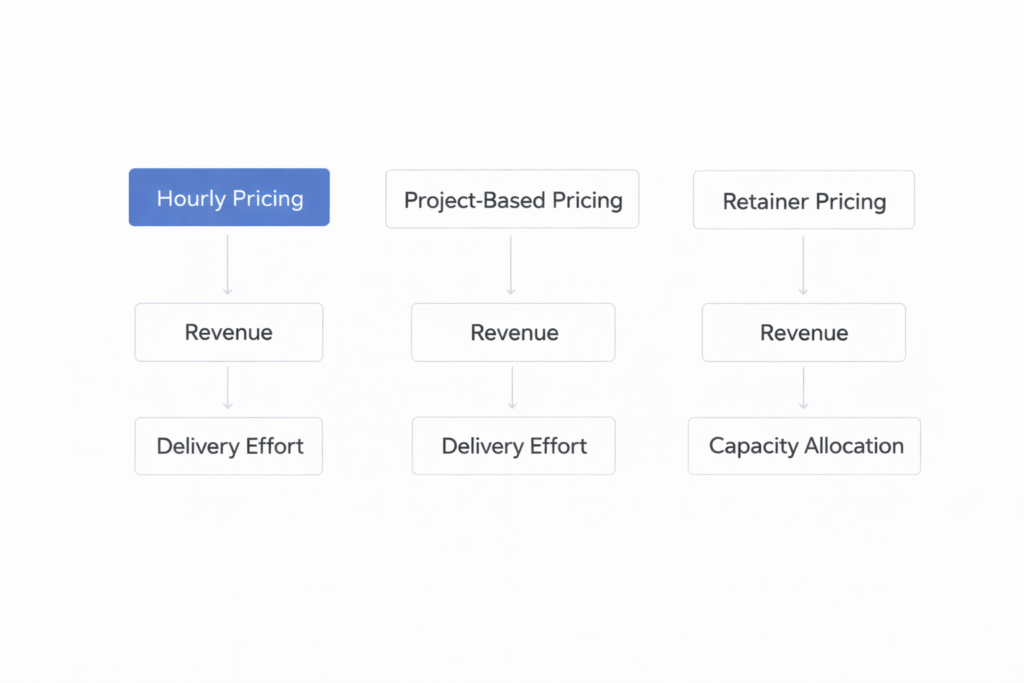
The three dominant pricing models differ in how they structure revenue and delivery commitments.
1. Hourly Pricing
Hourly pricing charges clients based on time spent delivering services.
Advantages
- simple calculation
- flexible scope adjustments
- transparent billing structure
Limitations
- income tied directly to time
- efficiency reduces billable hours
- revenue ceiling linked to available capacity
Hourly pricing is operationally simple but economically constrained.
2. Project-Based Pricing
Project pricing defines a fixed price for delivering a specific outcome.
Advantages
- potential for higher margins
- efficiency increases profitability
- clearer revenue predictability
Limitations
- inaccurate scoping can reduce margins
- revision cycles increase workload
- delivery risk shifts toward the freelancer
Project pricing introduces leverage but requires strong scope control.
To evaluate whether project pricing is actually profitable, you can use:
→ Client Profitability Calculator
This helps translate fixed pricing into real financial outcomes based on delivery effort.
3. Retainer-Based Pricing
Retainers involve recurring payments for ongoing services or access to consulting support.
Advantages
- predictable recurring revenue
- reduced sales pressure
- stronger long-term client relationships
Limitations
- recurring coordination overhead
- structural capacity commitments
- reduced scheduling flexibility
Retainers stabilize revenue but require careful capacity planning.
→ Retainer Capacity Planning Model
Operational Impact
Pricing models influence several operational dimensions of a freelance consulting business.
Revenue Predictability
Retainers create consistent income streams, while project-based pricing produces episodic revenue patterns.
Margin Quality
Project pricing may generate higher margins when delivery efficiency improves.
Capacity Allocation
Different models consume delivery capacity in different ways.
Client Behavior
Pricing structures influence how clients request work, manage scope, and interact with the freelancer.
To maintain visibility into how pricing decisions affect financial performance over time, structured Profit Tracking Tools for Freelancers can support ongoing analysis.
System-Level Impact Across Processome
Pricing models influence several systems within the Processome architecture.
- Client Pipeline System → qualification of opportunities aligned with pricing strategy
- Capacity Planning System → alignment of pricing structures with delivery workload
- Profit Tracking System → evaluation of margin performance across pricing models
- Delivery & Operations System → structuring engagements around defined deliverables
Pricing connects revenue generation with execution feasibility.
Common Failure Patterns
Freelancers often weaken profitability by applying pricing models without considering their structural implications.
Several patterns appear frequently.
Defaulting to Hourly Pricing
Hourly pricing becomes the default even when alternative models may produce stronger margins.
Underestimating Project Complexity
Projects may be priced too aggressively, reducing margins during delivery.
Accepting Retainers Without Capacity Modeling
Recurring work is accepted without evaluating long-term capacity impact.
Discounting Under Pipeline Pressure
Prices are reduced during periods of low pipeline activity.
These behaviors gradually erode financial performance.
Strategic Outcome
When freelancers design pricing models deliberately, the financial structure of the consulting business becomes significantly stronger.
Instead of reacting to individual negotiations, consultants build engagements aligned with both delivery capacity and profitability goals.
This produces several advantages.
- Improved revenue predictability → recurring engagements stabilize income
- Stronger margins → efficient delivery structures increase profitability
- Better workload control → pricing aligns with available capacity
Over time, pricing evolves from a negotiation tactic into a strategic design decision.
Final Perspective
Freelancers often believe success depends on charging higher rates.
In practice, financial sustainability depends on choosing the right pricing structure.
Within the Processome operating model, the → Profit Tracking System evaluates how pricing decisions influence revenue, margin stability, and long-term profitability.
Freelancers who understand pricing models design more resilient consulting businesses.
Pricing is not just a number.
Pricing is architecture.