Pricing Sensitivity Analysis for Freelancers (How Price Changes Affect Profit)
Introduction
Pricing sensitivity analysis for freelancers shows how changes in price affect revenue, workload, and profitability.
Pricing decisions directly influence the profitability of freelance consulting work. Even small price adjustments can significantly impact margins, workload requirements, and financial sustainability.
However, many freelancers change prices without understanding how those adjustments affect their overall financial performance.
Pricing sensitivity analysis introduces structure to these decisions.
Within the Processome operating model, pricing evaluation belongs to the → Profit Tracking System—the financial intelligence layer responsible for understanding how pricing decisions influence revenue and profitability.
Pricing sensitivity analysis examines how price changes affect outcomes such as revenue targets, contribution margins, and capacity requirements.
Pricing is not only about setting a number.
It is about understanding how that number shapes the economics of the business.
What is Pricing Sensitivity Analysis?
Pricing sensitivity analysis evaluates how different pricing levels influence financial outcomes.
Instead of assuming a single “correct” price, freelancers model multiple pricing scenarios and compare their impact.
For example:
| Price per Project | Projects Needed for €100k Revenue |
|---|---|
| €5,000 | 20 projects |
| €7,500 | 14 projects |
| €10,000 | 10 projects |
This analysis reveals how pricing affects:
- workload requirements
- client volume
- contribution margin
- capacity utilization
Pricing sensitivity connects pricing decisions with operational constraints.
It builds on financial frameworks such as:
→ Contribution Margin in Freelance Businesses
→ Break-Even Analysis for Freelancers
The Core Problem
Freelancers often adjust pricing reactively.
Typical triggers include:
- losing deals during negotiations
- increasing demand for services
- comparing rates with competitors
These adjustments are usually made without evaluating how price changes affect financial performance.
Several risks emerge when pricing changes are not analyzed.
Underpricing
Prices may be lowered without understanding the margin impact.
Revenue Dependence on Workload
Lower prices require more work to reach income targets.
Misinterpreting Demand Signals
High demand does not automatically lead to higher profitability.
Capacity Pressure
Lower pricing often increases client volume and coordination overhead.
Pricing sensitivity analysis reveals how these dynamics interact.
Pricing Sensitivity Framework
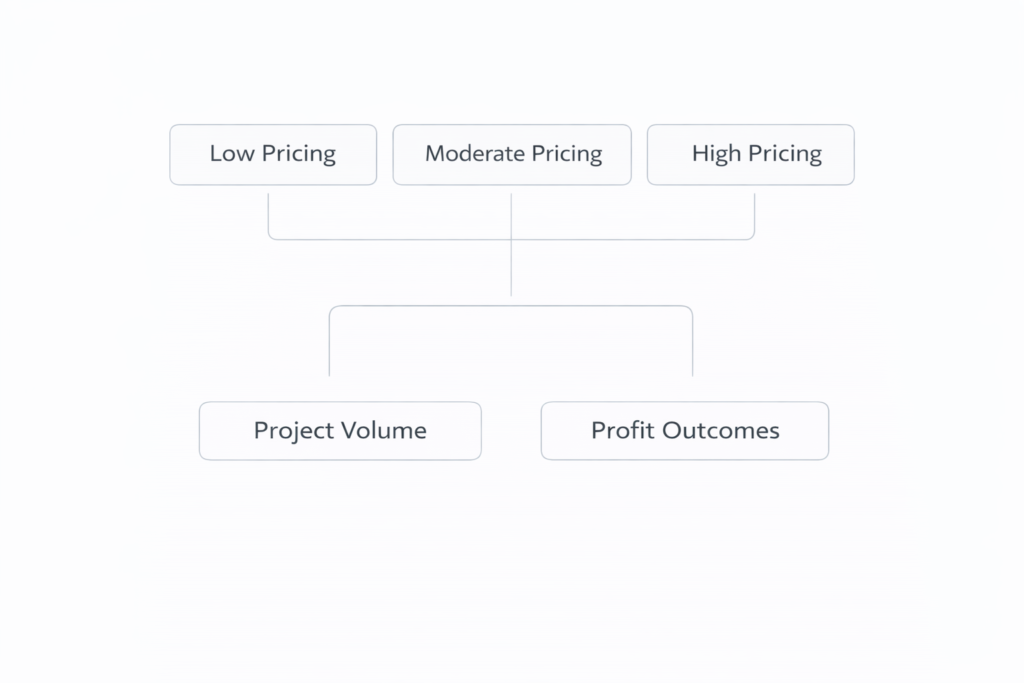
Pricing sensitivity analysis typically evaluates three dimensions.
1. Revenue Impact
Higher prices reduce the number of engagements required to achieve revenue targets.
Lower prices increase required client volume.
This relationship helps freelancers evaluate how pricing affects workload.
→ Break-Even Analysis for Freelancers
2. Margin Impact
Pricing changes directly affect contribution margins.
- Higher prices → higher margin potential
- Lower prices → reduced profitability
→ Contribution Margin in Freelance Businesses
Margins determine whether pricing produces sustainable profit.
3. Capacity Impact
Pricing decisions influence how much work is required.
Lower prices typically require:
- more projects
- more clients
- more coordination
Higher prices reduce delivery pressure but may affect conversion rates.
Pricing must align with realistic delivery capacity.
Operational Impact
Pricing sensitivity analysis improves several strategic decisions.
Pricing Strategy
Freelancers can evaluate how different price levels affect profitability.
Workload Planning
Pricing determines how many projects are required to reach income targets.
Client Portfolio Design
Higher pricing often enables working with fewer, higher-value clients.
Financial Forecasting
Scenario modeling improves revenue and profit projections.
If you want to test how your pricing impacts profitability and workload, you can use:
→ Client Profitability Calculator
This helps translate pricing scenarios into real financial outcomes.
System-Level Impact Across Processome
Pricing sensitivity analysis influences multiple systems within the Processome architecture.
- Client Pipeline System → required deal volume at different price levels
- Capacity Planning System → workload implications of pricing decisions
- Profit Tracking System → margin analysis across pricing scenarios
- Delivery & Operations System → execution impact of client volume
Pricing analysis connects financial strategy with operational feasibility.
Common Failure Patterns
Freelancers often weaken pricing decisions by ignoring economic analysis.
Several patterns frequently appear.
Discounting Without Analysis
Prices are reduced without understanding margin impact.
Ignoring Capacity Constraints
Pricing assumes unrealistic workload levels.
Copying Competitor Pricing
Market benchmarks are used without evaluating cost structure.
Static Pricing
Prices remain unchanged despite increased demand or expertise.
Pricing sensitivity analysis helps prevent these mistakes.
Strategic Outcome
When freelancers apply pricing sensitivity analysis, pricing decisions become significantly more strategic.
Instead of guessing optimal pricing levels, consultants evaluate how pricing affects workload, profitability, and sustainability.
This produces several advantages.
- Stronger pricing discipline → prices align with financial goals
- Improved profitability → identify optimal pricing levels
- Better workload control → align client volume with capacity
Over time, pricing evolves from reactive negotiation into structured financial strategy.
Final Perspective
Freelancers often treat pricing as a fixed number.
In reality, pricing is a dynamic variable that influences revenue, workload, and profit simultaneously.
Within the Processome operating model, the → Profit Tracking System provides the frameworks required to evaluate pricing decisions systematically.
Pricing sensitivity analysis transforms pricing from guesswork into economic design.
Small price changes can produce large financial consequences.
Understanding this relationship strengthens financial strategy.