Consultant Revenue Benchmarks (What Freelancers Typically Earn)
Introduction
Consultant revenue benchmarks help freelancers understand how their income compares to typical consulting businesses.
Freelancers often evaluate financial performance in isolation. Revenue is observed month by month, but it is often unclear how those numbers compare to broader consulting norms.
Benchmarking provides context.
Revenue benchmarks allow freelancers to evaluate whether their income aligns with typical patterns across solo consulting businesses. They help assess growth potential, pricing strategy, and business maturity.
Within the Processome operating model, benchmarking belongs to the → Profit Tracking System—the financial intelligence layer responsible for interpreting financial metrics and identifying performance patterns.
Revenue benchmarks do not determine success.
They provide context for evaluating performance.
What are Consultant Revenue Benchmarks?
Consultant revenue benchmarks represent typical income ranges observed across freelance and solo consulting businesses.
These benchmarks vary depending on several structural factors:
- specialization and expertise
- pricing model
- delivery capacity
- client portfolio structure
For example, revenue levels differ significantly between:
- general freelance services
- specialized technical consulting
- strategic advisory roles
Revenue benchmarks therefore provide directional context—not fixed targets.
Financial performance should always be evaluated alongside profitability metrics such as:
→ Revenue Growth vs Profit Growth
→ Gross Margin for Freelancers
Revenue scale alone does not determine financial health.
The Core Problem
Many freelancers evaluate revenue without external reference points.
Typical questions include:
- Is my revenue level sustainable?
- Am I underpricing my services?
- How does my income compare to other consultants?
Without benchmarks, it becomes difficult to interpret financial progress objectively.
Several problems may arise.
Misinterpreting Revenue Levels
Revenue may appear strong or weak without understanding industry norms.
Inaccurate Pricing Decisions
Pricing strategies may rely on incomplete market assumptions.
Unrealistic Growth Targets
Revenue goals may ignore capacity or market constraints.
Weak Financial Planning
Financial expectations may not reflect realistic consulting models.
Revenue benchmarks provide necessary perspective.
Consultant Revenue Benchmark Framework
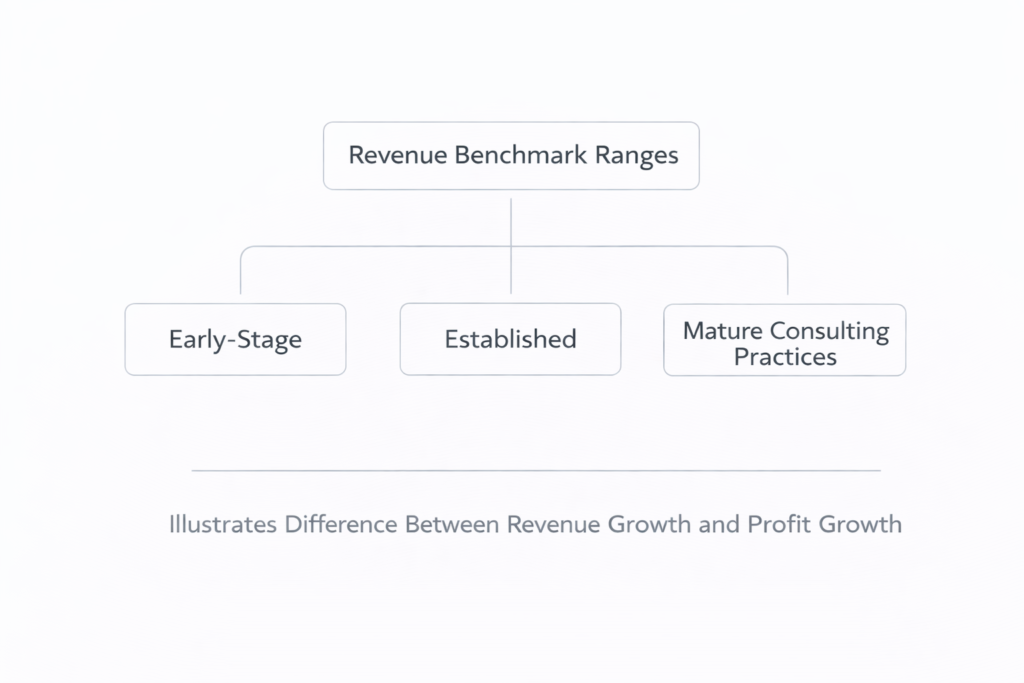
Revenue benchmarks can be interpreted across different stages of business maturity.
1. Early-Stage Consulting Revenue
Early-stage freelancers typically operate with smaller client portfolios and evolving pricing structures.
Characteristics:
- project-based work
- developing specialization
- inconsistent pipeline
Revenue often fluctuates significantly at this stage.
2. Established Consulting Revenue
Established freelancers develop more stable and structured revenue patterns.
Characteristics:
- clearer specialization
- improved pricing discipline
- recurring client relationships
Revenue becomes more predictable and structured.
3. Mature Consulting Revenue
Mature consulting businesses typically achieve higher revenue levels due to:
- strong market positioning
- higher-value engagements
- refined pricing strategies
At this stage, focus often shifts toward profitability rather than pure revenue growth.
→ Contribution Margin in Freelance Businesses
Operational Impact
Revenue benchmarking improves several strategic decisions.
Pricing Strategy
Benchmarks provide context for evaluating pricing levels.
Growth Planning
Revenue targets can be aligned with realistic market patterns.
Positioning Strategy
Higher revenue levels often correlate with stronger specialization.
Financial Perspective
Benchmarks help interpret performance more objectively.
Benchmarking supports more informed decision-making.
System-Level Impact Across Processome
Revenue benchmarks influence multiple systems.
- Client Pipeline System → targeting opportunities aligned with desired revenue levels
- Capacity Planning System → evaluating workload required to reach revenue targets
- Profit Tracking System → interpreting revenue relative to profitability
- Delivery & Operations System → scaling execution to support larger engagements
Benchmark analysis connects financial performance with operational feasibility.
Common Failure Patterns
Freelancers often misuse benchmarks.
Comparing Without Context
Revenue varies significantly by niche and positioning.
Ignoring Profitability
Higher revenue does not guarantee stronger financial performance.
Overextending Capacity
Chasing benchmarks may lead to unsustainable workload.
Benchmark Obsession
Excessive comparison can distract from building a sustainable model.
Benchmarks should inform—not dictate—decisions.
Strategic Outcome
When freelancers use revenue benchmarks correctly, they gain valuable context for evaluating their business.
Instead of interpreting revenue in isolation, consultants can position themselves more strategically.
This produces several advantages.
- Improved financial perspective → clearer understanding of performance
- More realistic growth planning → targets aligned with market dynamics
- Better pricing evaluation → insights into positioning opportunities
Over time, benchmarks support more structured financial strategy.
Final Perspective
Revenue benchmarks provide useful context for evaluating freelance consulting performance.
However, they should not replace financial analysis.
Within the Processome operating model, the → Profit Tracking System combines benchmarking with profitability frameworks to evaluate business performance more accurately.
Freelancers who understand both scale and profitability gain a clearer view of their financial trajectory.
Revenue size matters.
Profitability determines sustainability.