Freelance Business Unit Economics (How to Measure Client Profitability)
Introduction
Freelance business unit economics explains how individual client engagements generate profit—not just how much revenue the business produces.
Freelancers often evaluate financial performance through total revenue or monthly income. While these figures indicate the scale of business activity, they do not reveal how efficiently individual engagements contribute to profitability.
Unit economics introduces a more granular financial perspective.
Within the Processome operating model, unit economics belongs to the → Profit Tracking System—the financial intelligence layer responsible for analyzing how individual revenue units contribute to overall business performance.
In a freelance consulting context, the primary economic unit is typically a client engagement, such as a project, retainer, or advisory contract.
Freelance business unit economics evaluates how each engagement contributes to revenue, cost structure, and profit generation.
Revenue describes the size of the business.
Unit economics explains how that revenue is created.
What is Freelance Business Unit Economics?
Unit economics evaluates the financial performance of a single revenue unit within the freelance business.
In consulting, typical economic units include:
individual projects
monthly retainers
advisory engagements
For each unit, the following variables are analyzed:
revenue generated
delivery effort required
direct costs incurred
resulting contribution margin
This analysis connects directly to frameworks such as:
→ Contribution Margin in Freelance Businesses
→ Client Profitability Analysis for Freelancers
Unit economics allows freelancers to understand which engagements generate the most financial value.
Rather than evaluating revenue globally, freelancers analyze the economic performance of each individual engagement.
The Core Problem
Many freelancers evaluate business performance only at the aggregate level.
Typical metrics include:
total monthly revenue
annual income
number of clients
While these metrics show overall business activity, they do not reveal whether individual engagements contribute positively to profitability.
Several structural problems can emerge when engagement-level economics remain invisible.
Hidden Low-Profit Work
Certain clients or projects may consume disproportionate delivery effort.
Uneven Margin Distribution
Some engagements may generate strong margins while others produce weak financial returns.
Pricing Misalignment
Prices may not reflect the true delivery cost of individual engagements.
Inefficient Portfolio Design
Freelancers may accumulate clients without evaluating their economic contribution.
Unit economics analysis reveals these patterns.
Freelance Unit Economics Framework
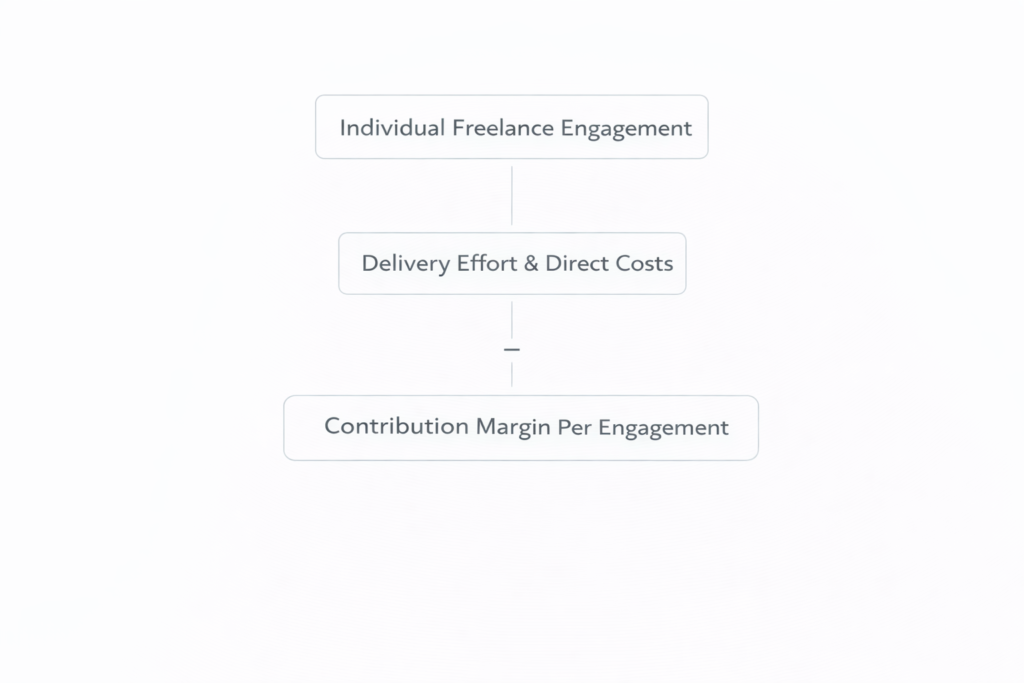
A unit economics framework evaluates several key variables.
1. Revenue per Engagement
The first component measures the revenue generated by each client engagement.
Examples include:
- project fees
- monthly retainers
- advisory session revenue
Revenue establishes the economic size of the engagement—but not its profitability.
2. Delivery Effort
Delivery effort measures the amount of work required to complete the engagement.
Typical components include:
- project execution hours
- coordination time
- revision cycles
- research and preparation
Delivery effort directly influences effective hourly yield.
→ Effective Hourly Rate Calculation Framework
Understanding delivery effort is critical for evaluating engagement profitability.
3. Direct Costs
Some engagements may involve additional direct costs.
Examples include:
- subcontractor payments
- specialized tools or software
- production expenses
These costs reduce the contribution margin of the engagement.
→ Gross Margin for Freelancers
Direct cost visibility improves financial evaluation.
4. Contribution Margin per Engagement
Once revenue and costs are known, contribution margin reveals the financial value created by the engagement.
Higher margins indicate:
- efficient delivery
- strong pricing discipline
- healthy project structure
Lower margins may signal operational inefficiencies or pricing misalignment.
If you want to evaluate this at the engagement level, a Client Profitability Calculator helps translate delivery effort and costs into clear margin visibility.
Operational Impact
Client Portfolio Management
Freelancers can identify which engagements generate the strongest financial return.
Pricing Strategy
Engagement-level profitability provides insight into optimal pricing levels.
Capacity Allocation
Higher-margin engagements can be prioritized within limited delivery capacity.
Financial Forecasting
Unit-level performance improves the accuracy of financial projections.
If you are managing multiple engagements, structured Profit Tracking Tools for Freelancers help maintain consistent visibility into profitability across your portfolio.
System-Level Impact Across Processome
Unit economics analysis influences multiple systems within the Processome architecture.
- Client Pipeline System → targeting opportunities aligned with profitable engagement structures
- Capacity Planning System → allocation of delivery effort toward higher-value engagements
- Profit Tracking System → measurement of financial performance at the engagement level
- Delivery & Operations System → process improvements that increase engagement efficiency
Engagement-level economics influence the design of the entire consulting system.
Common Failure Patterns
Ignoring Delivery Effort
Revenue may appear strong while hidden delivery effort reduces profitability.
Treating All Clients Equally
Different engagements may generate very different margins.
Focusing Only on Revenue Growth
Increasing revenue without analyzing engagement economics can reduce profitability.
Weak Time Tracking
Without delivery effort data, unit economics analysis becomes unreliable.
Financial discipline requires visibility into both revenue and effort.
Strategic Outcome
When freelancers analyze business unit economics, financial decision-making becomes significantly more precise.
This produces several advantages.
- Improved pricing discipline → prices reflect actual delivery economics
- Stronger client portfolio design → focus on high-value engagements
- More efficient capacity allocation → prioritize profitable work
Over time, freelancers build consulting businesses designed around financially efficient engagements.
Final Perspective
Freelance businesses often measure success through total revenue.
However, financial performance ultimately depends on how individual engagements generate profit.
Within the Processome operating model, the → Profit Tracking System provides the frameworks required to evaluate these economic dynamics.
Unit economics reveals how revenue is actually created.
Revenue measures scale.
Unit economics explains performance.