Break-Even Analysis for Freelancers (How Much Revenue You Actually Need)
Introduction
Break-even analysis for freelancers shows how much revenue you need to cover costs before you start making profit.
Many solo B2B freelancers set income targets such as:
- “I want to earn €8,000 per month.”
- “I want to reach €100,000 per year.”
However, these targets are often disconnected from the underlying economics of the business.
Without understanding cost structure, delivery capacity, and margins, revenue goals become arbitrary rather than financially grounded.
Within the Processome operating model, financial planning belongs to the → Profit Tracking System—the financial intelligence layer responsible for translating revenue activity into sustainable profit.
Break-even analysis identifies the minimum revenue required to sustain your business.
Break-even defines survival.
Profit defines progress.
What is Break-Even Analysis?
Break-even analysis determines the revenue level at which total income exactly covers total costs.
At this point:
Total Revenue = Total Costs
When a freelance business operates at break-even:
- all costs are covered
- no profit is generated
- the business sustains itself
Profit begins only after revenue exceeds the break-even threshold.
Break-even analysis helps freelancers determine:
- the minimum monthly revenue required
- whether pricing is sufficient
- how workload relates to financial sustainability
This creates a financial baseline for decision-making.
The Core Problem
Freelancers often focus primarily on revenue.
Invoices, project values, and monthly income are the most visible metrics.
However, this perspective ignores the structural costs required to operate the business.
Typical costs include:
- software subscriptions
- insurance
- accounting services
- payment processing fees
- professional tools
- workspace expenses
- taxes and savings
These expenses exist even when no client work is delivered.
When costs are ignored, revenue targets may fail to sustain the business.
Break-even analysis introduces visibility into the relationship between revenue and cost structure.
Break-Even Analysis Framework
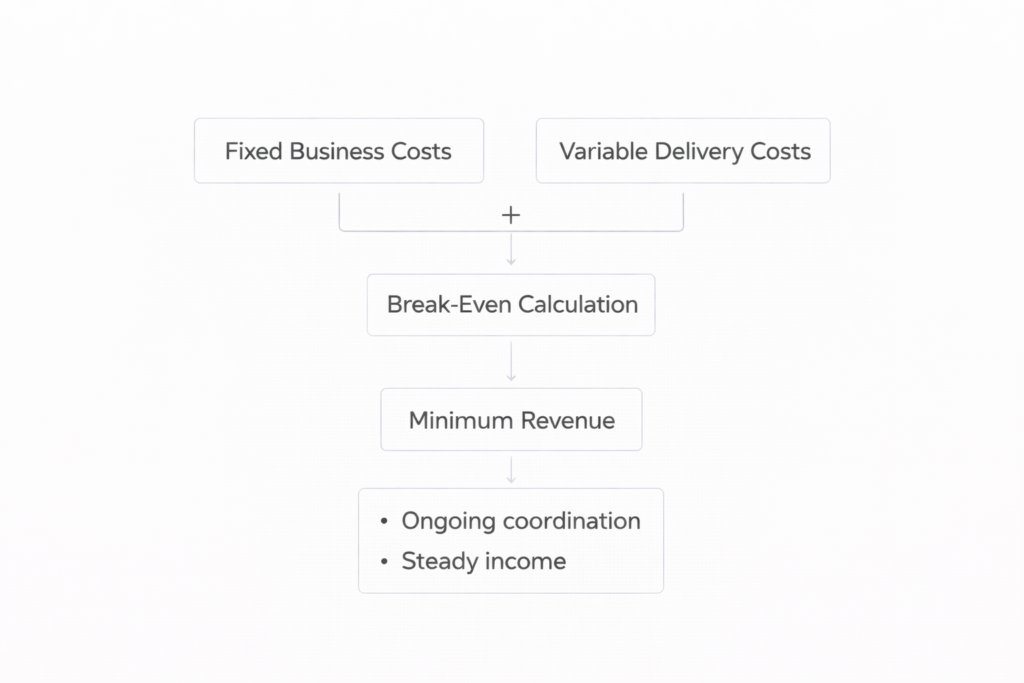
Break-even analysis requires understanding three core components.
1. Fixed Costs
Fixed costs remain relatively stable regardless of workload.
Examples include:
- software subscriptions
- insurance
- accounting services
- workspace expenses
These costs define the baseline financial requirement of the business.
2. Variable Costs
Variable costs increase as client work increases.
Examples include:
- subcontractor payments
- specialized tools or services
- production costs
- external resources
These costs reduce how much revenue contributes to profit.
3. Contribution Margin
Contribution margin represents the portion of revenue remaining after delivery costs.
→ Contribution Margin in Freelance Businesses
Break-even revenue can be estimated using:
Break-Even Revenue = Fixed Costs ÷ Contribution Margin Ratio
- Higher margins → lower break-even point
- Lower margins → higher revenue required
To calculate your break-even point more precisely, you can use:
→ Client Profitability Calculator
This helps translate your costs, pricing, and delivery effort into a realistic revenue target.
Operational Impact
Break-even analysis improves several strategic decisions.
Revenue Target Setting
Freelancers gain clarity on the minimum revenue required each month.
Pricing Strategy
Pricing can be evaluated relative to required income levels.
Cost Management
Understanding cost structure reveals opportunities to reduce expenses.
Financial Stability
Break-even provides a baseline for evaluating financial risk.
Revenue planning becomes grounded in economic reality.
System-Level Impact Across Processome
Break-even analysis connects financial planning with multiple systems.
- Client Pipeline System → required revenue targets
- Capacity Planning System → whether workload supports break-even
- Profit Tracking System → cost structure and margin visibility
- Delivery & Operations System → efficiency that protects margins
Break-even clarity improves coordination between revenue, workload, and sustainability.
Common Failure Patterns
Freelancers often miscalculate break-even thresholds due to incomplete assumptions.
Ignoring Non-Billable Time
Revenue projections assume unrealistic billable hours.
Underestimating Recurring Costs
Small expenses accumulate into significant cost structures.
Excluding Taxes and Savings
Financial obligations are often omitted from calculations.
Assuming Unrealistic Utilization
Break-even models assume workload levels that are not sustainable.
Conservative assumptions improve accuracy.
Strategic Outcome
When break-even analysis is implemented correctly, financial decision-making becomes more structured.
Freelancers gain clarity about the economic requirements of their business.
This produces several advantages.
- Realistic revenue targets → grounded in actual costs
- Improved pricing discipline → projects must cover costs
- Reduced financial stress → clear baseline for sustainability
Over time, break-even clarity strengthens financial resilience.
Final Perspective
Revenue targets can feel motivating.
But without understanding break-even economics, they may have little connection to sustainability.
Within the Processome operating model, the → Profit Tracking System provides the financial intelligence required to evaluate whether revenue supports long-term viability.
Freelancers who understand break-even thresholds build consulting businesses on economic reality.
Break-even defines the foundation.
Profit builds on top of it.