Revenue vs Profit Growth for Freelancers (Why More Revenue Doesn’t Mean More Profit)
Introduction
Revenue vs profit growth for freelancers explains why increasing income does not always lead to better financial performance.
Freelancers often evaluate business progress through revenue growth. Higher monthly income, larger projects, and increasing client demand appear to signal success.
However, revenue growth does not automatically translate into improved financial outcomes.
A freelance business can generate more revenue while profitability declines due to increased delivery effort, operational inefficiencies, or pricing misalignment.
Within the Processome operating model, financial performance analysis belongs to the → Profit Tracking System—the financial intelligence layer responsible for understanding how revenue converts into profit.
Comparing revenue growth and profit growth helps freelancers distinguish between business expansion and true financial improvement.
Revenue growth reflects scale.
Profit growth reflects efficiency.
What is Revenue vs Profit Growth?
Revenue growth measures how total income increases over time.
Profit growth measures how much of that revenue converts into retained financial value.
The difference between these metrics reveals whether a freelance business is becoming more efficient—or simply larger.
For example:
| Year | Revenue | Profit | Profit Margin |
|---|---|---|---|
| Year 1 | €80,000 | €40,000 | 50% |
| Year 2 | €120,000 | €42,000 | 35% |
Revenue increased significantly, but profit grew only slightly while margins declined.
This typically occurs when:
- delivery effort increases faster than revenue
- pricing does not reflect workload expansion
- operational inefficiencies increase
Profit analysis relies on frameworks such as:
→ Contribution Margin in Freelance Businesses
→ Gross Margin for Freelancers
These metrics reveal how efficiently revenue converts into profit.
The Core Problem
Many freelancers focus primarily on increasing revenue.
Common goals include:
- reaching higher monthly income targets
- securing larger projects
- expanding the client portfolio
While these goals increase business activity, they do not guarantee improved financial performance.
Several structural issues can cause revenue growth to outpace profit growth.
Increasing Delivery Effort
Higher revenue may require significantly more work hours.
Declining Margins
Projects may generate lower contribution margins due to underpricing or scope expansion.
Operational Complexity
Managing more clients increases coordination overhead.
Capacity Pressure
Higher revenue can push workload beyond sustainable limits.
Revenue growth alone does not indicate financial improvement.
Revenue vs Profit Growth Framework
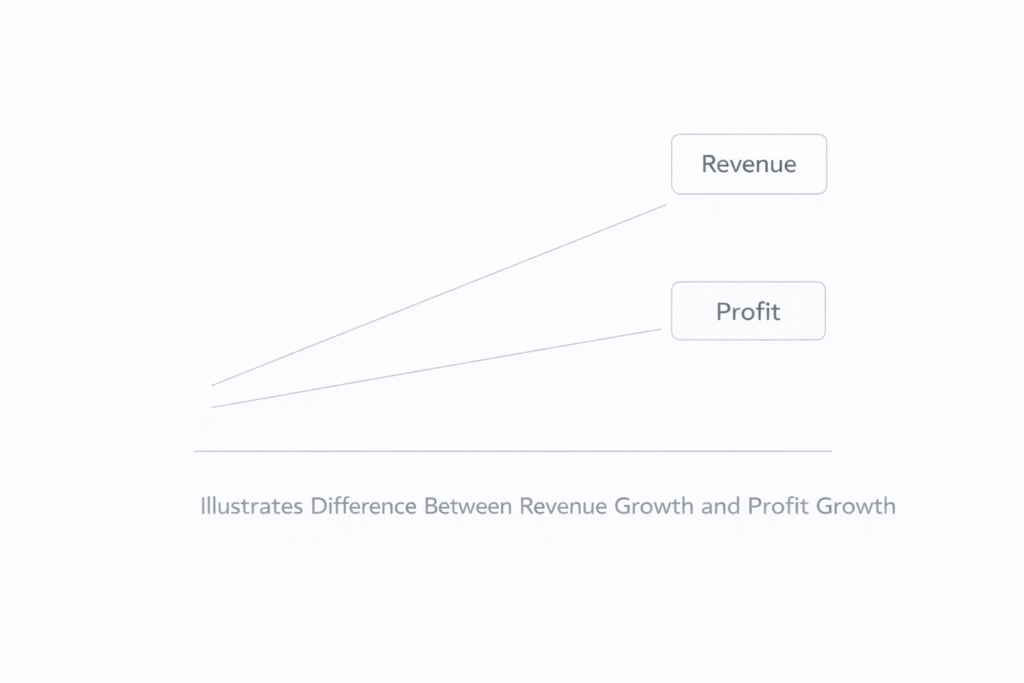
Evaluating revenue and profit growth requires analyzing multiple dimensions.
1. Revenue Expansion
Revenue growth comes from:
- larger projects
- more clients
- higher pricing
This reflects increased business activity—but not efficiency.
2. Margin Performance
Profit growth depends on how well margins are maintained or improved.
If margins decline as revenue increases, profitability may stagnate.
→ Contribution Margin in Freelance Businesses
Strong margin discipline ensures revenue translates into profit.
3. Capacity Utilization
Revenue growth often requires increased delivery effort.
This can lead to:
- higher workload intensity
- reduced flexibility
- increased burnout risk
Revenue must align with sustainable capacity.
4. Operational Efficiency
Profit growth depends on improving how work is delivered—not just how much work is sold.
Efficiency improvements include:
- better workflows
- tighter scope control
- improved onboarding processes
→ Delivery & Operations System
Efficiency determines whether revenue growth creates value.
Operational Impact
Understanding the difference between revenue growth and profit growth improves key decisions.
Pricing Strategy
Higher prices can increase profit without increasing workload.
Client Portfolio Management
Freelancers can prioritize high-margin engagements.
Workload Sustainability
Revenue targets align with realistic capacity.
Financial Planning
Forecasts become more accurate when margin trends are included.
Profit awareness improves decision-making across the business.
System-Level Impact Across Processome
Revenue and profit growth analysis connects multiple systems.
- Client Pipeline System → targeting profitable opportunities
- Capacity Planning System → evaluating workload impact of growth
- Profit Tracking System → monitoring margins and efficiency
- Delivery & Operations System → improving execution efficiency
Growth strategies require coordination across all systems.
Common Failure Patterns
Freelancers often pursue revenue growth without evaluating financial impact.
Chasing Revenue Targets
Increasing revenue without considering workload requirements.
Accepting Low-Margin Work
Large projects may appear attractive despite weak profitability.
Ignoring Delivery Costs
Additional effort reduces margins.
Overloading Capacity
Revenue growth pushes workload beyond sustainable levels.
These patterns lead to higher revenue without meaningful profit growth.
Strategic Outcome
When freelancers evaluate both revenue and profit growth, business development becomes more balanced.
Instead of pursuing revenue blindly, consultants optimize for efficiency and sustainability.
This produces several advantages.
- Stronger financial performance → profit grows alongside revenue
- Improved workload sustainability → capacity remains manageable
- Better strategic decisions → focus on high-value engagements
Over time, growth becomes more sustainable and controlled.
Final Perspective
Revenue growth is often treated as the primary indicator of success.
However, sustainable freelance businesses require both revenue expansion and profit growth.
Within the Processome operating model, the → Profit Tracking System provides the frameworks required to evaluate these dynamics.
Freelancers who monitor both metrics gain a clearer understanding of business performance.
Revenue growth expands activity.
Profit growth creates value.