Contribution Margin for Freelancers (How to Measure Project Profitability)
Introduction
Contribution margin for freelancers is one of the most important metrics for understanding real project profitability.
Many freelancers evaluate financial performance using revenue or total income. While these metrics indicate business activity, they do not reveal how efficiently that revenue converts into profit.
Consulting work involves multiple layers of effort: delivery time, coordination, revisions, and operational overhead. Without separating these components, it becomes difficult to determine which projects generate sustainable financial returns.
Within the Processome operating model, financial analysis belongs to the → Profit Tracking System—the financial intelligence layer responsible for evaluating how revenue translates into profitability.
Contribution margin measures how much revenue remains after the direct cost of delivering client work.
If you want to evaluate this per project, a Client Profitability Calculator helps translate delivery time into actual financial performance.
Revenue measures activity.
Contribution margin measures financial efficiency.
What is Contribution Margin for Freelancers?
Contribution margin measures how much revenue remains after subtracting the direct cost of delivering client work.
The formula can be expressed as:
Contribution Margin = Revenue – Direct Delivery Cost
In freelance consulting, the primary direct cost is delivery time.
This time can be translated into financial cost using your effective hourly rate.
For example:
| Project | Revenue | Delivery Hours | Delivery Cost | Contribution Margin |
|---|---|---|---|---|
| Project A | €6,000 | 50h | €3,000 | €3,000 |
| Project B | €6,000 | 80h | €4,800 | €1,200 |
Although both projects generate identical revenue, Project A produces significantly higher contribution margin.
This metric reveals the financial efficiency of consulting work.
Contribution margin connects closely with:
→ Effective Hourly Rate Calculation Framework
Understanding your effective hourly yield is the foundation for accurate margin analysis.
The Core Problem
Many freelancers evaluate projects solely through revenue.
For example:
- a €5,000 project appears more valuable than a €3,000 project
- a €2,000 monthly retainer appears stronger than a €1,500 engagement
However, revenue alone does not reveal how much delivery effort was required to produce that income.
Several structural issues appear when revenue becomes the primary financial metric.
Hidden Delivery Effort
Some projects require significantly more research, revisions, and coordination than initially expected.
Underestimated Project Costs
Freelancers often ignore time spent on client communication, onboarding, and follow-up work.
Inconsistent Profitability
Two projects with identical revenue may generate very different financial returns.
Misleading Revenue Growth
Freelancers may increase revenue while simultaneously decreasing profitability if delivery workload increases disproportionately.
These problems occur because the cost of producing revenue remains invisible.
Contribution margin exists to reveal the true economic value of client work.
Freelance Contribution Margin Framework
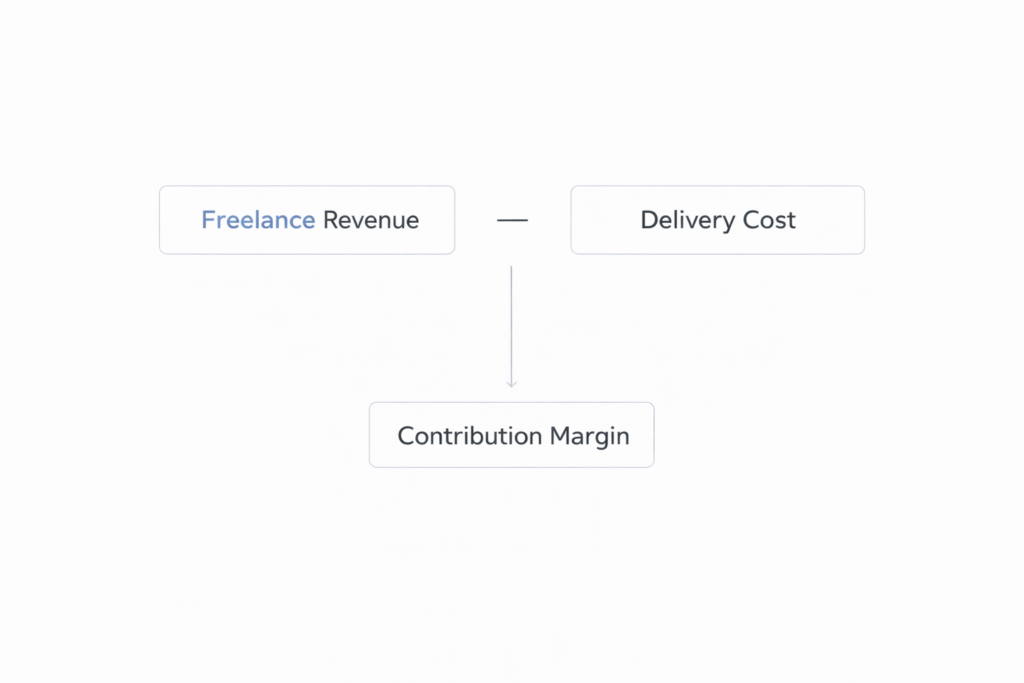
Contribution margin analysis typically involves three components.
1. Revenue
Revenue represents the total income generated from a project or client engagement.
Examples include:
- project fees
- monthly retainers
- advisory services
Revenue defines the starting point of the analysis—but does not determine profitability.
2. Direct Delivery Cost
Direct delivery cost represents the time required to complete the client engagement.
This includes:
- project execution
- research and analysis
- revisions and adjustments
- meetings and communication
Delivery cost is typically calculated using the freelancer’s effective hourly rate.
Time measurement methods are discussed in:
→ Time Tracking vs Capacity Planning
3. Contribution Margin
Contribution margin represents the portion of revenue remaining after delivery costs are deducted.
This remaining value contributes to:
- covering operational overhead
- generating profit
- supporting business growth
Higher contribution margins indicate more financially efficient client work.
Operational Impact
Tracking contribution margin improves several strategic decisions within a freelance consulting business.
Pricing Strategy
Freelancers can evaluate whether project pricing reflects actual delivery effort.
Project Selection
High-margin projects can be prioritized when allocating consulting capacity.
Workload Optimization
Consultants can increase profitability without increasing total workload.
Financial Forecasting
Contribution margin improves the accuracy of profit projections.
If you are actively tracking these metrics across projects, structured Profit Tracking Tools for Freelancers help maintain consistent visibility into margins and performance.
System-Level Impact Across Processome
Contribution margin influences several operational systems within the Processome architecture.
- Client Pipeline System → qualification of financially attractive opportunities
- Capacity Planning System → allocation of time toward high-margin projects
- Profit Tracking System → measurement of financial efficiency across engagements
- Delivery & Operations System → control of delivery effort and scope expansion
Contribution margin analysis improves coordination between revenue generation, delivery planning, and financial performance.
Common Failure Patterns
Freelancers often overlook contribution margin because revenue appears easier to measure.
Several patterns contribute to this problem.
Evaluating Projects by Revenue Only
Large projects may appear attractive despite requiring excessive delivery effort.
Ignoring Delivery Cost
Time spent on revisions, coordination, and follow-up work is often excluded from profitability analysis.
Underestimating Operational Overhead
Freelancers sometimes forget that contribution margin must also cover non-delivery business activities.
Increasing Revenue Instead of Margin
Revenue growth may occur even when contribution margins decline.
Without margin visibility, freelancers may unknowingly accept work that reduces overall profitability.
Strategic Outcome
When freelancers track contribution margin systematically, financial decision-making becomes more precise.
Instead of focusing only on revenue growth, consultants begin optimizing for financial efficiency.
This produces several advantages.
- Improved pricing discipline → pricing reflects actual delivery effort
- Better project selection → focus on high-margin work
- Higher profitability without increased workload → optimize instead of scale
Over time, contribution margin analysis transforms freelance consulting from revenue-based planning to profit-driven decision making.
Final Perspective
Revenue reveals how much work enters a consulting business.
Contribution margin reveals how much value that work actually creates.
Within the Processome operating model, the → Profit Tracking System provides the financial intelligence required to evaluate the true economics of freelance consulting.
Freelancers who understand contribution margin gain a clearer view of which projects support long-term financial sustainability.
Revenue measures scale.
Contribution margin measures efficiency.