Profitability Metrics for Consultants (How to Measure Financial Performance)
Introduction
Profitability metrics for consultants reveal how efficiently revenue converts into profit—not just how much income is generated.
Freelancers often monitor business performance through revenue indicators such as monthly income, project size, or total invoiced value. While these metrics reveal business activity, they provide limited insight into financial performance.
Profitability depends not only on how much revenue is generated but also on how efficiently that revenue converts into profit.
Within the Processome operating model, financial performance analysis belongs to the → Profit Tracking System—the financial intelligence layer responsible for evaluating how revenue translates into sustainable profit.
Profitability metrics allow freelancers to monitor the financial efficiency of their consulting work. They reveal whether client engagements, pricing structures, and delivery processes generate healthy margins.
Revenue indicates scale.
Profitability metrics reveal financial performance.
What are Profitability Metrics for Consultants?
Profitability metrics measure how efficiently a consulting business converts revenue into profit.
Unlike revenue indicators, these metrics incorporate delivery effort, cost structures, and operational efficiency.
Common profitability metrics used in freelance consulting include:
- contribution margin
- gross margin
- effective hourly rate
- client profitability
- revenue per client
Each metric provides a different perspective on financial performance.
These frameworks are explored in:
→ Contribution Margin in Freelance Businesses
→ Effective Hourly Rate Calculation Framework
Together, these indicators reveal whether revenue generation produces sustainable financial value.
The Core Problem
Many freelancers track revenue consistently but monitor profitability less systematically.
Typical indicators include:
- monthly revenue totals
- project values
- number of active clients
While these metrics show business activity, they do not reveal how efficiently work generates profit.
Several problems emerge when profitability metrics are not monitored.
Hidden Margin Decline
Delivery effort may gradually increase while pricing remains unchanged.
Unprofitable Clients
Certain engagements may generate weak margins despite strong revenue.
Pricing Misalignment
Prices may not reflect the real cost of delivering work.
Weak Financial Planning
Without profitability metrics, financial forecasting becomes less reliable.
Profitability metrics provide the financial insight required to address these issues.
Consultant Profitability Metrics Framework
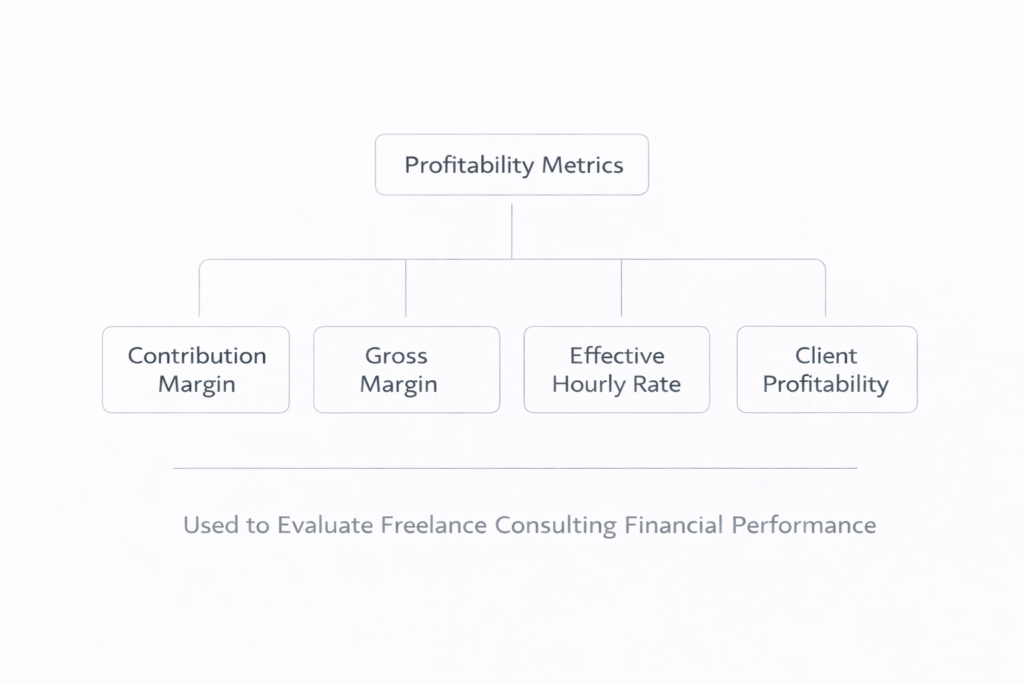
A structured profitability framework typically includes several categories of metrics.
1. Margin Metrics
Margin metrics evaluate how much revenue remains after delivery costs.
Examples include:
- contribution margin
- gross margin
These metrics reveal how efficiently consulting work converts revenue into financial value.
→ Gross Margin for Freelancers
2. Time-Based Profitability Metrics
Time-based metrics analyze how effectively delivery effort generates income.
Examples include:
- effective hourly rate
- delivery hours per project
These metrics reveal whether consulting work generates adequate financial return for the time invested.
3. Client-Level Profitability Metrics
Client profitability analysis evaluates financial performance across the client portfolio.
Examples include:
- profit generated per client
- revenue per client
- margin performance by engagement
Client-level analysis reveals which relationships produce the strongest financial outcomes.
→ Client Profitability Analysis for Freelancers
4. Portfolio-Level Profitability Metrics
Portfolio-level metrics evaluate the overall financial structure of the business.
Examples include:
- revenue concentration ratio
- income stability patterns
- profit forecasting metrics
These indicators reveal the broader financial health of the consulting business.
→ Revenue Concentration Risk Explained
Operational Impact
Profitability metrics improve several strategic decisions within a freelance consulting business.
Pricing Strategy
Metrics reveal whether pricing reflects delivery effort and cost structure.
Client Selection
Freelancers can prioritize engagements that generate stronger margins.
Capacity Allocation
Higher-margin work can be prioritized within limited delivery capacity.
Financial Forecasting
Profitability trends improve the accuracy of financial projections.
These metrics transform financial management from intuition into structured analysis.
System-Level Impact Across Processome
Profitability metrics influence multiple systems within the Processome architecture.
- Client Pipeline System → targeting opportunities aligned with profitable engagement structures
- Capacity Planning System → allocating delivery effort toward higher-value engagements
- Profit Tracking System → monitoring margin performance and financial efficiency
- Delivery & Operations System → improving workflows that protect profitability
Financial insight influences both revenue generation and operational execution.
Common Failure Patterns
Freelancers often undermine profitability analysis by focusing exclusively on revenue growth.
Several patterns frequently appear.
Revenue-Only Tracking
Revenue metrics may be monitored while profitability metrics remain ignored.
Inconsistent Data Collection
Time tracking or expense tracking may be incomplete.
Overcomplicated Metrics
Too many financial indicators may obscure the most important signals.
Irregular Financial Reviews
Profitability metrics lose value if they are not monitored consistently.
Effective financial management requires disciplined tracking.
Strategic Outcome
When freelancers track profitability metrics consistently, financial performance becomes easier to manage.
Instead of focusing solely on revenue growth, consultants gain visibility into the economic efficiency of their work.
This produces several advantages.
- Improved pricing decisions → prices reflect actual delivery economics
- Better client portfolio design → prioritize high-margin relationships
- Stronger financial planning → profit trends improve forecasting
Over time, profitability metrics transform financial management into structured business intelligence.
Final Perspective
Freelance consulting businesses often track revenue carefully.
However, sustainable financial performance depends on profitability rather than revenue alone.
Within the Processome operating model, the → Profit Tracking System provides the metrics required to evaluate financial efficiency.
Profitability metrics reveal whether revenue actually produces value.
Revenue measures activity.
Profitability measures success.