Client Pipeline System for Freelancers: Build a Predictable Client Pipeline
The Revenue Engine for Solo B2B Freelancers
Key Questions About Freelance Client Acquisition
→ How to get freelance clients consistently
→ Why freelancers struggle to get clients
→ How to build a freelance client pipeline
→ What is a freelance sales pipeline
→ How to get better freelance clients (not just more)
If you are trying to create a more predictable flow of clients, these are the core questions to start with.
These questions reflect a common pattern.
Freelancers rarely struggle with finding clients entirely.
They struggle with inconsistency.
Opportunities appear, but they are not structured.
Work arrives, but it is not predictable.
This creates cycles of overload and scarcity.
The Client Pipeline System addresses this problem by structuring how opportunities are generated, qualified, and converted into projects.
Introduction
Client pipeline systems for freelancers define how consulting opportunities are generated, qualified, and converted into predictable revenue.
Many freelancers rely on inconsistent lead flow and reactive sales activity. As a result, revenue becomes unpredictable and difficult to forecast.
For many solo B2B freelancers, revenue appears unpredictable. Some months generate strong client activity, while others produce little or no pipeline movement.
This volatility is rarely caused by market demand alone. In most cases, it emerges from the absence of a structured client acquisition system.
Within the Processome operating model, the Client Pipeline System functions as the revenue engine of a freelance consulting business.
It defines how opportunities are generated, evaluated, and converted into client engagements.
What Is a Client Pipeline System for Freelancers?
A client pipeline is the system that turns inconsistent leads into predictable freelance income.
Instead of relying on scattered conversations or memory, freelancers use a defined pipeline to:
- generate and capture leads
- qualify opportunities
- manage discovery and proposals
- track deal progression
- forecast revenue
This system transforms client acquisition from a reactive activity into a predictable process.
The Core Problem
Most freelancers manage sales activities informally.
Opportunities are tracked through:
- inbox conversations
- scattered notes
- calendar reminders
- memory
Pipeline stages may be unclear or entirely absent. Deals progress inconsistently, and forecasting often relies on intuition rather than structured data.
This approach introduces several operational risks.
Overcommitment During Strong Months
Without visibility into pipeline inflow, freelancers may accept too many projects when demand suddenly increases.
Revenue Gaps
When new opportunities fail to enter the pipeline consistently, revenue may decline sharply in subsequent months.
Reactive Pricing
Freelancers facing revenue pressure may lower prices or accept poorly aligned projects simply to maintain income.
Low Pipeline Visibility
Without structured tracking, freelancers cannot determine how many opportunities exist or how likely they are to convert.
These issues are not primarily sales problems. They are system design problems.
Revenue stability requires pipeline architecture.
Concept Explanation
The Client Pipeline System is the operational framework that governs how freelance opportunities move from initial contact to signed client engagements.
Instead of managing deals informally, freelancers structure the acquisition process through defined stages and measurable metrics.
A functioning pipeline system performs several core functions:
- capturing new opportunities
- evaluating lead quality
- structuring discovery and qualification
- managing proposals and negotiations
- forecasting expected revenue
These stages correspond to the broader freelance sales process described in:
→ Sales Process for Freelancers Explained
The pipeline system ensures that every opportunity progresses through the same structured lifecycle.
This creates consistency across client acquisition activities and provides the data necessary to monitor pipeline performance.
The Client Pipeline System Framework
The freelance revenue engine can be structured across six interconnected subsystems that collectively govern pipeline performance.
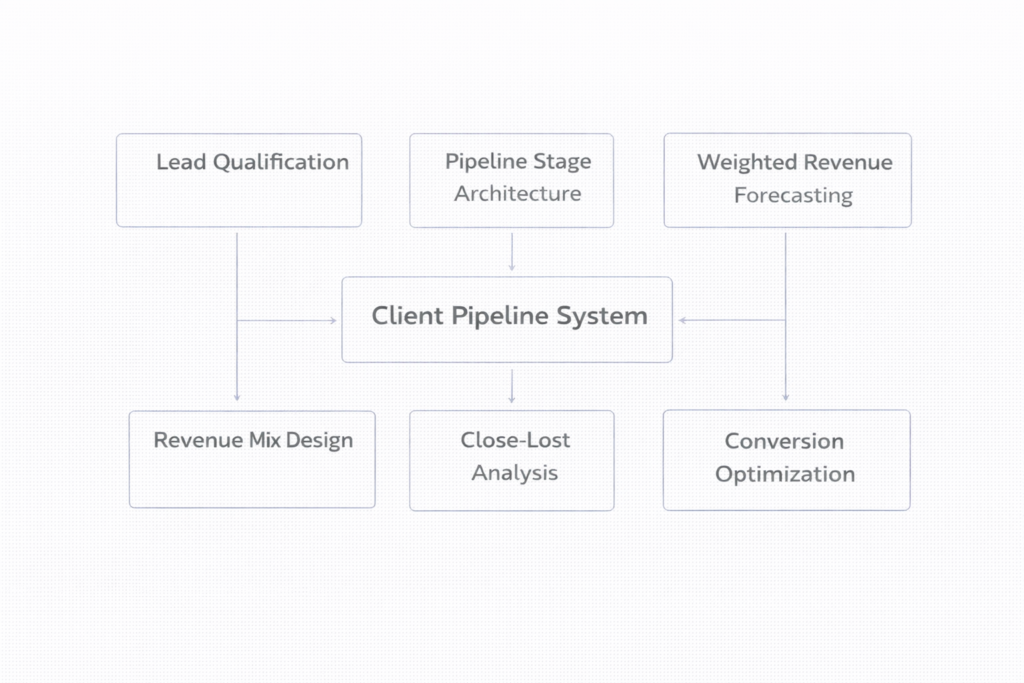
1. Lead Qualification Framework
Revenue quality is determined before a proposal is written.
Unqualified leads often produce:
- long sales cycles
- low proposal conversion rates
- misaligned projects
- delivery stress
A structured qualification framework evaluates:
- budget realism
- decision authority
- strategic fit
- urgency
- capacity alignment
This subsystem is explored in:
→ Client Qualification Framework for Freelancers
→ How to Qualify Freelance Leads Strategically
2. Pipeline Stage Architecture
Every opportunity must move through defined pipeline stages.
Typical stages may include:
- inquiry
- qualified opportunity
- discovery completed
- proposal sent
- negotiation
- closed (won or lost)
Each stage requires clear entry and exit criteria.
Without stage architecture, pipeline forecasting becomes unreliable.
Detailed stage structures are explained in:
→ Sales Pipeline Stages for Freelancers Explained
3. Weighted Revenue Forecasting
Pipeline forecasting converts opportunity data into realistic revenue expectations.
Rather than assuming every deal will close, forecasting applies probability weighting based on pipeline stage.
Example:
| Pipeline Value | Stage Probability | Forecasted Revenue |
| €20,000 | 40% | €8,000 |
This forecasting method supports systems such as:
→ Capacity Planning System
→ Profit Tracking System
Detailed forecasting models are explained in:
→ Weighted Revenue Forecasting for Freelancers
4. Conversion Optimization
Pipeline performance depends heavily on conversion rates between stages.
Key conversion indicators include:
- discovery-to-proposal ratio
- proposal-to-close rate
- average deal value
- sales cycle duration
Monitoring these metrics helps identify weak points in the sales process.
Conversion optimization frameworks are explored in:
→ Increase Proposal Conversion Rate as a Freelancer
5. Close-Lost Analysis
Rejected opportunities contain valuable data about pipeline performance.
Instead of ignoring lost deals, freelancers analyze them to understand:
- pricing objections
- timing issues
- authority gaps
- strategic misalignment
This intelligence improves future qualification and proposal strategy.
The analysis framework is explained in:
→ Close-Lost Analysis Framework for Freelancers
6. Revenue Mix Design
Revenue stability depends partly on the structure of the client portfolio.
Different engagement models produce different revenue patterns.
For example:
- project-heavy pipelines often produce volatile revenue
- retainer-based pipelines generate more stable income
Designing an appropriate revenue mix improves both capacity predictability and financial stability.
This subsystem is explored in:
→ Retainers vs Projects: Which Model Creates Stable Freelance Income
→ Revenue Mix Design for Solo Consultants
Operational Impact
A structured pipeline system influences several operational dimensions of a freelance consulting business.
Revenue Predictability
Forecasting models convert pipeline data into realistic revenue expectations.
This reduces financial uncertainty.
Capacity Planning Alignment
Pipeline visibility allows freelancers to anticipate upcoming workload.
This information supports systems such as:
→ Capacity Planning System
→ Utilization Rate for Solo Consultants
Client Portfolio Design
Pipeline filtering determines which types of clients enter the business.
Strategic acquisition decisions shape the long-term client portfolio.
This topic is explored in:
→ Freelance Client Portfolio Strategy
System-Level Impact Across Processome
The Client Pipeline System interacts with all other Processome systems.
Client Pipeline System → opportunity inflow
Capacity Planning System → workload feasibility
Profit Tracking System → revenue quality
Delivery & Operations System → execution stability
These systems form a closed operational loop that governs freelance business performance.
Common Failure Patterns
Freelancers often experience pipeline instability due to structural weaknesses.
Emotional Forecasting
Estimating revenue based on intuition rather than pipeline data leads to inaccurate expectations.
Unstructured Lead Qualification
Accepting poorly aligned opportunities reduces pipeline efficiency.
Missing Stage Definitions
Without clearly defined pipeline stages, deal progression becomes inconsistent.
Ignoring Lost Deals
Failure to analyze lost opportunities prevents improvement in future sales performance.
Strategic Outcome
When the Client Pipeline System is implemented effectively, freelance client acquisition becomes far more predictable.
Several strategic benefits emerge.
Forecastable revenue
Pipeline data provides realistic estimates of upcoming income.
Controlled capacity decisions
Freelancers can align new client engagements with available delivery capacity.
Improved pricing confidence
Reduced revenue pressure allows freelancers to maintain stronger pricing discipline.
Reduced feast-or-famine cycles
Consistent pipeline inflow stabilizes client acquisition.
Over time, the pipeline becomes a structured revenue engine rather than a reactive sales process.
Final Perspective
Freelance revenue volatility is often treated as an unavoidable characteristic of independent work. In reality, much of this instability results from missing operational structure.
The Client Pipeline System transforms client acquisition from a reactive process into a designed system.
Rather than waiting for opportunities to appear, freelancers build mechanisms that continuously generate, evaluate, and convert potential engagements.
Within the Processome operating model, this system forms the foundation of a stable consulting business.
Revenue becomes engineered rather than accidental.
Client Pipeline System Frameworks
The Client Pipeline System includes the following operational frameworks:
Lead Qualification & Pipeline Structure
→ Client Qualification Framework for Freelancers
→ How to Qualify Freelance Leads Strategically
→ Sales Pipeline Stages for Freelancers Explained
→ Increase Proposal Conversion Rate as a Freelancer
→ Weighted Revenue Forecasting for Freelancers
→ Close-Lost Analysis Framework for Freelancers
Revenue Structure
→ Retainers vs Projects: Which Model Creates Stable Freelance Income
→ Revenue Mix Design for Solo Consultants
CRM & Pipeline Infrastructure
→ Simple CRM Setup for Freelancers
→ CRM Systems for Solo B2B Freelancers: Structuring the Client Pipeline
→ Deal Tracking Systems for Freelancers
Lead Generation & Acquisition
→ Freelance Lead Generation System
→ Where Freelancers Find B2B Clients
→ Referral Systems for Consultants
→ Client Acquisition Channels Compared
Sales Process & Deal Progression
→ Sales Process for Freelancers Explained
→ Discovery Calls for Freelancers
→ Structuring Freelance Proposals
→ Proposal Follow-Up Strategies
→ Lead Nurturing for Consultants
Pipeline Performance & Forecasting
→ Pipeline Velocity for Freelancers
→ Pipeline Health Metrics
→ Forecasting Revenue from Your Pipeline
→ B2B Freelance Sales Metrics