Weighted Revenue Forecasting for Freelancers
Introduction
Many freelancers attempt to forecast future income by adding up the total value of deals in their pipeline.
At first glance, this approach seems logical. However, it often produces unrealistic expectations.
Not all opportunities have the same likelihood of closing. Early-stage leads carry significant uncertainty, while proposals under review are much more likely to convert.
This is where weighted revenue forecasting for freelancers becomes essential.
Instead of assuming that all deals will close, weighted forecasting adjusts each opportunity based on its probability of conversion. This produces a more realistic view of expected income.
Within the Processome operating model, revenue forecasting belongs to the → Client Pipeline System, the system responsible for converting pipeline activity into predictable consulting revenue.
Weighted forecasting allows freelancers to transform uncertain pipeline activity into structured, reliable planning inputs.
What Is Weighted Revenue Forecasting?
Weighted revenue forecasting for freelancers is a method of estimating future income by adjusting each pipeline opportunity based on its likelihood of closing.
Instead of treating all deals equally, each opportunity contributes only a portion of its total value to the forecast.
This portion reflects the deal’s probability of conversion.
For example:
- early-stage leads → low probability
- qualified opportunities → moderate probability
- proposals under review → higher probability
This produces expected revenue, not optimistic revenue.
Expected revenue is the only reliable input for systems such as:
→ Capacity Planning System
→ Profit Tracking System
Weighted forecasting therefore acts as a decision framework, not just a projection method.
The Core Problem
Many freelancers rely on unstructured or optimistic revenue forecasts.
A common assumption:
“If these deals close, I will generate €18,000 next month.”
This assumes:
- all deals are equally likely to close
- all deals will close on time
- all deals are feasible to deliver
In reality, these assumptions rarely hold.
This leads to predictable problems.
Inflated Revenue Expectations
Freelancers overestimate future income.
Distorted Capacity Planning
Time is reserved for deals that never materialize.
Premature Financial Decisions
Spending decisions are made based on uncertain revenue.
Increased Stress
Financial pressure increases when expected deals do not close.
Freelance revenue forecasting without weighting is not forecasting—it is speculation.
The Weighted Revenue Forecasting Framework
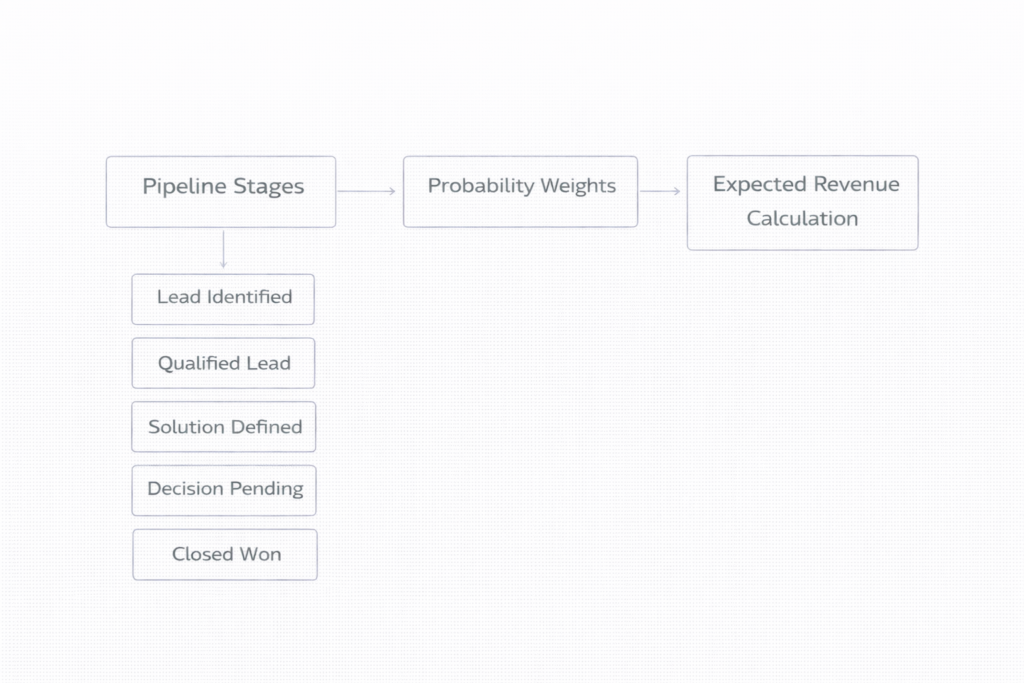
A structured pipeline revenue forecasting system for freelancers relies on three components.
1. Pipeline Stages
Weighted forecasting depends on clearly defined pipeline stages.
Each stage represents a different level of deal maturity.
Typical stages include:
- lead identified
- qualified lead
- solution defined
- decision pending
- closed
Pipeline structure is defined in:
→ Sales Pipeline Stages for Freelancers
Without clear stages, weighted forecasting cannot function effectively.
2. Probability Weights
Each pipeline stage carries a probability of closing.
A simplified model:
| Pipeline Stage | Confidence Level |
|---|---|
| Lead Identified | Low |
| Qualified Lead | Medium |
| Solution Defined | Medium–High |
| Decision Pending | High |
| Closed Won | Certain |
Exact percentages may vary, but the principle is consistent:
Confidence increases as uncertainty decreases
This prevents early-stage deals from distorting your freelance revenue forecast.
3. Expected Revenue Calculation
Each deal is adjusted using its probability weight.
Formula:
Deal Value × Probability = Weighted Contribution
Example:
- €10,000 deal × medium probability → partial contribution
- €8,000 deal × high probability → larger contribution
The total forecast equals the sum of all weighted contributions.
This produces a realistic estimate of pipeline-based freelance income.
Operationalizing Weighted Revenue Forecasting
Weighted forecasting requires more than a conceptual model—it depends on consistent pipeline tracking.
Each opportunity must be:
- assigned to a pipeline stage
- updated as new information emerges
- evaluated based on current probability
Without structured tracking, forecasts quickly become outdated or inaccurate.
To support this process, freelancers can use the tools available in:
→ Client Pipeline System Tools
These tools help maintain pipeline visibility, enforce stage consistency, and improve forecasting accuracy.
Operational Impact
Implementing weighted revenue forecasting for freelancers improves multiple operational dimensions.
Capacity Planning Discipline
Only credible opportunities influence workload decisions.
Improved Financial Visibility
Revenue expectations become realistic and actionable.
Stronger Pricing Discipline
Freelancers are less likely to discount weak deals under pressure.
System-Level Impact Across Processome
Weighted forecasting affects multiple systems:
- Client Pipeline System → revenue expectations
- Capacity Planning System → workload allocation
- Profit Tracking System → financial planning
- Delivery & Operations System → onboarding readiness
Accurate forecasting improves coordination across all systems.
Common Failure Patterns
Several mistakes reduce forecasting accuracy.
Assigning 100% Probability Too Early
Treating proposals as guaranteed revenue.
Ignoring Stalled Deals
Inactive opportunities remain in forecasts too long.
Adjusting Forecasts to Match Targets
Forecasts reflect desired outcomes instead of reality.
Neglecting Updates
Forecasts are not revised as pipeline conditions change.
These patterns turn forecasting into guesswork.
Strategic Outcome
When freelancers apply weighted pipeline forecasting, several benefits emerge.
More Realistic Revenue Expectations
Pipeline uncertainty is properly accounted for.
Improved Capacity Decisions
Workload planning is based on credible opportunities.
Reduced Financial Stress
Expectations align with reality.
Stronger Decision-Making
Freelancers operate with clearer financial signals.
Over time, weighted forecasting creates a more stable consulting business.
Final Perspective
Revenue uncertainty is unavoidable in freelance consulting—but it does not have to create instability.
Weighted revenue forecasting for freelancers transforms uncertain opportunities into structured expectations that can guide planning decisions.
Within the Processome operating model, this strengthens the Client Pipeline System by providing reliable inputs for capacity planning, profit tracking, and delivery operations.
Without weighting, forecasts are optimistic guesses.
With weighting, they become operational control.