Retainer vs Project Freelance: Which Model Creates Stable Income?
Introduction
Many freelancers experience fluctuating income and inconsistent workloads. Revenue may spike during active projects and decline once engagements end.
These patterns are often blamed on market conditions or client behavior. In reality, they are usually driven by how the freelance business is structured.
Understanding retainer vs project freelance models is essential for building stable income.
Different revenue models create different outcomes in:
- income predictability
- workload stability
- forecasting accuracy
- profit consistency
Within the Processome operating model, revenue structure belongs to the → Client Pipeline System, the system responsible for shaping how opportunities translate into long-term income.
The two dominant freelance revenue models are:
- project-based engagements
- retainer-based engagements
Each produces fundamentally different operational dynamics.
What Is the Difference Between Retainer and Project Freelance Work?
In a retainer vs project freelance model, the difference lies in how work is structured and delivered over time.
Project-based work:
- defined scope
- fixed or time-bound delivery
- one-time engagement
Retainer-based work:
- ongoing engagement
- recurring revenue (often monthly)
- continuous or advisory support
This structural difference affects:
- pipeline behavior
- capacity allocation
- revenue predictability
- margin stability
Choosing between retainers and projects is not just a pricing decision—it is a system design decision.
The Core Problem
Many freelancers choose between retainers and projects reactively.
Decisions are often based on:
- immediate cash flow needs
- available opportunities
- client preferences
This creates an unstructured revenue model.
As a result, several issues emerge.
Income Volatility
Project-heavy pipelines create revenue spikes followed by gaps.
Unpredictable Workload
Capacity fluctuates depending on project timing.
Weak Forecasting
Revenue becomes difficult to estimate reliably.
Fragile Planning
Long-term decisions become harder without stable income.
The problem is not the amount of work—it is the structure of that work.
The Freelance Revenue Model Framework
To evaluate retainer vs project freelance income models, freelancers should assess three key dimensions.
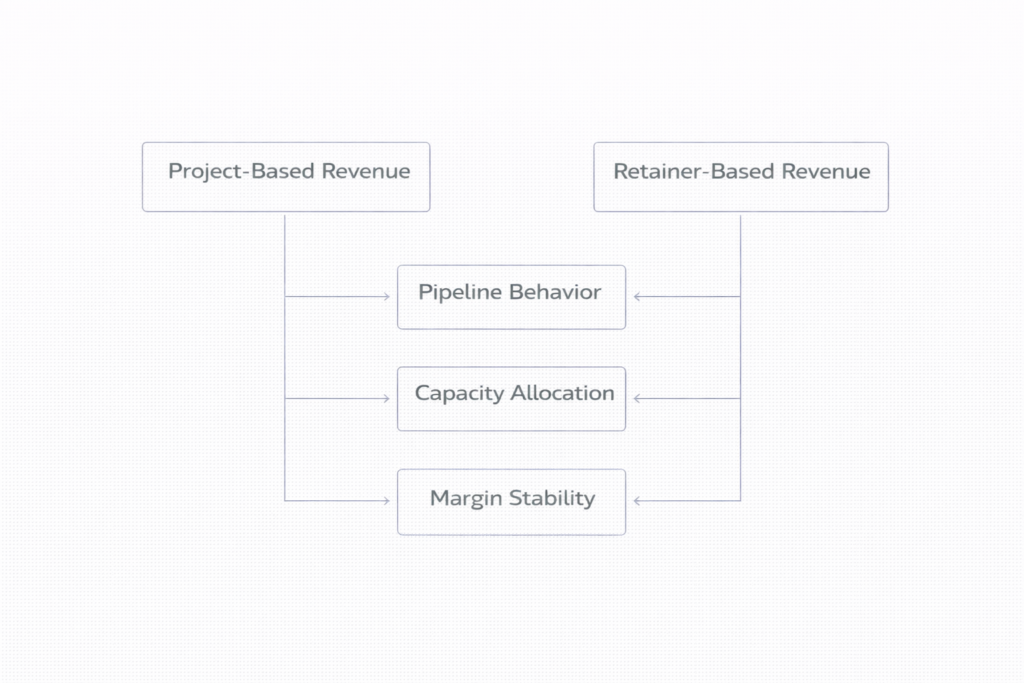
1. Pipeline Behavior
The revenue model determines how your pipeline must function.
Project-based pipelines require:
- continuous lead generation
- frequent proposals
- higher deal volume
Related systems include:
→ Sales Pipeline Stages for Freelancers
Retainer-based pipelines emphasize:
- fewer, higher-value clients
- stronger qualification
- longer relationship cycles
Once retainers are secured, pipeline pressure decreases because revenue becomes recurring.
2. Capacity Allocation
Revenue structure directly affects how your time is allocated.
Project work creates:
- workload spikes
- gaps between engagements
- scheduling instability
Retainers create:
- consistent allocation of time
- predictable workload distribution
However, retainers introduce a risk:
Scope expansion over time
If not controlled, retainers can consume more capacity than expected.
Capacity must be monitored through:
→ Capacity Planning System
→ Utilization Rate for Solo Consultants
3. Margin Stability
Profit behavior differs between models.
Projects:
- pricing resets each time
- margins vary depending on scope and negotiation
- higher variability
Retainers:
- stable revenue patterns
- predictable billing
- risk of hidden margin erosion if time increases
Monitoring profitability requires:
→ Profit Tracking System
→ Client Profitability Analysis for Freelancers
Stable revenue does not automatically mean stable profit.
Retainer vs Project Freelance: Key Tradeoffs
To better understand retainer vs project freelance income stability, compare the core tradeoffs:
| Dimension | Projects | Retainers |
|---|---|---|
| Revenue Pattern | Variable | Recurring |
| Pipeline Pressure | High | Lower (after baseline) |
| Capacity Stability | Low | High |
| Margin Stability | Variable | More stable (if controlled) |
| Flexibility | High | Lower |
Neither model is inherently better—the impact depends on how it fits your operating system.
Operational Impact
Your revenue model influences several core business systems.
Revenue Predictability
Retainers provide baseline stability, while projects introduce variability.
Pipeline Strategy
Projects require constant inflow; retainers rely on fewer, higher-quality deals.
Capacity Planning
Workload must align with engagement structure.
→ Capacity Planning for Freelancers Explained
System-Level Impact Across Processome
Revenue structure affects:
- Client Pipeline System → opportunity structure
- Capacity Planning System → workload distribution
- Profit Tracking System → margin monitoring
- Delivery & Operations System → client management
All systems must align with the chosen revenue model.
Common Failure Patterns
Freelancers often create instability due to structural mistakes.
Overreliance on Projects
Creates extreme income volatility.
Retainers Without Scope Control
Leads to hidden workload expansion.
Unstructured Hybrid Models
Mixing retainers and projects without planning creates chaos.
Ignoring Capacity Constraints
Growth without capacity awareness leads to delivery pressure.
Strategic Outcome
When freelancers design their retainer vs project freelance model deliberately, several advantages emerge.
Reduced Income Volatility
Retainers provide baseline stability.
Improved Forecasting
Recurring revenue improves predictability.
More Predictable Workload
Capacity becomes easier to manage.
Stronger Client Relationships
Retainers often deepen long-term engagement.
Most freelancers ultimately adopt a hybrid model—combining retainer stability with selective project work.
Final Perspective
The question is not whether retainers or projects are “better.”
The real question is how each model affects your business system.
Projects offer flexibility but create volatility.
Retainers offer stability but require discipline.
Within the Processome operating model, stable freelance income is not the result of chance—it is the result of deliberate revenue model design.