Referral System for Freelancers (How to Get Consistent Client Referrals)
Introduction
Referrals are one of the most powerful sources of new business for freelance consultants. Many high-value B2B engagements originate through introductions from trusted clients, colleagues, or professional partners.
However, while referrals often produce high-quality opportunities, most freelancers rely on them passively rather than structuring them as a repeatable system.
This is why building a referral system for freelancers is critical.
Within the Processome operating model, referral systems belong to the → Client Pipeline System, the revenue engine that governs how opportunities enter and progress through the freelance consulting pipeline.
A referral system transforms informal word-of-mouth into a structured acquisition mechanism. Instead of waiting for occasional introductions, freelancers can intentionally design processes that encourage consistent referrals.
When implemented correctly, referral systems become one of the most efficient ways to generate high-quality opportunities that feed the broader pipeline.
What Is a Referral System for Freelancers?
A referral system for freelancers is a structured method for generating client introductions through existing relationships.
Rather than relying on passive recommendations, the system activates three primary sources:
- satisfied clients
- professional network contacts
- strategic partners
The goal is to make referrals:
- easier to give
- clearer to understand
- more frequent
Referral leads are particularly valuable because they typically involve:
High Trust
The client already trusts the freelancer through the referrer.
Higher Lead Quality
Opportunities are more aligned with the freelancer’s expertise.
Shorter Sales Cycles
Less effort is required to convert the opportunity.
These advantages make referrals one of the most efficient acquisition channels—but only when structured deliberately.
The Core Problem
Many freelance consultants receive referrals, but few operate a deliberate system.
Instead, referrals occur through chance interactions such as:
- a past client mentioning the freelancer
- a colleague recommending them
- a partner passing along an opportunity
While valuable, relying on spontaneous referrals creates structural risks.
Unpredictable Opportunity Flow
Referral volume fluctuates significantly.
Limited Referral Visibility
Contacts may not fully understand what to refer.
Missed Referral Opportunities
Satisfied clients often forget to recommend.
Lack of Systematic Follow-Up
Referrals are not consistently tracked or converted.
For these reasons, referrals must be managed as a structured acquisition channel—not an occasional outcome.
The Referral System Framework
A structured freelance referral system consists of four core components:
- Referral Sources
- Referral Activation
- Referral Capture
- Referral Conversion
Together, these components transform referrals into a repeatable system.
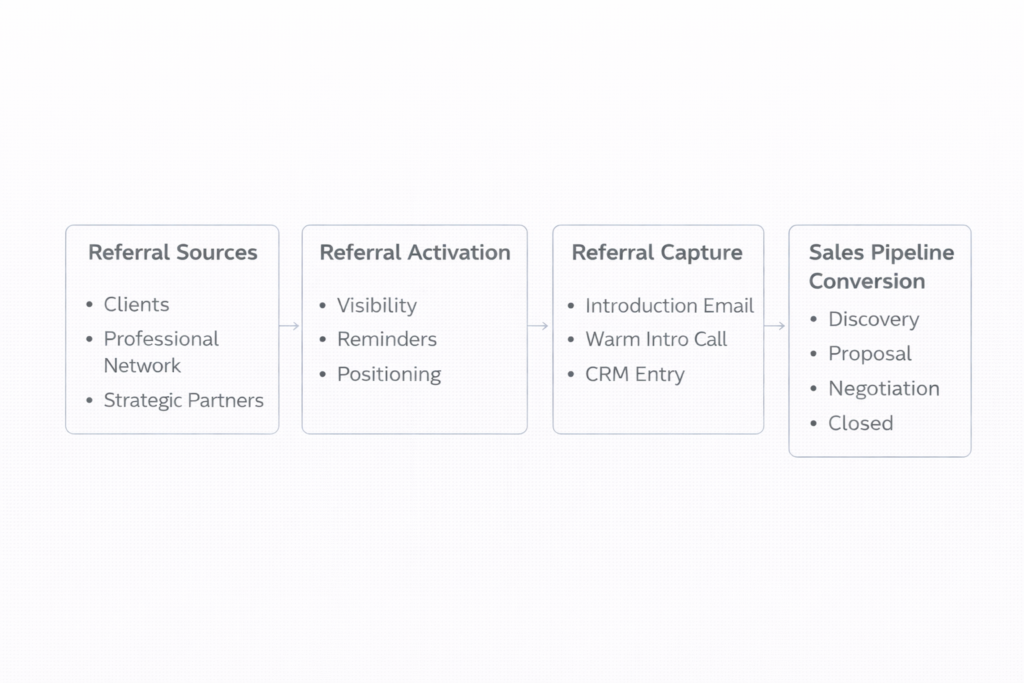
1. Referral Sources
Referral sources are individuals or organizations capable of introducing new clients.
Common sources include:
- current clients
- former clients
- colleagues and peers
- industry contacts
- partner agencies
Strong relationships increase referral frequency over time.
2. Referral Activation
Even satisfied clients do not automatically provide referrals.
Activation ensures contacts understand:
- what you do
- who you help
- which problems you solve
Activation methods include:
- sharing project outcomes
- discussing current focus areas
- periodic relationship check-ins
- signaling availability for new work
Clear positioning significantly improves referral relevance.
3. Referral Capture
Once a referral occurs, it must be captured and tracked.
Typical methods include:
- introduction emails
- shared messages
- direct introductions
At this stage, the lead enters the pipeline.
→ Deal Tracking Systems for Freelancers
→ Simple CRM Setup for Freelancers
Structured tracking ensures referrals are not lost and can be monitored.
4. Referral Conversion
Referral leads still move through the standard sales process:
- discovery
- qualification
- proposal
- closing
→ Discovery Calls for Freelancers
→ Sales Pipeline Stages for Freelancers
Although referrals convert faster, structured qualification remains essential.
Operationalizing Referral Systems
To make referrals consistent, freelancers should:
- maintain relationships with key contacts
- clearly communicate positioning
- periodically activate referral sources
- track referral origin and performance
Referral systems should operate within a broader acquisition structure:
→ Where Freelancers Find B2B Clients
→ Freelance Lead Generation System
Operational Impact
A structured referral system for freelancers improves multiple operational dimensions.
Higher Pipeline Quality
Referral leads are typically well-aligned.
Improved Conversion Rates
Trust reduces sales friction.
→ Pipeline Velocity for Freelancers
Lower Acquisition Cost
Referrals require minimal marketing effort.
Faster Sales Cycles
Fewer interactions are needed to close deals.
System-Level Impact Across Processome
Referral systems support:
- Client Pipeline System → opportunity inflow
- Capacity Planning System → workload feasibility
- Profit Tracking System → revenue quality
- Delivery & Operations System → execution stability
High-quality opportunities improve downstream system performance.
Common Failure Patterns
Passive Referral Dependence
Waiting instead of activating referrals.
Lack of Clear Positioning
Contacts don’t know what to refer.
Weak Relationship Maintenance
Lost connections reduce opportunities.
Poor Referral Tracking
No visibility into source performance.
→ Deal Tracking Systems for Freelancers
Strategic Outcome
When referral systems are implemented effectively:
Consistent Introduction Flow
Freelancers receive regular referrals.
Higher Conversion Rates
Warm leads convert more easily.
Shorter Sales Cycles
Deals progress faster.
Stronger Relationships
Referral systems reinforce long-term networks.
Over time, referrals become one of the most reliable acquisition channels.
Final Perspective
Referrals are often treated as fortunate outcomes of good work. In reality, they can be structured into a predictable system.
Understanding how freelancers get referrals allows client acquisition to become consistent rather than random.
Within the Processome operating model, referral systems ensure that the Client Pipeline System receives a steady flow of high-quality opportunities that support long-term growth.