Freelance Lead Generation System (How to Get Consistent Clients)
Introduction
Lead generation is the starting point of every freelance revenue system. Without a consistent flow of new opportunities, the sales pipeline becomes unstable and revenue fluctuates.
Many freelancers experience irregular income not because of poor delivery or pricing—but because lead generation is inconsistent.
This is why building a freelance lead generation system is critical.
Within the Processome operating model, lead generation belongs to the → Client Pipeline System, the system responsible for acquiring, qualifying, and converting new clients.
For solo B2B freelancers, lead generation is not just a marketing activity. It is a structured system that determines:
- how many opportunities enter the pipeline
- how qualified those opportunities are
- how predictable revenue becomes
Without a system, client acquisition is sporadic.
With a system, it becomes repeatable and measurable.
What Is a Freelance Lead Generation System?
A freelance lead generation system is a structured method for continuously generating qualified client opportunities.
It defines:
- where leads come from
- how they enter the pipeline
- how frequently they are generated
- how they are tracked and managed
The key principle is pipeline feeding.
Opportunities move through the pipeline—but they also drop out. Without new leads entering at the top, the pipeline eventually empties.
A lead generation system ensures continuous inflow.
To function effectively, it must provide:
Consistency
Lead generation happens continuously—not only when work slows down.
Quality
Leads align with expertise and positioning.
Simplicity
The system remains manageable for a solo operator.
The Core Problem
Most freelancers approach lead generation informally.
Opportunities come from:
- occasional referrals
- sporadic LinkedIn activity
- past clients reaching out
- one-off outreach
These sources can generate work—but they do not create a system.
Revenue Volatility
Pipeline gaps create income gaps.
Reactive Selling
Freelancers look for clients only when work slows down.
Low-Quality Leads
Poorly aligned opportunities increase wasted effort.
Pipeline Starvation
Without inflow, even strong pipelines collapse.
This is why lead generation is the entry point of the entire revenue system.
The Lead Generation System Framework
A freelance lead generation system consists of four core components.
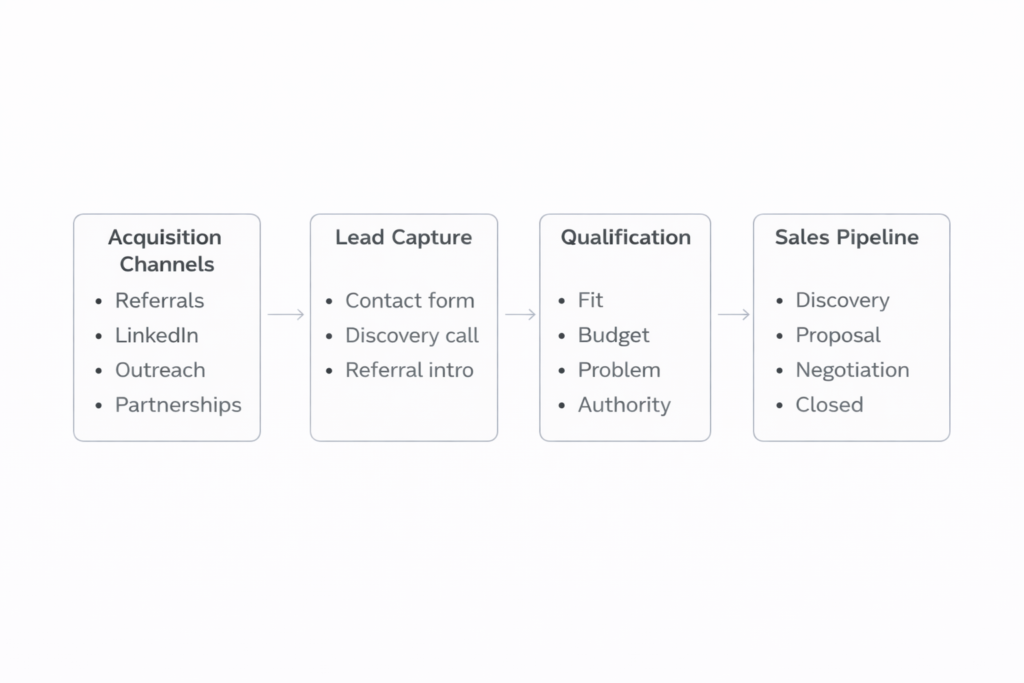
1. Acquisition Channels
Channels generate new opportunities.
Common B2B freelance channels include:
- referrals
- LinkedIn visibility
- outbound outreach
- partnerships
- niche communities
Each channel differs in quality and predictability.
A strong system combines 2–4 channels, rather than relying on one.
→ Client Acquisition Channels Compared
→ Where Freelancers Find B2B Clients
2. Lead Capture
Lead capture converts interest into a conversation.
Examples include:
- inbound forms
- scheduled calls
- referral introductions
- outreach responses
The goal is not to sell—but to initiate structured interaction.
→ Discovery Calls for Freelancers
3. Opportunity Qualification
Not every lead should enter the pipeline.
Qualification determines whether the opportunity:
- fits expertise
- has a real problem
- has budget
- is viable
Structured qualification protects time and improves conversion rates.
→ Client Qualification Framework for Freelancers
→ How to Qualify Freelance Leads Strategically
4. Pipeline Entry
Once qualified, a lead becomes a deal in the pipeline.
It enters structured stages such as:
- discovery
- proposal
- negotiation
- closed
Tracking this requires a structured system.
→ Deal Tracking Systems for Freelancers
→ Simple CRM Setup for Freelancers
You can explore supporting tools here:
→ Client Pipeline System Tools
Operational Impact
A structured lead generation system for freelancers improves several key areas.
Revenue Predictability
Consistent lead inflow enables realistic revenue forecasting.
→ Weighted Revenue Forecasting for Freelancers
Pipeline Health
A healthy pipeline requires:
- continuous inflow
- active opportunities
- stage distribution
→ Pipeline Health Metrics
→ Pipeline Velocity for Freelancers
Proposal Efficiency
Better leads improve:
- conversion rates
- time spent on proposals
- overall pipeline efficiency
Client Portfolio Quality
Lead quality determines long-term client composition.
→ Freelance Client Portfolio Strategy
→ Revenue Mix Design for Solo Consultants
Common Failure Patterns
Referral Dependence
High quality, low predictability.
Reactive Lead Generation
Starting too late creates revenue gaps.
Channel Fragmentation
Too many channels → no consistency.
Missing Pipeline Integration
Leads are generated but not tracked.
Without integration, visibility is lost.
Strategic Outcome
When a freelance lead generation system is implemented:
Predictable Opportunity Flow
New leads enter consistently.
Improved Conversion Efficiency
Better leads increase success rates.
Greater Revenue Stability
Pipeline becomes reliable.
Higher Client Quality
Better alignment improves long-term outcomes.
Over time, client acquisition becomes a structured system—not a reactive activity.
Final Perspective
Freelancers often treat lead generation as marketing or networking.
In reality, it is a system that determines whether revenue is stable or volatile.
Within the Processome operating model, the Client Pipeline System functions as the revenue engine—and lead generation is its entry point.
Without it, the pipeline runs dry.
With it, growth becomes predictable.