Lead Nurturing for Consultants (How to Nurture Freelance Leads Effectively)
Introduction
Lead nurturing for consultants is a critical component of the freelance sales process, particularly in B2B environments where decision cycles are often extended.
Not every potential client is ready to engage immediately. Organizations may still be defining their problem, evaluating options, or waiting for budget availability.
Without a structured lead nurturing process, these early-stage opportunities often disappear.
Within the Processome operating model, lead nurturing belongs to the → Client Pipeline System, the system responsible for managing how opportunities develop over time before converting into consulting engagements.
A well-designed lead nurturing system for freelancers ensures that potential clients remain engaged until the opportunity becomes viable.
What Is Lead Nurturing for Freelancers?
Lead nurturing for freelancers is the structured process of maintaining engagement with potential clients over time.
The goal is not immediate conversion, but long-term relationship development.
A strong freelance lead nurturing process focuses on:
- maintaining visibility
- providing occasional value
- staying relevant over time
- identifying when the opportunity becomes active
This process typically applies to early pipeline stages such as:
- initial contact
- early discovery
- postponed opportunities
→ Sales Process for Freelancers Explained
→ Discovery Calls for Freelancers
The Core Problem
Many freelancers do not have a defined lead nurturing strategy.
Instead, they focus only on leads that are immediately ready to convert.
Common situations include:
- leads not ready yet
- budget constraints
- delayed initiatives
- exploratory conversations
Without nurturing, these leads are lost.
Lost Future Opportunities
Potential clients disappear before they are ready.
Pipeline Instability
Only short-term opportunities are considered.
Inefficient Lead Generation
Freelancers constantly seek new leads instead of leveraging existing ones.
Weak Relationship Development
Clients forget the freelancer over time.
A structured lead nurturing process for consultants solves these issues by maintaining long-term engagement.
The Lead Nurturing Framework
An effective lead nurturing framework for freelancers consists of four components.
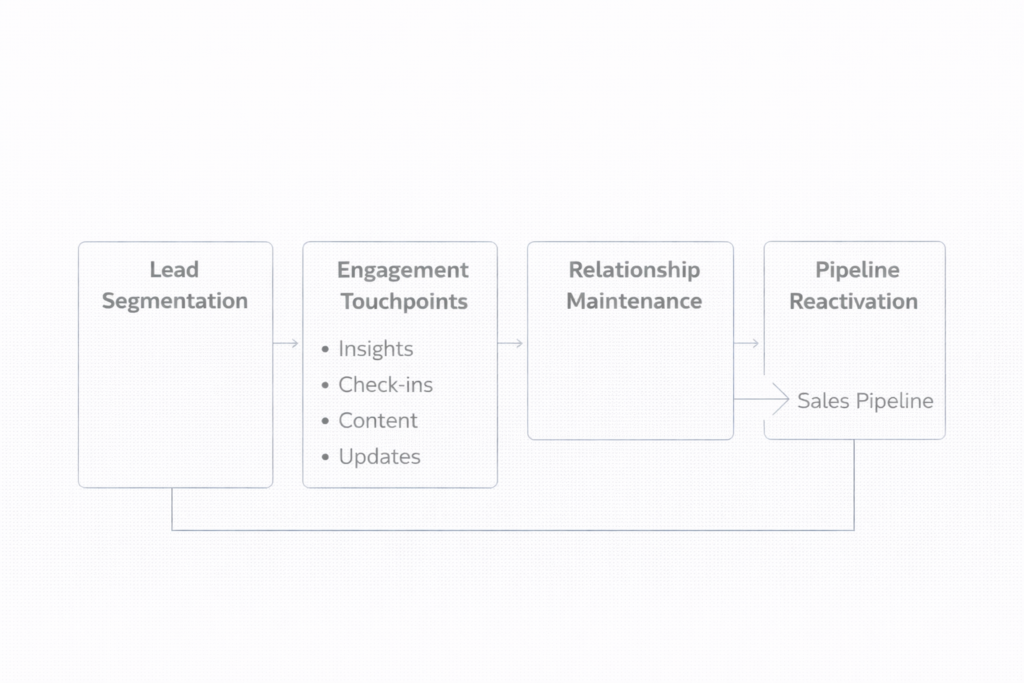
1. Lead Segmentation
Not all leads should be treated equally.
Segment leads based on:
- timeline (short-term vs long-term)
- readiness level
- type of opportunity
Segmentation determines how nurturing should be applied.
2. Engagement Touchpoints
Lead nurturing depends on periodic, low-friction interaction.
Examples:
- sharing relevant insights
- occasional check-ins
- industry observations
- reconnecting after time
Effective lead nurturing for consultants is consistent, not frequent.
3. Relationship Maintenance
Over time, nurturing builds trust and familiarity.
This increases the likelihood that:
- the freelancer is remembered
- the freelancer is trusted
- the freelancer is selected
Strong relationships often lead to:
- future projects
- referrals
- introductions
→ Referral Systems for Consultants
4. Pipeline Reactivation
Eventually, some nurtured leads become active.
Triggers include:
- new initiatives
- budget availability
- urgency increase
- organizational changes
At this point, the lead re-enters the active pipeline.
How Lead Nurturing Improves Pipeline Performance
A structured lead nurturing strategy improves:
- conversion rates over time
- pipeline consistency
- client acquisition efficiency
Instead of relying only on new leads, freelancers convert existing relationships.
This directly supports:
→ Freelance Lead Generation System
→ Where Freelancers Find B2B Clients
Operationalizing Lead Nurturing
To implement lead nurturing for freelancers, consistency is critical.
Freelancers should:
- track early-stage leads
- define follow-up intervals
- maintain light communication
- monitor lead status
Supporting systems include:
→ Deal Tracking Systems for Freelancers
You can manage supporting tools here:
→ Client Pipeline System Tools
Operational Impact
A structured lead nurturing process improves:
Higher Long-Term Conversion
More leads convert over time.
Stable Pipeline Volume
Opportunities remain in the system longer.
Reduced Acquisition Pressure
Less dependence on constant lead generation.
Stronger Relationships
Trust develops before the sales process begins.
System-Level Impact Across Processome
Lead nurturing influences:
- Client Pipeline System → opportunity retention
- Capacity Planning System → future workload visibility
- Profit Tracking System → revenue stability
- Delivery & Operations System → planning readiness
Common Failure Patterns
No Follow-Up After First Contact
Leads disappear.
Excessive Sales Pressure
Damages relationships.
Inconsistent Communication
Reduces visibility.
Lack of Tracking
Leads are forgotten.
Strategic Outcome
When freelancers implement structured lead nurturing strategies:
- more leads convert over time
- relationships strengthen
- pipeline stabilizes
- acquisition becomes more efficient
Lead nurturing transforms early-stage leads into future consulting engagements.
Final Perspective
Many freelance opportunities are not lost—they are simply not ready yet.
Lead nurturing ensures these opportunities remain connected to the pipeline until they become viable.
Within the Processome operating model, structured nurturing strengthens the Client Pipeline System by preserving and activating future opportunities.