Structuring Freelance Proposals (Framework to Win Clients & Increase Conversion)
Introduction
Structuring freelance proposals is a critical stage in the freelance sales process. After an opportunity has been explored and qualified, the proposal defines how the freelancer will solve the client’s problem, outlines the engagement structure, and presents the commercial terms.
Many freelancers treat proposals as simple documents or price quotes. However, a weak freelance proposal structure often leads to confusion, delayed decisions, and lower conversion rates.
Within the Processome operating model, proposals belong to the → Client Pipeline System, the system responsible for converting qualified opportunities into client engagements.
A structured freelance proposal framework ensures clarity, alignment, and faster decision-making. When designed correctly, proposals become a strategic tool for improving conversion performance.
What Is a Freelance Proposal?
A freelance proposal is a structured document that translates discovery insights into a clear engagement plan.
A strong consulting proposal structure serves multiple functions:
- clarifies the client’s problem
- defines the proposed solution
- establishes scope and deliverables
- explains pricing and terms
- defines next steps
The proposal acts as the bridge between qualification and delivery.
It follows earlier stages such as:
→ Freelance Lead Generation System
→ Discovery Calls for Freelancers
→ Client Qualification Framework for Freelancers
The Core Problem
Many freelancers struggle with how to write freelance proposals effectively.
Common issues include:
- focusing on services instead of outcomes
- unclear scope definitions
- confusing pricing explanations
- excessive detail that reduces clarity
These problems create operational risks.
Low Proposal Conversion
Clients hesitate when value is unclear.
Extended Negotiations
Ambiguity leads to back-and-forth discussions.
Scope Misalignment
Unclear deliverables create delivery issues.
Pipeline Inefficiency
Deals remain stuck in the proposal stage.
→ Pipeline Velocity for Freelancers
→ Sales Pipeline Stages for Freelancers Explained
The Freelance Proposal Structure Framework
A structured freelance proposal framework guides the client from problem to decision.
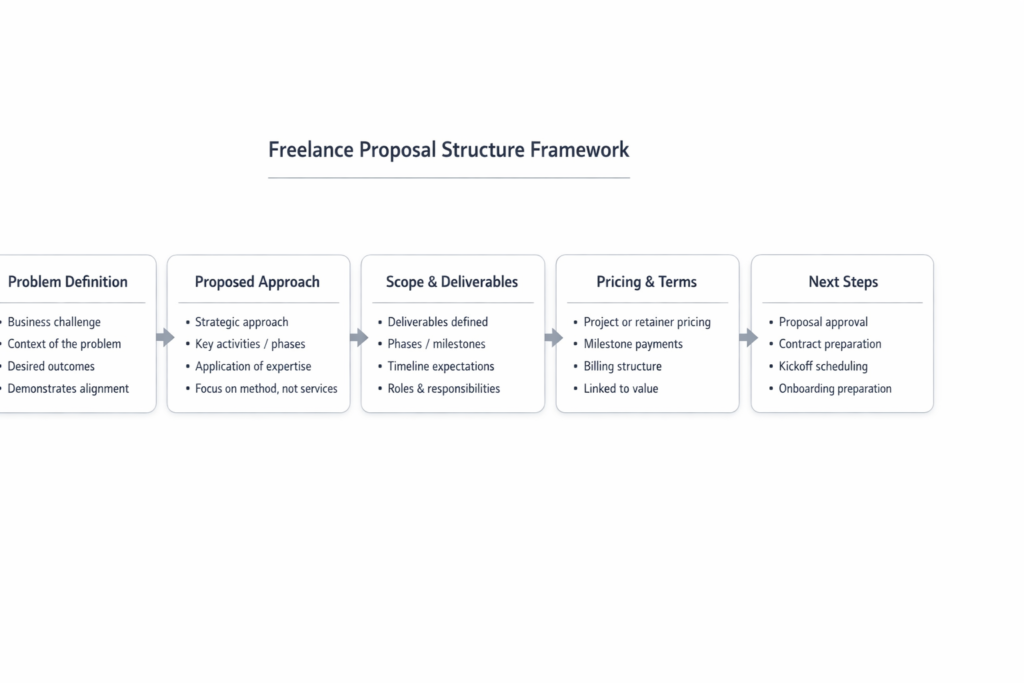
1. Problem Definition
The proposal begins by clearly restating the client’s problem.
This includes:
- current situation
- business impact
- desired outcome
This confirms alignment and demonstrates understanding.
2. Proposed Approach
This section explains how the problem will be solved.
A strong freelance proposal structure focuses on:
- methodology
- key phases
- strategic approach
Not just services—but how results will be achieved.
3. Scope and Deliverables
This defines the boundaries of the engagement.
Include:
- deliverables
- timeline
- milestones
- responsibilities
Clear scope reduces risk and prevents misunderstandings.
→ Scope Control Framework for Solo Consultants
→ Preventing Scope Creep in Freelance Projects
4. Pricing and Commercial Terms
This section explains how the engagement is structured financially.
Options include:
- project pricing
- retainers
- milestone payments
Pricing should reflect value—not effort.
→ Pricing Models for Solo B2B Freelancers
→ Retainers vs Projects: Which Model Creates Stable Freelance Income
5. Next Steps
Every proposal must guide the client toward a decision.
Typical next steps:
- approval
- contract
- kickoff
- onboarding
Without clear next steps, deals stall.
→ Proposal Follow-Up Strategies
How Proposal Structure Improves Conversion
A structured freelance proposal framework reduces decision friction.
- clients understand the problem
- solutions are clear
- scope is defined
- pricing is justified
This leads to:
- faster decisions
- higher conversion rates
- fewer objections
→ Increase Proposal Conversion Rate as a Freelancer
Operationalizing Freelance Proposals
To structure proposals consistently, freelancers should:
- use a repeatable proposal framework
- align proposals with discovery insights
- standardize structure (not content)
- track proposal outcomes
All proposals should be tracked in a system:
→ Deal Tracking Systems for Freelancers
→ Simple CRM Setup for Freelancers
You can manage supporting tools here:
→ Client Pipeline System Tools
Operational Impact
Structuring freelance proposals improves several areas.
Higher Conversion Rates
Clear proposals improve decision-making.
Faster Sales Cycles
Less clarification required.
Reduced Scope Risk
Defined boundaries improve delivery.
Better Forecasting
Consistent proposals improve pipeline visibility.
→ B2B Freelance Sales Metrics
→ Pipeline Velocity for Freelancers
System-Level Impact Across Processome
Proposal structure influences:
- Client Pipeline System → conversion
- Capacity Planning System → workload forecasting
- Profit Tracking System → pricing clarity
- Delivery & Operations System → scope stability
Common Failure Patterns
Generic Proposals
Reduce perceived value.
Overly Complex Documents
Create confusion.
Weak Scope Definition
Leads to scope creep.
Missing Decision Structure
Causes stalled deals.
Strategic Outcome
When freelancers structure proposals effectively:
- conversion rates increase
- sales processes become faster
- delivery risks decrease
- positioning improves
Over time, a strong freelance proposal structure becomes a core component of the sales system.
Final Perspective
Structuring freelance proposals is not just about documentation—it is about decision-making.
A well-designed proposal transforms a qualified opportunity into a clear engagement.
Within the Processome operating model, proposals ensure that the Client Pipeline System converts opportunities into stable, well-defined consulting engagements.