Deal Tracking System for Freelancers (How to Track Pipeline Deals)
Introduction
Client acquisition in freelance consulting rarely happens in a single interaction. Opportunities typically progress through multiple stages—initial contact, discovery, proposal, and negotiation—before a deal is closed.
To manage this effectively, freelancers need a structured way to track each opportunity.
Without a system, it becomes difficult to know:
- where each deal stands
- what action is required next
- how likely the deal is to close
This is where a deal tracking system for freelancers becomes essential.
Within the Processome operating model, deal tracking belongs to the → Client Pipeline System, the system responsible for organizing how opportunities move through the freelance sales pipeline.
A structured deal tracking system creates a centralized view of all opportunities—turning scattered conversations into a controlled pipeline.
What Is a Deal Tracking System for Freelancers?
A deal tracking system for freelancers is a structured method for monitoring opportunities as they move through the sales pipeline.
Each opportunity becomes a deal record that includes key information such as:
- client or organization
- project context
- estimated value
- current stage
- next action
- expected timeline
Deals progress through defined stages such as:
- lead identified
- discovery
- qualified
- proposal
- negotiation
- closed
These stages align with:
→ Sales Pipeline Stages for Freelancers
The purpose of deal tracking is not just organization—it is visibility and control.
The Core Problem
Many freelancers manage deals informally.
Common practices include:
- tracking conversations in email
- storing notes in documents
- relying on memory
This approach breaks down as pipeline volume increases.
Lost Opportunities
Follow-ups are missed or delayed.
Pipeline Confusion
It becomes unclear which deals are active or stalled.
Inconsistent Sales Process
Each opportunity is handled differently.
Weak Revenue Forecasting
Pipeline value cannot be estimated reliably.
Without a structured freelance deal tracking system, the pipeline becomes difficult to manage.
The Deal Tracking System Framework
A functional deal tracking system for freelancers consists of four core components.
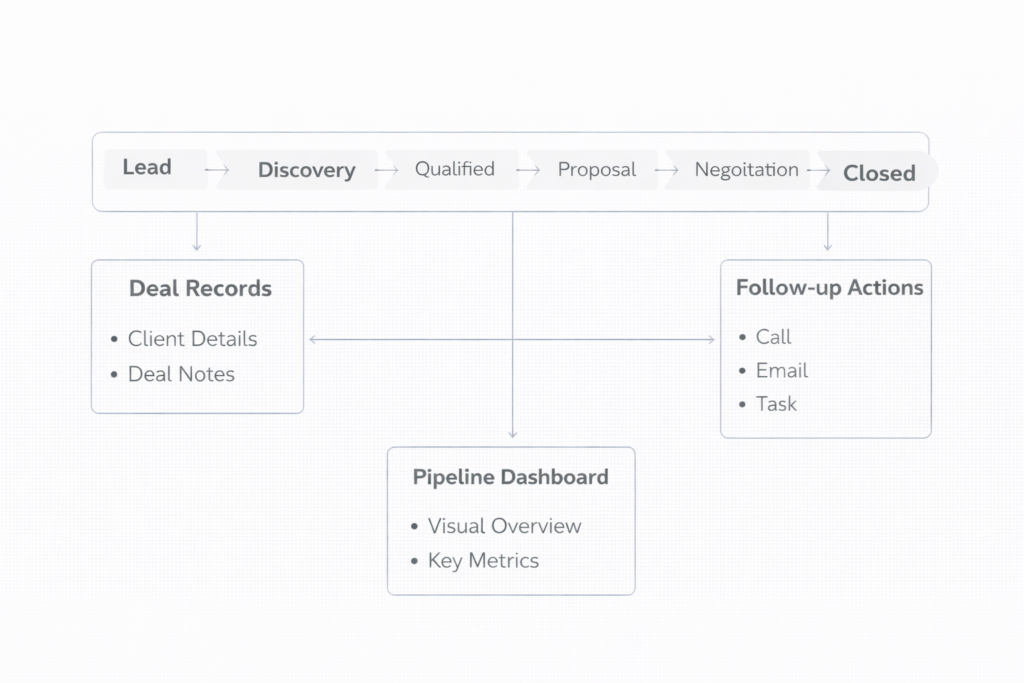
1. Pipeline Stages
Pipeline stages define how deals progress from initial contact to closure.
Typical stages include:
- lead identified
- discovery completed
- qualified opportunity
- proposal sent
- negotiation
- closed
Clear stage definitions ensure consistency.
→ Sales Pipeline Stages for Freelancers
2. Deal Records
Each opportunity should have a structured deal record.
This includes:
- client name
- opportunity description
- deal value
- stage
- expected closing date
Structured records allow freelancers to manage multiple deals simultaneously.
3. Follow-Up Actions
Each deal must include a clearly defined next action.
Examples:
- schedule discovery call
- send proposal
- follow up after proposal
- initiate negotiation
Tracking next actions ensures deals continue progressing.
→ Proposal Follow-Up Strategies
4. Pipeline Dashboard
A pipeline dashboard provides a visual overview of all deals.
It shows:
- active opportunities
- current stage
- deal value
- expected timeline
This enables quick evaluation of pipeline health.
→ Pipeline Velocity for Freelancers
→ Pipeline Health Metrics
Operationalizing Deal Tracking
A deal tracking system only works when it is applied consistently.
Freelancers should:
- update deal stages after each interaction
- define the next action for every deal
- remove or reclassify inactive opportunities
Without consistent updates, the pipeline becomes inaccurate.
To support structured tracking, freelancers can use the tools available in:
→ Client Pipeline System Tools
These tools help centralize deal tracking and maintain pipeline visibility.
Operational Impact
A structured deal tracking system for freelancers improves several operational dimensions.
Improved Pipeline Visibility
All deals are clearly tracked and accessible.
Stronger Follow-Up Discipline
Next actions ensure deals continue moving forward.
Accurate Revenue Forecasting
Structured deal data supports forecasting models.
→ Weighted Revenue Forecasting for Freelancers
System-Level Impact Across Processome
Deal tracking supports:
- Client Pipeline System → visibility
- Capacity Planning System → workload awareness
- Profit Tracking System → forecasting accuracy
- Delivery & Operations System → onboarding readiness
Consistent tracking improves coordination across systems.
Common Failure Patterns
Freelancers often undermine deal tracking systems through:
Tracking Across Multiple Tools
Fragmentation reduces visibility.
Missing Next Actions
Deals stall without defined steps.
Inconsistent Updates
Pipeline data becomes unreliable.
Overcomplicating the System
Too many fields reduce usability.
Deal tracking should remain simple and actionable.
Strategic Outcome
When freelancers implement structured deal tracking:
Full Pipeline Visibility
All opportunities are visible and organized.
Improved Deal Progression
Next-action tracking increases conversion rates.
Better Forecasting
Pipeline data becomes reliable.
Stronger Operational Control
Freelancers can anticipate and manage upcoming work.
Over time, deal tracking becomes a core component of a professional freelance sales system.
Final Perspective
Freelancers often manage deals through informal conversations and scattered notes. While this may work initially, it does not scale.
A deal tracking system for freelancers transforms sales into a structured process.
Within the Processome operating model, deal tracking ensures that the Client Pipeline System maintains visibility, discipline, and predictability.
Without tracking, the pipeline becomes unclear.
With tracking, it becomes controllable.