Discovery Calls for Freelancers (How to Run High-Converting Discovery Calls)
Introduction
Discovery calls for freelancers are one of the most critical stages in the freelance sales process. They represent the first structured conversation where a freelancer evaluates a potential client’s problem, context, and engagement viability.
Many freelancers treat the freelance discovery call as a casual conversation or an opportunity to pitch services. In practice, its primary function is different.
A discovery call is a qualification mechanism, not a sales pitch.
Within the Processome operating model, discovery calls belong to the → Client Pipeline System, the revenue engine that governs how opportunities move from lead generation to qualified deals.
When handled informally, discovery calls lead to weak qualification, misaligned proposals, and low conversion rates.
When structured correctly, they act as a filtering system, ensuring that only viable opportunities move forward.
What Is a Discovery Call for Freelancers?
A discovery call for freelancers is a structured conversation designed to evaluate whether a potential client engagement should proceed.
The objective of a client discovery call in consulting is not immediate selling, but structured evaluation:
- understanding the client’s problem
- assessing project feasibility
- determining fit with your expertise
- evaluating commercial viability
This stage functions as the first formal qualification step in the freelance pipeline.
Discovery calls typically follow lead generation activities such as:
→ Freelance Lead Generation System
→ Where Freelancers Find B2B Clients
If successful, the opportunity progresses toward:
- scoping
- proposal development
- closing
→ Sales Pipeline Stages for Freelancers Explained
→ Structuring Freelance Proposals
The Core Problem
Many freelancers do not know how to run a discovery call effectively.
Instead, they rely on informal conversations:
- unstructured discussions
- jumping between topics
- early pricing conversations
- unclear outcomes
This creates predictable issues.
Weak Opportunity Qualification
Without a structured discovery call framework, poor-fit opportunities move forward.
Proposal Inefficiency
Freelancers create proposals for unqualified leads.
Misaligned Expectations
Scope and outcomes remain unclear.
Pipeline Noise
Low-quality opportunities distort pipeline visibility and forecasting.
A structured freelance discovery call process prevents these problems.
The Discovery Call Framework
A structured discovery call framework for freelancers consists of five key phases.
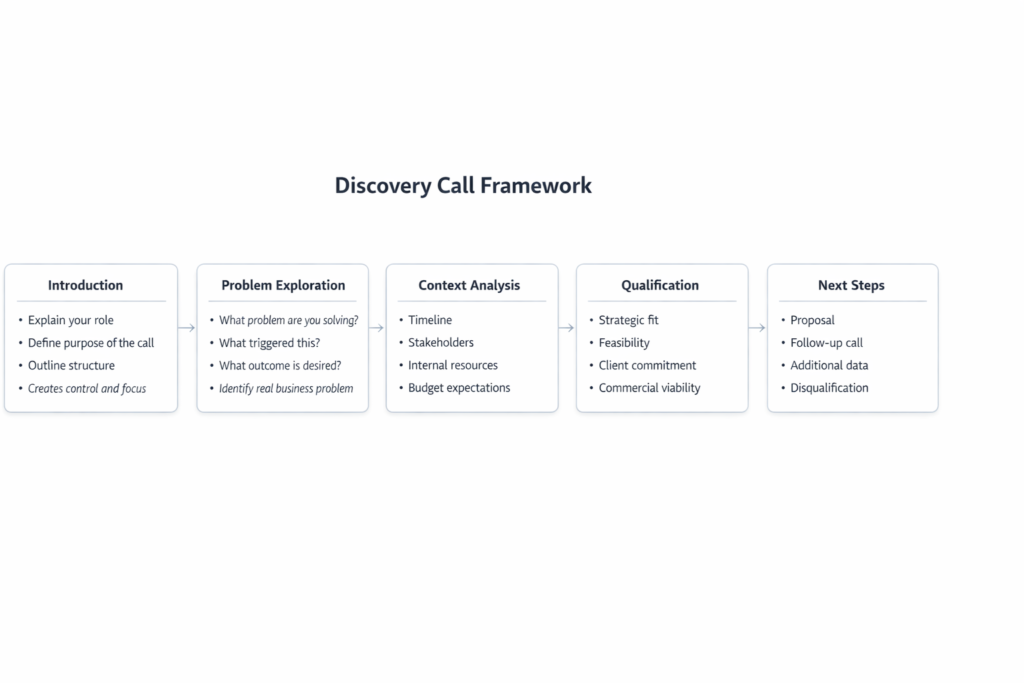
1. Introduction
Set expectations for the client discovery call:
- explain your role
- define the purpose of the call
- outline the structure
This creates control and focus.
2. Problem Exploration
This is the most important part of any freelance discovery call.
Key questions:
- What problem are you trying to solve?
- What triggered this initiative?
- What outcome do you want?
The goal is to uncover the real business problem—not just surface requests.
3. Context Analysis
A strong discovery call framework includes context gathering:
- timeline
- stakeholders
- internal resources
- budget expectations
This determines whether the project is viable.
4. Qualification
This stage defines whether the opportunity should move forward.
A proper discovery call for freelancers must evaluate:
- strategic fit
- feasibility
- client commitment
- commercial viability
→ Client Qualification Framework for Freelancers
→ How to Qualify Freelance Leads Strategically
5. Next Steps
Every freelance discovery call must end with a clear outcome:
- proposal
- follow-up call
- additional data
- disqualification
Without defined next steps, deals stall.
How Discovery Calls Improve Pipeline Quality
A structured discovery call process acts as a filter inside the sales pipeline.
- weak opportunities are removed early
- strong opportunities are clarified
- pipeline quality improves
This leads to:
- fewer wasted proposals
- higher conversion rates
- more predictable revenue
→ Increase Proposal Conversion Rate as a Freelancer
Operationalizing Discovery Calls
To run effective discovery calls for freelancers, consistency is essential.
Freelancers should:
- follow a repeatable discovery call framework
- capture structured data during the call
- assign pipeline stages immediately
- define next actions
Supporting systems include:
→ Deal Tracking Systems for Freelancers
→ Simple CRM Setup for Freelancers
You can manage supporting tools here:
→ Client Pipeline System Tools
Operational Impact
A structured freelance discovery call system improves:
Lead Quality
Only qualified opportunities move forward.
Conversion Rates
Better qualification increases proposal success.
Forecast Accuracy
Reliable pipeline data improves forecasting.
→ Weighted Revenue Forecasting for Freelancers
Capacity Planning
Early clarity improves workload decisions.
System-Level Impact Across Processome
Discovery calls influence:
- Client Pipeline System → qualification
- Capacity Planning System → feasibility
- Profit Tracking System → pricing decisions
- Delivery & Operations System → execution clarity
Common Failure Patterns
Turning Discovery Into a Sales Pitch
Reduces effectiveness of the discovery call process.
Pricing Too Early
Breaks qualification logic.
Shallow Problem Exploration
Leads to weak proposals.
No Clear Next Step
Causes pipeline stagnation.
Strategic Outcome
When freelancers implement structured discovery calls:
- pipeline quality improves
- proposal efficiency increases
- sales cycles shorten
- client alignment strengthens
Over time, the freelance discovery call becomes a core control mechanism within the pipeline.
Final Perspective
A discovery call for freelancers is not just a conversation—it is a structured decision-making stage.
Handled correctly, it determines whether an opportunity should enter the revenue system.
Within the Processome operating model, discovery calls strengthen the Client Pipeline System by ensuring that only qualified, viable opportunities progress toward proposals and conversion.