How to Qualify Freelance Leads Strategically (Framework + Criteria)
Introduction
Most freelancers focus heavily on generating leads—but far fewer have a clear system for deciding which opportunities are worth pursuing.
Without a structured way to qualify freelance leads, every inquiry can appear valuable. In practice, many leads lead to unclear scope, pricing pressure, or delivery issues later in the project.
A strategic approach to freelance lead qualification introduces a consistent way to evaluate opportunities before they enter your pipeline.
Instead of focusing only on whether a lead might convert, you assess whether the engagement fits your operational structure.
This includes evaluating:
- whether the client has a realistic budget
- whether the problem is clearly defined
- whether the scope can be controlled
- whether the timeline fits your capacity
This shifts lead management from reactive decision-making to structured intake control.
Within the Processome operating model, lead qualification belongs to the → Client Pipeline System, the system responsible for managing how opportunities enter and progress through the freelance sales pipeline.
This framework expands on:
→ Client Qualification Framework for Freelancers
Together, these systems ensure that only viable opportunities enter the pipeline—protecting capacity, margin stability, and delivery quality.
What Is Strategic Lead Qualification?
Strategic lead qualification is the process of evaluating whether a freelance lead should enter your pipeline based on operational compatibility.
Unlike traditional sales filtering, which focuses on closing deals, strategic qualification focuses on protecting system stability.
Key distinction:
| Approach | Primary Objective |
|---|---|
| Sales Filtering | Optimize conversion |
| Strategic Qualification | Protect system stability |
Sales filtering asks:
“Can this opportunity be closed?”
Strategic qualification asks:
“Should this opportunity enter the system at all?”
Qualification decisions typically occur during early interactions such as discovery conversations, discussed in:
→ Discovery Calls for Freelancers
→ Sales Pipeline Stages for Freelancers Explained
The Core Problem
Many freelancers evaluate incoming leads reactively rather than strategically.
Common decision drivers include:
- excitement about new opportunities
- perceived prestige of the client
- short-term income pressure
- reluctance to reject potential work
As a result, leads are evaluated based on interest rather than operational fit.
This creates predictable downstream problems.
Scope Instability
Projects evolve unpredictably due to unclear initial problem definition.
Capacity Overload
Multiple accepted engagements exceed available delivery capacity.
Margin Compression
Excessive meetings or revisions reduce effective hourly earnings.
Delivery Stress
Poorly qualified leads introduce complexity that affects execution.
These issues often appear during delivery—but originate during the lead qualification stage.
Freelancers managing leads informally (e.g. inbox or notes) often lack visibility into pipeline quality. Systems such as:
→ Simple CRM Setup for Freelancers
and the supporting tools available in:
→ Client Pipeline System Tools
help structure opportunities before qualification decisions are made.
The Strategic Lead Qualification Framework
A structured approach to freelance lead qualification evaluates each opportunity across five key dimensions.
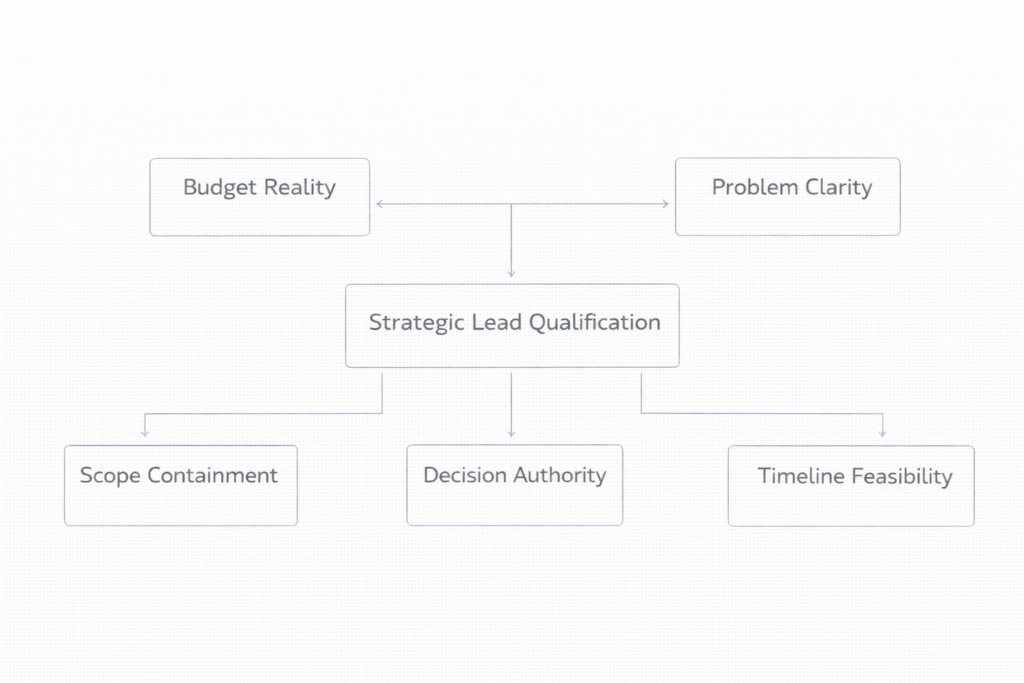
A practical lead qualification checklist for freelancers includes:
1. Budget Reality
The client must have a realistic budget aligned with the scope of work.
Signals of weak alignment include:
- hesitation around pricing
- requests for early discounts
- positioning the project as “exploratory” to reduce commitment
If the budget cannot support the required scope, margin pressure will emerge during delivery.
Financial alignment affects:
→ Profit Tracking System
→ Effective Hourly Rate Calculation Framework
2. Problem Clarity
The client’s problem must be sufficiently defined to allow clear scoping.
Warning signals include:
- vague objectives
- shifting problem definitions
- unclear success criteria
Ambiguous problems often lead to unpaid discovery work and repeated revisions.
Clear problem definition is essential for controlling delivery effort.
3. Decision Authority
You must understand who has authority to approve:
- project scope
- budget allocation
- timelines
- contractual agreements
If conversations happen only with intermediaries, risks include:
- prolonged decision cycles
- repeated proposal revisions
- unreliable forecasting
Early verification improves pipeline efficiency.
4. Scope Containment
The engagement must have clearly defined boundaries.
Evaluate whether:
- deliverables can be specified clearly
- scope boundaries are realistic
- change requests can be formalized
Uncontrolled scope leads to workload expansion without proportional revenue.
This directly affects:
→ Capacity Planning System
→ Profit Tracking System
5. Timeline Feasibility
The proposed timeline must align with your available capacity.
Warning signals include:
- unrealistic urgency
- compressed delivery timelines
- rigid deadlines unrelated to scope complexity
Timeline feasibility must be evaluated alongside:
→ Capacity Planning for Freelancers Explained
For a structured evaluation of workload feasibility, refer to:
→ Capacity Planning System Tools
Capacity determines feasibility—urgency alone should not override constraints.
Operational Impact
Strategic lead qualification improves multiple operational dimensions.
Stronger Pipeline Quality
Fewer but higher-quality leads enter the pipeline.
Improved Capacity Stability
Projects align with available delivery capacity.
Better Profit Protection
Qualified engagements maintain healthier margins.
System-Level Impact Across Processome
Strategic qualification affects the full Processome architecture:
- Client Pipeline System → opportunity filtering
- Capacity Planning System → workload feasibility
- Profit Tracking System → margin protection
- Delivery & Operations System → execution stability
Filtering early improves every downstream system.
Common Failure Patterns
Accepting Prestige Clients Without Evaluation
High-profile clients may still create operational misalignment.
Discounting Before Scope Is Defined
Pricing decisions made too early often reduce margins.
Accepting Urgency as Justification
Artificial deadlines pressure poor decisions.
Postponing Qualification Decisions
Moving forward while “hoping things will align later.”
These issues compound during delivery.
Strategic Outcome
Implementing structured lead qualification leads to:
Higher-Quality Opportunities
Leads better match your operating structure.
More Predictable Workload
Projects align with capacity constraints.
Improved Profit Stability
Engagements maintain stronger margins.
Stronger Decision-Making
Greater confidence in rejecting misaligned leads.
Over time, your pipeline becomes a curated set of viable consulting opportunities—not a random collection of leads.
Final Perspective
Freelance growth is often framed as a lead generation problem. In practice, long-term stability depends equally on how you qualify freelance leads.
Strategic qualification ensures that only engagements compatible with your operating structure enter the pipeline.
Within the Processome model, this acts as a control layer inside the Client Pipeline System—protecting revenue, capacity, and delivery stability.