Simple CRM Setup for Freelancers (How to Structure Your Pipeline)
Introduction
Many freelancers look for tools to improve their sales process and assume that implementing a CRM will solve their pipeline problems.
In practice, a CRM does not create structure—it only enforces the structure that already exists.
That is why a simple CRM setup for freelancers is not about choosing the right tool. It is about ensuring that your pipeline is clearly defined before the tool is introduced.
Within the Processome operating model, CRM setup belongs to the → Client Pipeline System, the system responsible for managing how opportunities enter and progress through the freelance sales pipeline.
For solo B2B freelancers, the goal of a CRM is not automation or complexity. Its purpose is to maintain pipeline discipline by ensuring that every opportunity is visible, structured, and consistently tracked.
When implemented correctly, a CRM becomes an enforcement layer for your pipeline—not the system itself.
What Is a Simple CRM Setup for Freelancers?
A simple CRM setup for freelancers is a minimal system for tracking pipeline opportunities in a structured and consistent way.
It focuses on:
- pipeline stage visibility
- qualification status
- deal value tracking
Unlike complex sales systems, a freelance CRM setup prioritizes clarity over automation.
The CRM does not define your sales process—it reflects it.
Before implementing a CRM, the following elements must already exist:
→ Sales Pipeline Stages for Freelancers
→ How to Qualify Freelance Leads Strategically
→ Weighted Revenue Forecasting for Freelancers
Once these are defined, the CRM ensures that every opportunity follows the same structure.
The Core Problem
Many freelancers implement CRM tools before defining their pipeline structure.
Typical questions include:
- which CRM tool to use
- which automation features to enable
- how follow-ups should be scheduled
These decisions are made before defining:
- pipeline stages
- qualification criteria
- deal tracking logic
This tool-first approach creates several issues.
Overengineered Pipelines
Too many stages, fields, or automation rules.
Inconsistent Data
Opportunities are tracked differently across the pipeline.
Low Adoption
The CRM becomes burdensome and is abandoned.
Reduced Forecast Reliability
Unstructured data leads to unreliable forecasts.
A CRM should simplify pipeline management—not complicate it.
The Simple CRM Framework
A freelance CRM setup should focus on three essential functions.
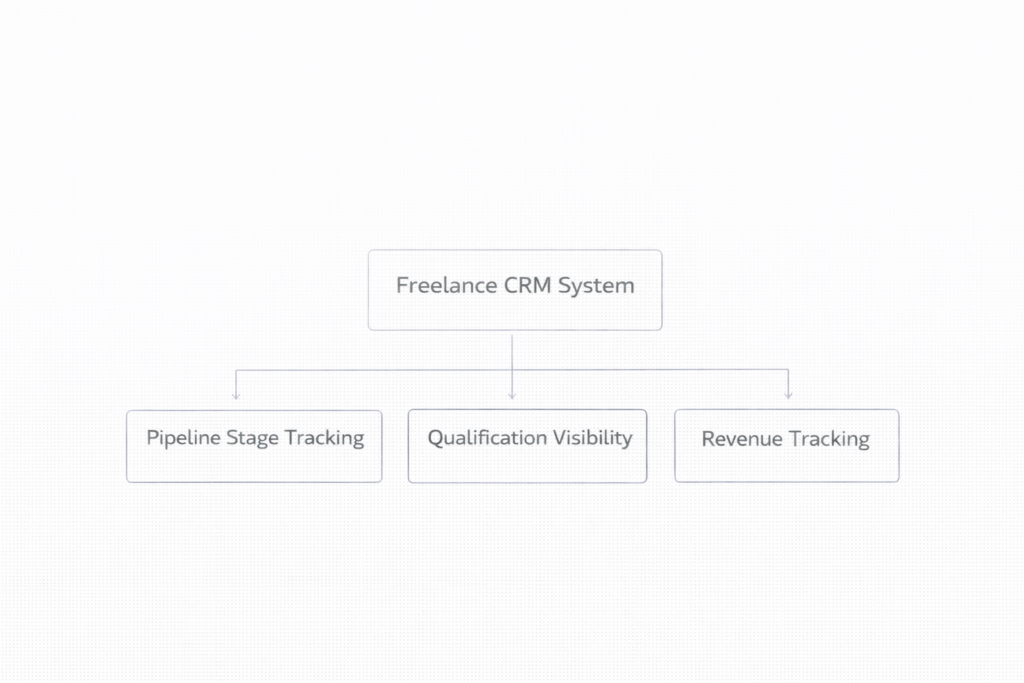
1. Pipeline Stage Tracking
Every opportunity must exist within a clearly defined stage.
Each deal should occupy exactly one stage at any time.
Typical stages include:
- lead identified
- qualified opportunity
- solution defined
- decision pending
- closed
These stages align with:
→ Sales Pipeline Stages for Freelancers
Tracking stage progression ensures pipeline visibility and consistency.
2. Qualification Visibility
The CRM should clearly indicate whether an opportunity has passed qualification.
This prevents weak leads from progressing through the pipeline unnoticed.
Qualification frameworks include:
→ Client Qualification Framework for Freelancers
Clear qualification status improves pipeline quality and decision-making.
3. Revenue Tracking
Each opportunity should include:
- deal value
- expected timing
- current stage
This enables freelance revenue forecasting.
Rather than calculating forecasts directly, the CRM provides the structured data required for:
→ Weighted Revenue Forecasting for Freelancers
The CRM acts as a data source—not a forecasting tool.
Operationalizing a Simple CRM Setup
A CRM only works when it is used consistently.
Freelancers should:
- update deal stages regularly
- remove inactive opportunities
- maintain consistent data structure
Without discipline, even a simple CRM setup loses effectiveness.
To support this, freelancers can use the tools available in:
→ Client Pipeline System Tools
These tools help implement and maintain structured pipeline tracking without unnecessary complexity.
Operational Impact
A well-structured CRM for freelancers improves several operational dimensions.
Pipeline Visibility
Clear overview of all active opportunities.
Improved Forecast Accuracy
Consistent data improves forecasting reliability.
Stronger Capacity Alignment
Upcoming workload becomes easier to anticipate.
→ Capacity Planning for Freelancers Explained
System-Level Impact Across Processome
CRM discipline supports:
- Client Pipeline System → opportunity tracking
- Capacity Planning System → workload forecasting
- Profit Tracking System → revenue visibility
- Delivery & Operations System → onboarding readiness
Consistent pipeline data improves decision-making across all systems.
Common Failure Patterns
Freelancers often encounter issues due to poor CRM setup.
Excessive Data Fields
Too much tracking increases administrative burden.
Custom Stages per Client
Breaks consistency across pipeline data.
Tracking Activity Instead of Decisions
Creates noise instead of clarity.
Keeping Unqualified Leads
Reduces pipeline quality.
These issues reduce trust in the CRM and lead to abandonment.
Strategic Outcome
When freelancers implement a simple CRM setup, several benefits emerge.
Clear Pipeline Visibility
All opportunities are structured and visible.
Improved Forecasting
Reliable data supports accurate projections.
Better Capacity Planning
Workload can be anticipated more effectively.
Reduced Complexity
The CRM supports the system without adding friction.
Over time, the CRM becomes a background system that enforces discipline rather than requiring attention.
Final Perspective
CRM systems are often perceived as complex sales tools. For freelancers, their role is much simpler.
A simple CRM setup for freelancers should act as a structured record of pipeline activity—nothing more.
Within the Processome operating model, the CRM supports the Client Pipeline System by enforcing the structure required for predictable revenue.
When the system is well designed, the CRM becomes almost invisible.