Delivery System for Freelancers Explained
Introduction
Freelance consulting businesses often invest significant effort in client acquisition and sales processes. However, once a project begins, delivery operations frequently rely on informal coordination rather than structured execution systems.
This creates operational instability.
Projects may progress through ad-hoc communication, improvised task management, and shifting expectations. While this approach can work temporarily, it becomes increasingly fragile as client complexity grows.
Within the Processome operating model, execution stability is governed by the → Delivery & Operations System, the operational framework responsible for ensuring that consulting work is delivered consistently, predictably, and efficiently.
A delivery system defines how projects move from signed agreement to completed outcome.
Without it, execution becomes reactive.
With it, delivery becomes structured and repeatable.
The Core Problem
Many freelancers begin projects without a defined operational structure.
Typical delivery practices include:
- coordinating tasks through email threads
- managing deliverables through memory or informal notes
- responding to client requests reactively
- adjusting scope without structured review
This informal approach introduces several risks.
Unclear Project Structure
Without defined workflows, project progress may become inconsistent or difficult to track.
Scope Drift
Client expectations may evolve without clear boundaries or change management.
Delivery Delays
Lack of structured milestones can cause timelines to slip unnoticed.
Coordination Overload
Freelancers may spend excessive time clarifying expectations and project status.
These problems are not primarily caused by client behavior.
They emerge from the absence of a structured delivery system.
Concept Explanation
A freelance delivery system is the operational structure that governs how consulting work is executed after a project is sold.
It defines the processes through which:
- projects are initiated
- work is planned and organized
- deliverables are produced
- client communication is managed
- outcomes are reviewed and completed
Instead of treating every engagement as a unique operational challenge, the delivery system establishes a consistent execution model.
Several supporting frameworks contribute to this system, including:
→ Project Planning for Freelancers
→ Client Onboarding System for Freelancers
These frameworks ensure that each engagement follows a predictable operational path.
A structured delivery system reduces operational friction and improves execution reliability.
Freelance Delivery System Framework
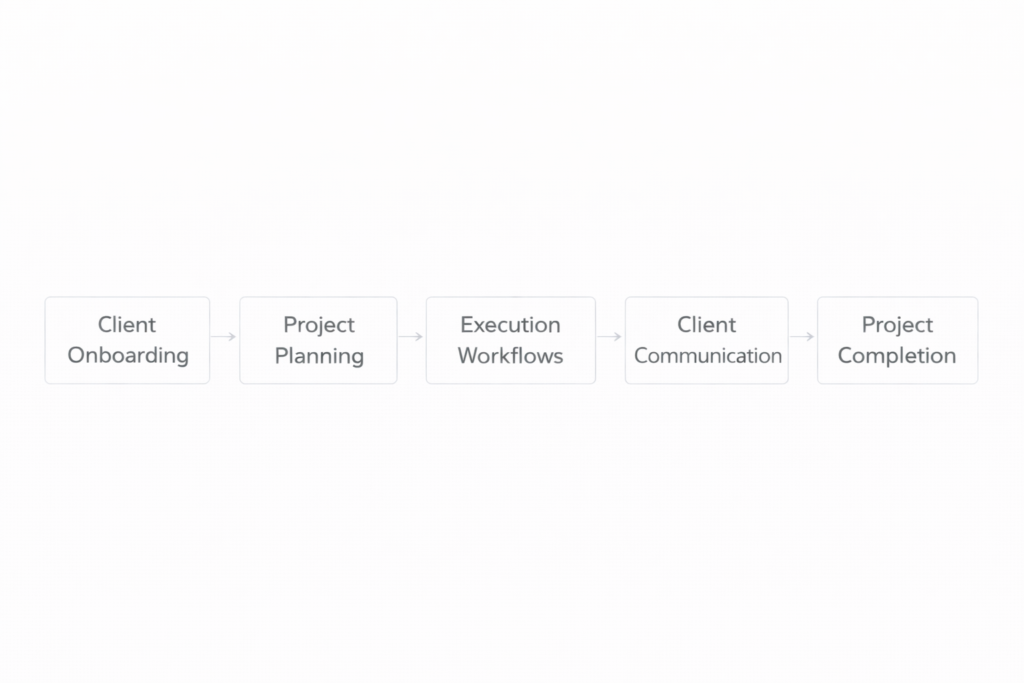
A delivery system can be structured around five operational stages.
1. Client Onboarding
Delivery begins with structured onboarding.
This stage ensures that both consultant and client share clear expectations regarding:
- project scope
- deliverables
- communication channels
- timeline structure
Onboarding frameworks are explored in:
→ Client Onboarding System for Freelancers
Clear onboarding prevents confusion during execution.
2. Project Planning
Once onboarding is complete, the project must be translated into an operational plan.
Planning defines:
- milestones
- deliverables
- delivery timelines
- review cycles
Project planning creates visibility into how work will progress.
This framework is discussed in:
→ Project Planning for Freelancers
3. Execution Workflow
The execution stage governs how work is actually performed.
This includes:
- task sequencing
- research and analysis
- deliverable development
- iterative feedback cycles
Execution workflows ensure that projects progress consistently rather than through ad-hoc activity.
4. Client Communication
Effective communication maintains alignment throughout the project.
Structured communication may include:
- milestone updates
- review sessions
- feedback cycles
Clear communication reduces misunderstandings and ensures that client expectations remain aligned with project progress.
5. Project Completion
The final stage ensures that deliverables are finalized and outcomes are reviewed.
Completion activities may include:
- final deliverable handoff
- outcome validation
- project retrospective
Structured completion improves delivery quality and strengthens long-term client relationships.
Operational Impact
A structured delivery system improves several operational aspects of freelance consulting businesses.
Execution Consistency
Projects follow predictable workflows rather than improvisational coordination.
Reduced Delivery Risk
Structured milestones reduce the likelihood of unexpected delays.
Client Confidence
Clear processes increase client trust in the delivery approach.
Operational Efficiency
Standardized workflows reduce coordination overhead and decision fatigue.
Delivery systems therefore improve both execution quality and operational stability.
System-Level Impact Across Processome
The Delivery & Operations System coordinates execution with the other Processome systems.
Client Pipeline System → opportunity inflow aligned with delivery capability
Capacity Planning System → workload feasibility during project execution
Profit Tracking System → margin visibility through controlled delivery effort
Delivery & Operations System → execution stability and operational reliability
Delivery systems ensure that incoming work can be executed consistently within operational constraints.
Common Failure Patterns
Freelancers frequently experience delivery problems due to missing operational structure.
Several patterns are common.
Improvised Project Management
Projects may progress through informal communication rather than defined workflows.
Weak Onboarding
Poorly defined expectations at project start lead to confusion later.
Scope Drift
Deliverables expand without structured change management.
Reactive Communication
Client updates occur only when issues arise rather than through planned communication cycles.
These patterns create delivery instability and increase operational stress.
Strategic Outcome
When freelancers implement structured delivery systems, execution becomes significantly more predictable.
Instead of managing each engagement through improvisation, consultants operate through defined operational frameworks.
This produces several advantages.
Consistent project progress
Structured workflows ensure that work advances steadily.
Improved delivery quality
Standardized processes reduce errors and coordination problems.
Reduced operational stress
Freelancers spend less time managing delivery chaos.
Stronger client relationships
Predictable delivery increases client confidence.
Over time, delivery becomes an operational system rather than a reactive process.
Final Perspective
Freelancers often focus heavily on client acquisition while leaving delivery processes informal.
However, the long-term sustainability of consulting businesses depends equally on execution reliability.
Within the Processome operating model, the → Delivery & Operations System ensures that consulting work is delivered through structured, repeatable processes.
Client acquisition creates opportunity.
Delivery systems transform opportunity into consistent results.