Client Communication Systems
Introduction
Communication plays a central role in freelance consulting engagements. Clients expect updates, feedback discussions, and collaboration throughout the delivery process.
However, when communication occurs without structure, it can quickly become a source of operational friction. Freelancers may receive messages across multiple channels, respond reactively to requests, and struggle to maintain focus on project execution.
Within the Processome operating model, communication discipline belongs to the → Delivery & Operations System, the framework responsible for maintaining stable collaboration between consultants and clients.
Client communication systems define how information flows during a consulting engagement. Instead of responding to communication demands informally, freelancers establish structured processes that guide when and how interactions occur.
Clear communication systems reduce interruptions and improve delivery stability.
The Core Problem
Many freelancers manage client communication reactively.
Clients may contact consultants through various channels, including:
- messaging platforms
- phone calls
- project management tools
Without defined communication structures, freelancers often respond immediately to incoming messages.
This approach introduces several operational challenges.
Constant Interruptions
Frequent client messages disrupt focused work.
Fragmented Communication
Information becomes scattered across multiple platforms.
Unclear Update Expectations
Clients may request updates frequently if communication rhythms are not defined.
Delayed Feedback
Feedback cycles may occur unpredictably, slowing project progress.
These challenges rarely result from excessive communication alone.
They emerge when communication systems are missing.
Concept Explanation
A client communication system defines how consultants and clients exchange information throughout a consulting engagement.
Instead of allowing communication to occur randomly, freelancers establish operational rules that govern interaction.
Communication systems typically define:
- communication channels
- update frequency
- meeting structures
- feedback processes
These rules ensure that communication remains predictable and efficient.
Communication systems complement other operational frameworks such as:
→ Project Kickoff Framework for Consultants
→ Managing Client Expectations
Kickoff meetings establish communication norms, while expectation management ensures that clients understand how interaction will occur.
Together, these frameworks create structured collaboration.
Client Communication System Framework
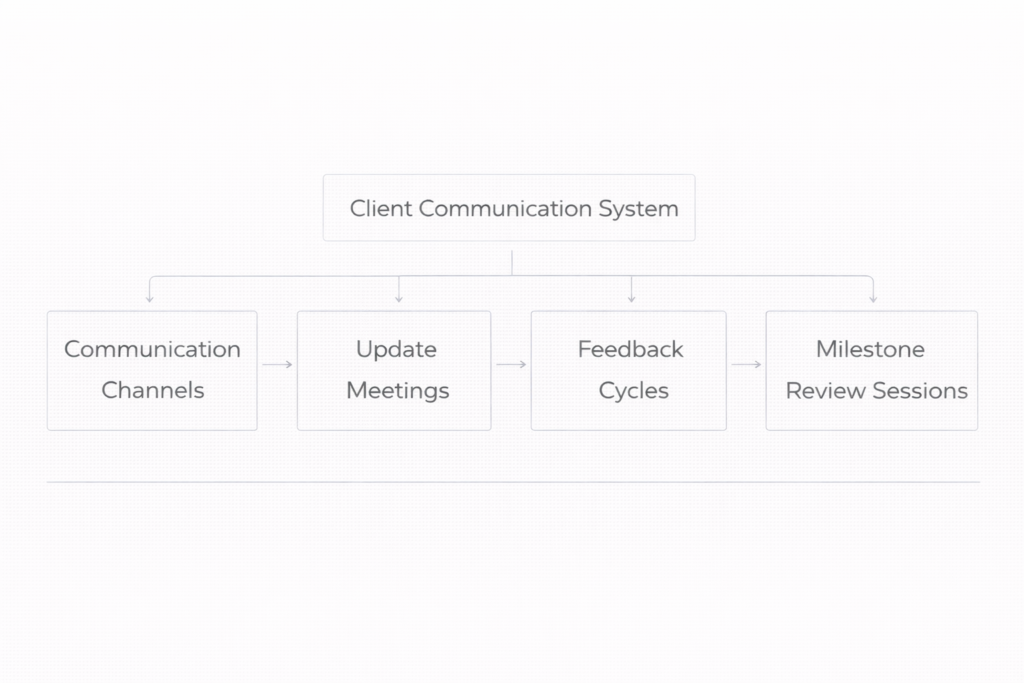
A structured communication system typically includes four operational components.
1. Defined Communication Channels
Freelancers should define the primary channels used for client communication.
Common channels include:
- email for formal communication
- messaging platforms for quick coordination
- video calls for milestone discussions
Defining channels reduces fragmentation and keeps information organized.
2. Scheduled Update Meetings
Regular update meetings help maintain alignment between consultant and client.
These meetings may include:
- project progress updates
- milestone reviews
- discussion of upcoming deliverables
Scheduled updates reduce the need for frequent ad-hoc communication.
3. Structured Feedback Cycles
Feedback should occur at defined points within the project timeline.
This may involve:
- reviewing milestone deliverables
- providing consolidated feedback
- confirming alignment before proceeding
Structured feedback improves delivery momentum.
4. Communication Response Guidelines
Freelancers should clarify response expectations.
Examples include:
- expected response times
- appropriate communication channels for urgent issues
- boundaries for non-urgent communication
These guidelines help maintain focus during project execution.
Operational Impact
Structured communication systems improve several operational aspects of freelance consulting engagements.
Reduced Interruptions
Freelancers can focus on delivery work without constant reactive communication.
Improved Information Flow
Defined channels keep project information organized.
Faster Feedback Cycles
Clients know when and how feedback should occur.
Stronger Collaboration
Structured communication improves transparency and trust.
Communication systems therefore strengthen both operational efficiency and client relationships.
System-Level Impact Across Processome
Client communication systems influence coordination across the Processome operating architecture.
Client Pipeline System → expectations established during discovery and proposal stages
Capacity Planning System → predictable communication schedules reduce workflow disruption
Profit Tracking System → efficient collaboration protects margin and delivery efficiency
Delivery & Operations System → structured communication stabilizes project execution
Communication discipline ensures that consulting engagements remain operationally efficient.
Common Failure Patterns
Freelancers often experience communication challenges because communication structures remain informal.
Several patterns frequently appear.
Multiple Communication Channels
Clients contact freelancers through many platforms simultaneously.
Reactive Messaging
Freelancers respond immediately to all messages.
Missing Update Rhythm
Clients request frequent updates because progress communication is unclear.
Unstructured Feedback
Feedback arrives in fragmented messages rather than organized review sessions.
These patterns increase operational complexity.
Strategic Outcome
When structured communication systems are implemented, freelance consulting engagements become significantly more organized.
Instead of reacting continuously to incoming messages, freelancers guide communication through defined processes.
This produces several advantages.
Improved focus
Freelancers can concentrate on delivery work.
Clear collaboration structure
Clients understand how and when communication will occur.
Faster project progress
Structured feedback cycles maintain momentum.
Stronger client relationships
Transparent communication improves trust.
Communication systems transform collaboration from reactive messaging into structured interaction.
Final Perspective
Freelancers often assume that communication simply happens naturally during consulting engagements.
In reality, communication quality depends heavily on operational structure.
Within the Processome operating model, the → Delivery & Operations System ensures that client collaboration occurs through clear communication channels, defined feedback cycles, and structured update rhythms.
Clear communication systems create stable collaboration.