Scope Control Framework for Solo Consultants
Introduction
Many freelance consulting projects begin with clearly defined deliverables. However, as work progresses, additional requests, revisions, and new expectations often emerge.
These changes may appear small individually, but over time they can significantly expand the workload associated with a project.
Without structured scope control, freelancers often experience:
- expanding project requirements
- increasing delivery effort
- declining project margins
Within the Processome operating model, scope management belongs to the → Delivery & Operations System, the operational framework responsible for maintaining delivery stability and execution discipline.
A scope control framework ensures that consulting engagements remain aligned with their original objectives while providing a structured mechanism for handling legitimate project changes.
Scope discipline protects delivery stability.
Without it, project boundaries dissolve.
The Core Problem
Scope expansion is one of the most common operational risks in freelance consulting.
Clients frequently request additional work during the course of a project.
Examples include:
- additional deliverables
- extended analysis or research
- new stakeholder presentations
- extra revision cycles
While many of these requests may appear reasonable, accepting them without structured evaluation introduces several risks.
Margin Erosion
Additional work increases delivery effort without corresponding revenue.
Timeline Instability
Project schedules may extend as new requests accumulate.
Capacity Disruption
Unexpected work may interfere with other scheduled client engagements.
Expectation Confusion
Clients may begin to assume that additional work is included within the original scope.
These problems emerge when scope boundaries are not actively managed.
Scope control protects both delivery capacity and financial sustainability.
Concept Explanation
A scope control framework defines how consulting projects manage changes to deliverables, timelines, or requirements during execution.
Instead of accepting or rejecting requests informally, freelancers evaluate them through structured criteria.
Scope control involves three core principles:
- defining clear project boundaries
- identifying scope changes early
- evaluating requests through structured decision rules
This approach ensures that project changes are handled transparently and professionally.
Structured scope management is closely connected to several other operational frameworks.
For example:
→ Change Request Management for Freelancers
→ Project Planning for Freelancers
These frameworks help ensure that delivery expectations remain aligned throughout the project lifecycle.
Section 3 — Scope Control Framework
[Image Placeholder – Scope Control Framework]
Alt text: framework showing defined project scope, incoming change requests, evaluation process, and decisions to approve, adjust pricing, or defer work
SEO file name: scope-control-framework-processome.png
Image prompt:
Diagram showing a project scope boundary receiving incoming change requests that pass through an evaluation process before being accepted, repriced, or deferred.
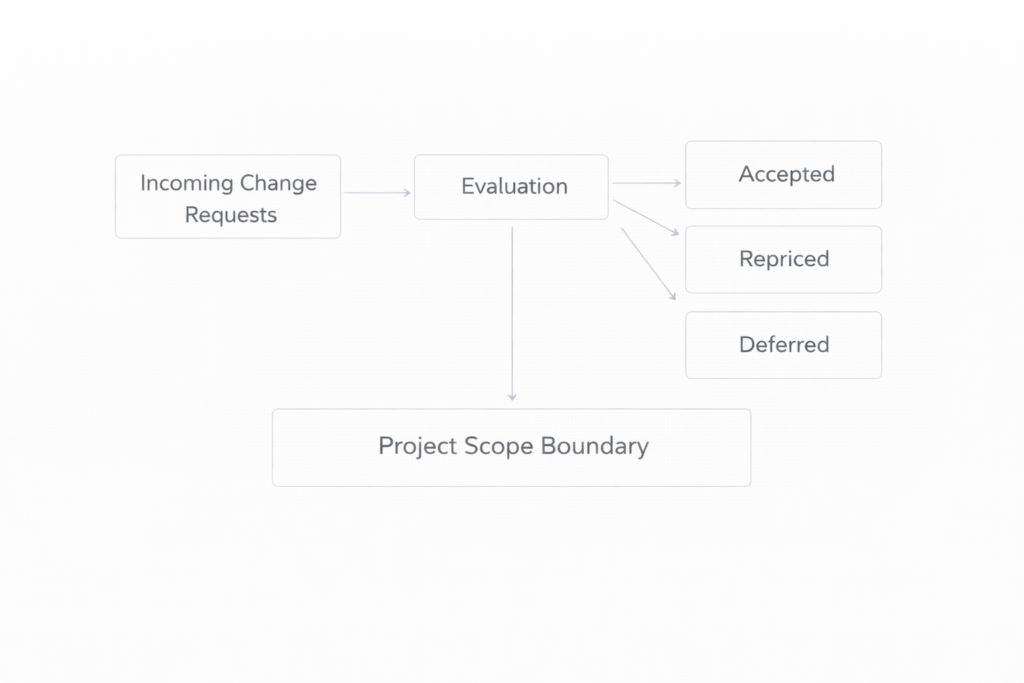
A scope control framework typically includes four operational components.
1. Scope Definition
Scope control begins with a clearly defined project scope.
Scope definitions should include:
- deliverables
- milestones
- revision limits
- communication structure
Clear scope definitions establish a shared understanding between consultant and client.
Ambiguous scope definitions create opportunities for uncontrolled expansion.
2. Change Request Identification
Scope changes often emerge gradually during project execution.
Freelancers must identify when a request exceeds the original agreement.
Common signals include:
- requests for additional deliverables
- expanded research requirements
- new stakeholder involvement
- repeated revision cycles
Early identification prevents scope changes from accumulating unnoticed.
3. Change Evaluation
Once a potential scope change is identified, it must be evaluated.
Evaluation criteria may include:
- impact on delivery time
- effect on project schedule
- additional delivery effort required
This evaluation determines whether the request should be:
- incorporated into the existing scope
- treated as additional work
- scheduled for a future engagement
Structured evaluation prevents impulsive decisions.
4. Scope Adjustment
When scope changes are accepted, adjustments must be formalized.
Possible adjustments include:
- revised pricing
- extended timelines
- additional deliverables under a new agreement
Formalizing adjustments maintains alignment between effort and compensation.
This step preserves both delivery discipline and financial sustainability.
Operational Impact
A structured scope control framework improves several aspects of freelance consulting operations.
Margin Protection
Additional work is evaluated and priced appropriately.
Delivery Stability
Projects remain aligned with planned timelines and capacity allocations.
Client Transparency
Clients gain a clear understanding of how project changes affect delivery.
Workload Predictability
Freelancers maintain better control over their delivery schedules.
Scope control therefore protects both operational stability and financial performance.
System-Level Impact Across Processome
Scope management affects several systems within the Processome operating architecture.
Client Pipeline System → qualification of projects with clearly defined deliverables
Capacity Planning System → workload stability during project execution
Profit Tracking System → margin visibility through controlled delivery effort
Delivery & Operations System → execution stability through structured change management
Clear scope control ensures that delivery operations remain aligned with both capacity and financial objectives.
Common Failure Patterns
Freelancers often struggle with scope control because additional work requests can feel difficult to refuse.
Several patterns frequently appear.
Informal Scope Expansion
Freelancers accept additional requests without documenting scope changes.
Fear of Client Friction
Consultants may avoid discussing scope boundaries to maintain positive relationships.
Weak Initial Scope Definitions
Projects may begin with unclear deliverables, creating ambiguity later.
Delayed Change Management
Scope changes may only be addressed after significant additional work has already been performed.
These behaviors gradually undermine delivery discipline.
Strategic Outcome
When scope control frameworks are implemented effectively, freelance projects become significantly more stable and predictable.
Instead of absorbing uncontrolled workload expansion, consultants manage project changes through structured decision processes.
This produces several advantages.
Protected margins
Additional work receives appropriate compensation.
Stable project timelines
Delivery schedules remain aligned with capacity constraints.
Improved client relationships
Clear communication reduces misunderstandings.
Stronger operational discipline
Freelancers maintain control over delivery execution.
Scope control transforms project change from a risk into a manageable operational process.
Final Perspective
Scope expansion is one of the most common causes of margin erosion in freelance consulting.
Without structured scope control, small changes gradually accumulate into significant delivery pressure.
Within the Processome operating model, the → Delivery & Operations System ensures that consulting engagements remain aligned with defined objectives and operational capacity.
Clear scope boundaries protect both delivery stability and financial sustainability.
Defined scope creates predictable delivery.