Documentation Systems for Consultants
Introduction
Consulting work produces a significant amount of information. Client conversations, research insights, project plans, deliverables, and operational procedures all generate knowledge that supports future work.
However, many freelancers store this information informally across scattered documents, emails, and notes. Over time, this fragmentation makes it difficult to locate important information or reuse valuable insights.
Within the Processome operating model, knowledge management belongs to the → Delivery & Operations System, the framework responsible for maintaining stable and repeatable consulting processes.
Documentation systems organize the information produced during consulting engagements and operational work.
Instead of allowing knowledge to remain dispersed, freelancers create structured systems that store, organize, and retrieve information efficiently.
Well-designed documentation systems transform experience into reusable operational knowledge.
The Core Problem
Freelancers often manage documentation informally.
Information may be stored in:
- scattered documents
- email threads
- personal notes
- project folders
While these sources may contain valuable insights, they rarely form a coherent knowledge system.
This fragmentation introduces several operational challenges.
Lost Knowledge
Important insights from previous projects may become difficult to locate.
Repeated Work
Freelancers may recreate analyses or frameworks that were already developed earlier.
Inconsistent Processes
Operational procedures may vary between projects because documentation is incomplete.
Slower Project Preparation
Freelancers may spend time searching for relevant materials before beginning new work.
These problems rarely result from lack of knowledge.
They usually arise because that knowledge has not been organized systematically.
Concept Explanation
A documentation system is the structured method used to store and organize information generated through consulting work and business operations.
Instead of saving information in isolated locations, freelancers create organized documentation repositories that capture:
- consulting frameworks and insights
- project deliverables and templates
- operational procedures
- research materials
Documentation systems ensure that knowledge remains accessible and reusable.
They support both project execution and operational efficiency.
Documentation systems also complement frameworks such as:
→ SOP Library Structure for Freelancers
→ Delivery Workflow Systems
Standard operating procedures define processes, while documentation systems store the information that supports those processes.
Documentation System Framework
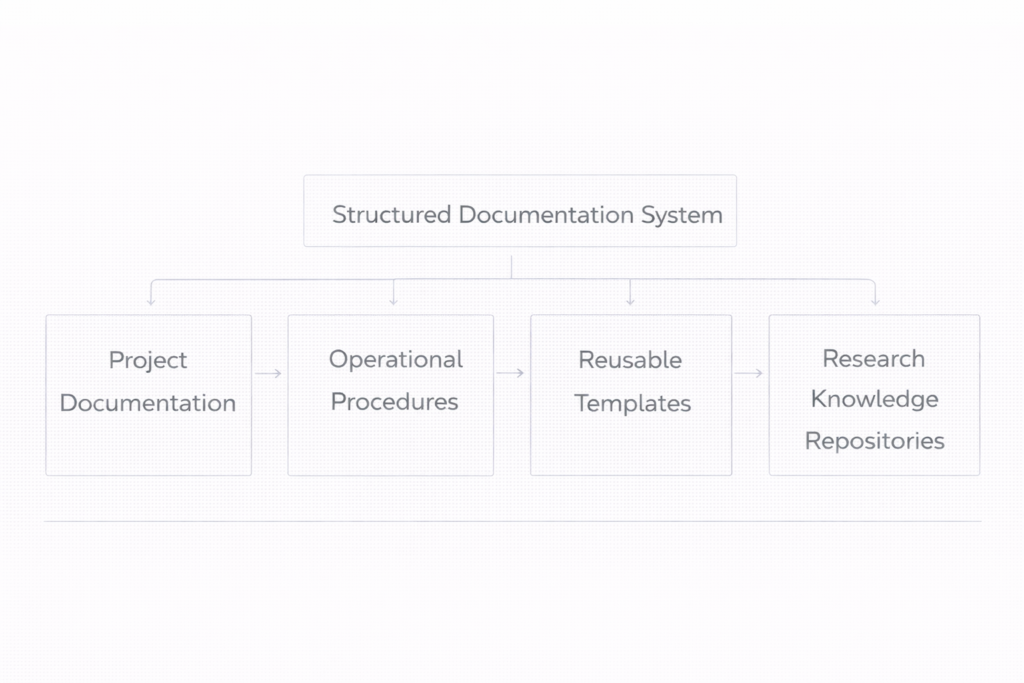
A structured documentation system typically includes four core knowledge categories.
1. Project Documentation
Project documentation stores materials generated during consulting engagements.
Examples include:
- research notes
- project analyses
- deliverables and presentations
- client-specific insights
Maintaining organized project documentation allows freelancers to reference previous work efficiently.
2. Operational Procedures
Operational documentation records the processes used to run the consulting business.
Examples include:
- onboarding procedures
- proposal preparation steps
- delivery workflows
These documents support consistent operational execution.
3. Templates and Frameworks
Freelancers often reuse common structures across projects.
Templates may include:
- proposal structures
- presentation layouts
- research frameworks
Maintaining template libraries reduces preparation time for future projects.
4. Research and Knowledge Resources
Consulting often involves ongoing research and industry analysis.
A documentation system may store:
- industry insights
- reference materials
- analytical models
Organizing research knowledge improves future analytical work.
Operational Impact
Structured documentation systems improve several operational aspects of freelance consulting businesses.
Faster Project Preparation
Freelancers can quickly access relevant frameworks and materials.
Reduced Repetition
Existing insights and templates can be reused across projects.
Consistent Processes
Operational documentation supports repeatable workflows.
Stronger Knowledge Management
Experience accumulates into structured knowledge assets.
Documentation systems therefore transform scattered information into organized consulting knowledge.
System-Level Impact Across Processome
Documentation systems strengthen coordination across the Processome operating architecture.
Client Pipeline System → documented insights support proposal preparation and discovery discussions
Capacity Planning System → structured templates reduce preparation time for new projects
Profit Tracking System → operational documentation improves efficiency and margin performance
Delivery & Operations System → organized knowledge supports consistent consulting delivery
Documentation therefore strengthens both operational stability and consulting effectiveness.
Common Failure Patterns
Freelancers often struggle with documentation because systems are poorly structured.
Several patterns frequently appear.
Unorganized Knowledge Storage
Information is stored without clear categorization.
Excessive Documentation
Freelancers create documents that are rarely used or referenced.
Inconsistent Updates
Documentation becomes outdated as processes evolve.
Difficult Retrieval
Important information remains difficult to locate.
These issues reduce the usefulness of documentation systems.
Strategic Outcome
When documentation systems are implemented effectively, freelance consulting operations become significantly more efficient and scalable.
Instead of relying solely on personal memory, freelancers build structured knowledge repositories that support future work.
This produces several advantages.
Faster project execution
Relevant materials can be accessed quickly.
Improved process consistency
Operational procedures remain documented and repeatable.
Greater knowledge leverage
Insights from past projects support future engagements.
Stronger operational systems
Consulting knowledge becomes an organized business asset.
Documentation systems transform individual expertise into reusable knowledge infrastructure.
Final Perspective
Freelancers often accumulate significant knowledge through consulting work.
However, without structured documentation systems, much of that knowledge remains underutilized.
Within the Processome operating model, the → Delivery & Operations System ensures that consulting insights and operational procedures are organized systematically.
Documentation converts experience into lasting operational knowledge.
Structured knowledge supports stronger consulting systems.