Delivery Risk Management Framework
Introduction
Consulting projects often appear predictable at the start. Deliverables are defined, timelines are agreed upon, and both consultant and client expect the engagement to progress smoothly.
However, as projects unfold, various risks can disrupt delivery. Stakeholder availability may change, project scope may evolve, or unexpected complexity may emerge during execution.
Without structured risk management, these disruptions can lead to missed deadlines, increased workload pressure, and declining margins.
Within the Processome operating model, delivery stability is governed by the → Delivery & Operations System, the framework responsible for ensuring that consulting engagements remain predictable and controlled.
A delivery risk management framework helps freelancers anticipate, monitor, and respond to risks before they destabilize project execution.
Risk management does not eliminate uncertainty.
It ensures that uncertainty remains manageable.
The Core Problem
Many freelancers address delivery risks only after problems appear.
For example:
- timelines are adjusted once delays occur
- additional work is absorbed when scope expands
- client expectations are clarified only after misunderstandings arise
This reactive approach introduces several operational risks.
Delivery Delays
Unexpected complications may extend project timelines.
Capacity Disruptions
Unplanned work can interfere with other client commitments.
Margin Erosion
Additional effort may be required without corresponding compensation.
Client Friction
Late identification of risks may create tension between consultant and client.
These challenges often arise not because risks exist, but because risks are not identified early.
Effective consulting operations anticipate potential disruptions.
Concept Explanation
Delivery risk management is the process of identifying potential threats to project execution and establishing strategies to mitigate their impact.
Instead of reacting to unexpected issues, freelancers proactively evaluate potential risks that may affect delivery.
Typical delivery risks include:
- unclear project scope
- delayed client feedback
- stakeholder availability issues
- unexpected technical complexity
- evolving project requirements
A structured risk management framework allows freelancers to identify these factors early and develop mitigation strategies.
Delivery risk management connects closely with several operational frameworks, including:
→ Scope Control Framework for Solo Consultants
→ Change Request Management for Freelancers
These frameworks ensure that evolving project requirements remain controlled during execution.
Delivery Risk Management Framework
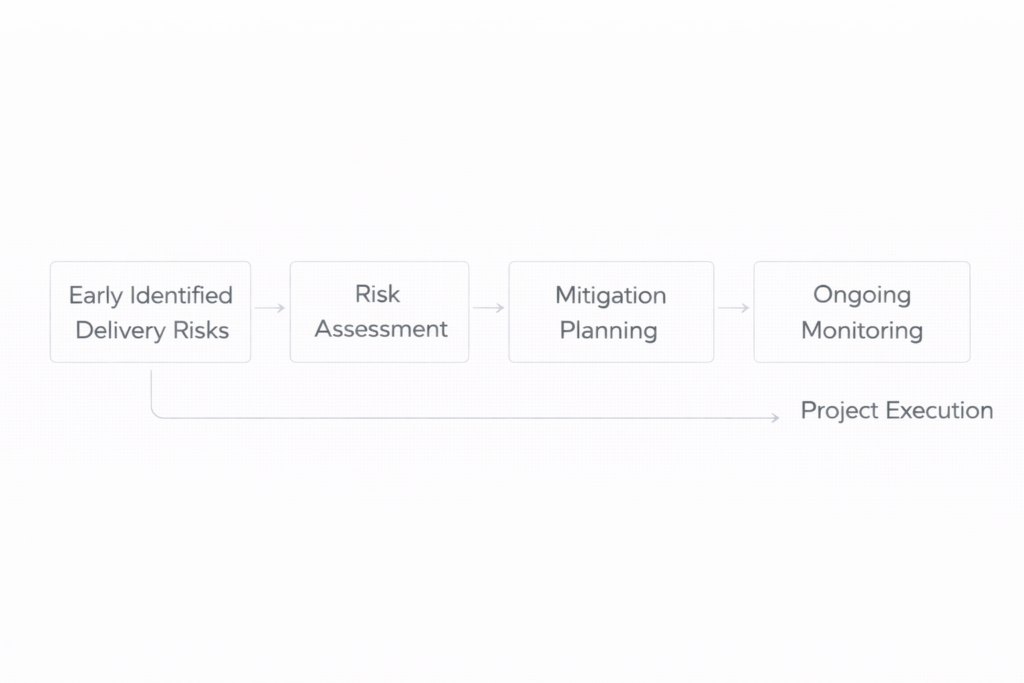
A delivery risk management system typically includes four operational stages.
1. Risk Identification
The first step is identifying potential risks before project execution begins.
Freelancers should consider factors such as:
- complexity of deliverables
- number of stakeholders involved
- dependency on client inputs
- tight delivery timelines
Early identification allows freelancers to prepare mitigation strategies.
2. Risk Assessment
Once risks are identified, their potential impact must be evaluated.
Assessment typically considers:
- likelihood of occurrence
- potential effect on timelines
- impact on delivery effort
This evaluation helps determine which risks require active monitoring.
3. Risk Mitigation
Mitigation strategies reduce the likelihood or impact of identified risks.
Examples may include:
- defining clear scope boundaries
- establishing milestone reviews
- requesting required information early in the project
Mitigation ensures that risks remain manageable rather than disruptive.
4. Ongoing Monitoring
Delivery risks evolve throughout a project.
Freelancers must therefore monitor:
- emerging project complexity
- stakeholder availability
- evolving client expectations
Monitoring allows consultants to respond early if new risks appear.
Risk management is therefore a continuous operational process.
Operational Impact
Implementing delivery risk management improves several aspects of freelance consulting operations.
Greater Project Predictability
Early risk identification improves delivery planning.
Reduced Timeline Disruptions
Mitigation strategies prevent delays from escalating.
Protected Margins
Structured risk management prevents uncontrolled workload expansion.
Improved Client Collaboration
Transparent communication about risks strengthens client trust.
Risk management therefore improves both execution stability and relationship quality.
System-Level Impact Across Processome
Delivery risk management improves coordination across the Processome operating architecture.
Client Pipeline System → project risks evaluated during qualification
Capacity Planning System → workload adjustments made when risks emerge
Profit Tracking System → margin visibility maintained despite evolving project conditions
Delivery & Operations System → execution stability through proactive risk control
Risk awareness ensures that consulting engagements remain aligned with operational capacity and financial expectations.
Common Failure Patterns
Freelancers often encounter delivery problems because risk management is informal or absent.
Several patterns frequently occur.
Ignoring Early Warning Signals
Potential risks are recognized but not addressed early.
Overconfidence in Project Simplicity
Consultants assume projects will progress exactly as planned.
Delayed Risk Communication
Clients are informed about issues only after significant delays occur.
Absorbing Risk Internally
Freelancers attempt to resolve problems alone rather than adjusting project expectations.
These behaviors allow manageable risks to evolve into delivery disruptions.
Strategic Outcome
When delivery risk management is implemented effectively, freelance consulting projects become significantly more resilient.
Instead of reacting to unexpected disruptions, freelancers anticipate and manage risks proactively.
This produces several advantages.
More predictable project outcomes
Potential disruptions are identified early.
Stronger delivery control
Freelancers maintain visibility into evolving project conditions.
Reduced operational stress
Unexpected problems are addressed before they escalate.
Improved client relationships
Transparent risk management builds trust and credibility.
Delivery risk management transforms uncertainty into manageable operational variables.
Final Perspective
Consulting projects inherently involve uncertainty. Clients face evolving challenges, and project complexity can shift during execution.
Attempting to eliminate uncertainty entirely is unrealistic.
Within the Processome operating model, the → Delivery & Operations System ensures that uncertainty is addressed through structured operational processes.
Delivery success does not require perfect predictability.
It requires effective risk management.