Change Request Management for Freelancers
Introduction
Consulting projects rarely unfold exactly as originally planned. As delivery progresses, clients often request additional analysis, revised deliverables, or expanded project objectives.
Some of these changes are legitimate evolutions of the work. Others represent scope expansion that was not included in the original agreement.
Without a structured process for managing such changes, freelancers frequently face expanding workloads, unstable timelines, and declining project margins.
Within the Processome operating model, change management belongs to the → Delivery & Operations System, the operational framework responsible for maintaining execution stability during consulting engagements.
A change request management system defines how project adjustments are evaluated, approved, and incorporated into delivery plans.
Without this system, changes accumulate informally.
With it, project evolution remains controlled and transparent.
The Core Problem
Most freelancers manage project changes informally.
When a client asks for additional work, the freelancer often responds in real time without structured evaluation.
Typical responses include:
- agreeing to small additions during meetings
- incorporating extra analysis without documenting it
- expanding deliverables to maintain client satisfaction
While these actions may seem harmless individually, they introduce significant operational risks.
Scope Expansion
Projects gradually expand beyond their original scope.
Timeline Disruption
Additional work compresses delivery schedules and creates pressure on other commitments.
Margin Erosion
Extra effort is frequently delivered without corresponding compensation.
Client Expectation Drift
Clients begin to assume that additional requests are included within the project.
These problems arise when project changes are handled informally rather than through structured processes.
Concept Explanation
Change request management is the operational process used to evaluate and incorporate modifications to a project’s scope, timeline, or deliverables.
Instead of responding to changes immediately, freelancers assess requests through defined decision criteria.
Change management typically includes three stages:
- identifying the requested change
- evaluating its operational impact
- determining how the change should be handled
Possible outcomes include:
- approving the change within the existing scope
- adjusting project timelines or deliverables
- creating a separate agreement for additional work
Change management works closely with other delivery frameworks, including:
→ Scope Control Framework for Solo Consultants
→ Project Planning for Freelancers
These frameworks ensure that project boundaries and delivery structures remain aligned throughout the engagement.
Change Request Management Framework
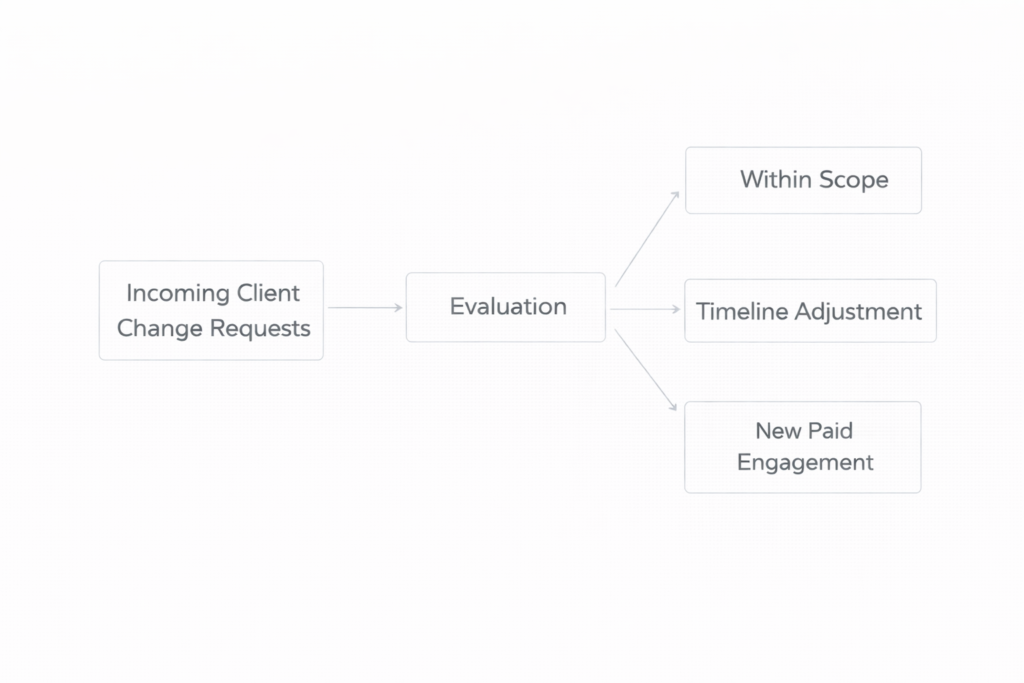
A structured change request management process typically includes four operational stages.
1. Request Identification
The first step is recognizing when a request represents a project change.
Requests may include:
- additional deliverables
- expanded research scope
- new stakeholders requiring input
- extended revision cycles
Early identification prevents additional work from accumulating unnoticed.
2. Impact Assessment
Once identified, the request must be evaluated.
This evaluation typically considers:
- additional delivery time required
- potential impact on project timelines
- effect on other scheduled work
Impact assessment allows freelancers to understand the operational consequences of the request before responding.
3. Decision Path
Based on the assessment, the request can follow several paths.
Possible decisions include:
- approving the request within the existing scope
- adjusting timelines while maintaining the current scope
- proposing additional compensation
- deferring the request to a future engagement
Structured decision paths prevent impulsive acceptance of additional work.
4. Change Documentation
Once a decision is made, the change should be documented.
Documentation may include:
- updated deliverable descriptions
- revised project timelines
- additional agreements or pricing adjustments
Formal documentation ensures that both consultant and client remain aligned on the updated project parameters.
Operational Impact
A structured change request management system improves several operational aspects of freelance consulting engagements.
Margin Protection
Additional work is evaluated and compensated appropriately.
Timeline Stability
Project schedules remain realistic despite evolving requirements.
Client Transparency
Clients understand how project changes affect scope, timelines, and costs.
Delivery Control
Freelancers maintain authority over how projects evolve during execution.
Change management therefore strengthens both operational discipline and financial sustainability.
System-Level Impact Across Processome
Change request management affects several interconnected systems within the Processome architecture.
Client Pipeline System → project scope clarity during qualification
Capacity Planning System → workload adjustments when project changes occur
Profit Tracking System → margin visibility through controlled scope expansion
Delivery & Operations System → execution stability during evolving project requirements
Structured change management ensures that delivery operations remain aligned with capacity and financial constraints.
Common Failure Patterns
Freelancers often struggle with change management because client relationships encourage flexibility.
Several recurring patterns appear.
Accepting Changes Informally
Freelancers incorporate additional work without documenting or evaluating the request.
Avoiding Pricing Conversations
Consultants may hesitate to request additional compensation for expanded scope.
Late Identification of Scope Changes
Requests are recognized only after significant additional work has already been completed.
Unclear Change Documentation
Agreed changes may not be recorded clearly, creating future misunderstandings.
These behaviors gradually undermine delivery control.
Strategic Outcome
When change request management is implemented effectively, project evolution becomes structured rather than chaotic.
Freelancers maintain professional flexibility while preserving operational discipline.
This produces several advantages.
Controlled project evolution
Changes are incorporated through clear decision processes.
Protected margins
Additional effort is aligned with appropriate compensation.
Stable delivery timelines
Projects remain consistent with capacity planning.
Stronger client relationships
Clear communication reduces misunderstandings.
Change management transforms project change from a risk into a manageable operational process.
Final Perspective
Consulting projects naturally evolve as new information emerges. Attempting to eliminate change entirely is unrealistic.
However, unmanaged change introduces operational instability and financial risk.
Within the Processome operating model, the → Delivery & Operations System ensures that project evolution occurs through structured decision processes rather than informal agreements.
Change will always occur.
Structured change management ensures that it remains controlled.