Workflow Automation for Freelancers
Introduction
Freelance consulting work often involves a variety of recurring operational tasks. These may include onboarding new clients, sending proposals, scheduling meetings, delivering project updates, or managing administrative processes.
When these activities are handled manually, they can gradually consume significant time and attention.
As the number of clients and projects increases, operational complexity grows as well.
Within the Processome operating model, operational efficiency belongs to the → Delivery & Operations System, the framework responsible for ensuring that consulting work progresses through stable and efficient processes.
Workflow automation helps freelancers reduce repetitive manual work by structuring recurring processes and allowing technology to execute routine steps.
Instead of repeatedly performing the same operational tasks, freelancers design workflows that handle these activities automatically.
Automation increases operational efficiency while preserving focus for high-value consulting work.
The Core Problem
Many freelancers perform operational tasks manually each time they occur.
Examples include:
- sending onboarding documents
- scheduling discovery calls
- organizing project files
- sending follow-up messages
- tracking project milestones
While each individual task may appear small, the cumulative workload can become substantial.
Several operational challenges emerge.
Administrative Time Expansion
Freelancers spend increasing amounts of time on operational coordination.
Process Inconsistency
Manual processes may vary between clients or projects.
Delayed Responses
Operational tasks may be postponed due to competing priorities.
Reduced Delivery Focus
Administrative work competes with time needed for consulting activities.
These issues rarely result from lack of productivity.
They usually indicate that operational workflows have not been structured for efficiency.
Concept Explanation
Workflow automation is the process of using predefined rules and technology to execute recurring operational tasks automatically.
Instead of manually repeating each process step, freelancers design workflows that trigger actions when specific events occur.
Examples of automated workflows include:
- sending onboarding materials when a new client signs a contract
- creating project folders automatically when a project begins
- scheduling follow-up reminders after meetings
- updating project status in task management systems
Automation does not eliminate operational processes.
It standardizes and accelerates them.
Workflow automation complements other operational frameworks such as:
→ SOP Library Structure for Freelancers
→ Client Onboarding System for Freelancers
Standard operating procedures define processes, while automation helps execute them efficiently.
Workflow Automation Framework
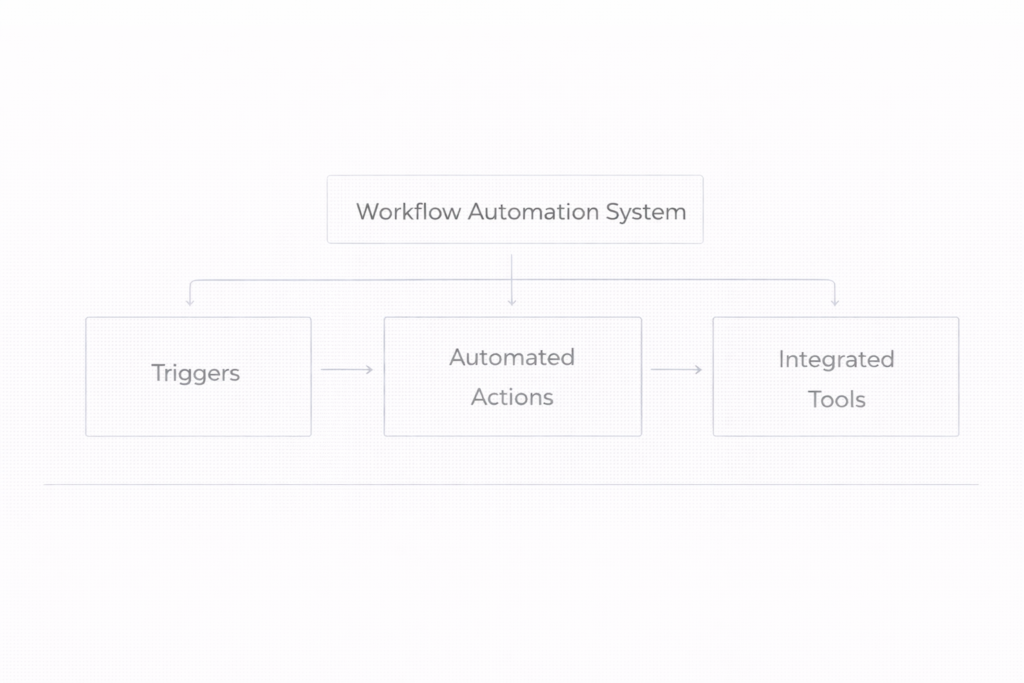
A structured workflow automation framework typically includes four operational components.
1. Process Identification
The first step is identifying processes suitable for automation.
Typical candidates include:
- client onboarding workflows
- proposal follow-up reminders
- meeting scheduling
- recurring reporting tasks
Processes that occur frequently and follow predictable steps are ideal candidates for automation.
2. Trigger Definition
Automation workflows begin with defined triggers.
Triggers represent events that start the automated process.
Examples include:
- a signed client contract
- creation of a new project
- completion of a project milestone
- scheduled time intervals
Triggers activate the automated workflow.
3. Automated Actions
Once triggered, the workflow executes predefined actions.
Examples include:
- sending automated emails
- creating project folders
- generating task lists
- updating project management tools
These actions reduce the need for manual coordination.
4. System Integration
Automation often connects multiple tools used in freelance operations.
Examples may include:
- CRM systems
- project management platforms
- document management tools
- scheduling software
Integrating these systems allows workflows to move information automatically between tools.
Operational Impact
Workflow automation improves several operational aspects of freelance consulting businesses.
Reduced Administrative Work
Automation reduces the time required for routine tasks.
Consistent Operational Processes
Standardized workflows improve process reliability.
Faster Operational Responses
Clients receive information or updates more quickly.
Greater Focus on Consulting Work
Freelancers can allocate more time to analysis, strategy, and client advisory work.
Automation therefore strengthens operational efficiency without increasing workload.
System-Level Impact Across Processome
Workflow automation improves coordination across the Processome operating architecture.
Client Pipeline System → automated follow-ups support consistent pipeline management
Capacity Planning System → reduced administrative work frees delivery capacity
Profit Tracking System → operational efficiency improves margin performance
Delivery & Operations System → automated workflows stabilize operational processes
Automation ensures that operational tasks support consulting delivery rather than competing with it.
Common Failure Patterns
Freelancers often encounter difficulties with automation because implementation is poorly structured.
Several patterns frequently appear.
Automating Undefined Processes
Automation is attempted before operational workflows are clearly defined.
Over-Automation
Too many automated processes create complexity rather than efficiency.
Tool Fragmentation
Automation tools are disconnected from existing operational systems.
Lack of Monitoring
Automated workflows are not reviewed periodically for effectiveness.
These issues can reduce the benefits of automation.
Strategic Outcome
When workflow automation is implemented thoughtfully, freelance consulting operations become significantly more efficient.
Instead of performing repetitive administrative tasks manually, freelancers rely on structured systems to handle routine processes.
This produces several advantages.
Higher operational efficiency
Routine tasks require less manual effort.
Greater process consistency
Standardized workflows reduce operational variation.
Improved client experience
Automated processes improve responsiveness.
More time for consulting work
Freelancers focus on high-value activities.
Automation transforms operational processes into scalable systems.
Final Perspective
Freelancers often believe that improving productivity requires working faster or managing time more carefully.
In reality, many productivity gains come from improving operational systems.
Within the Processome operating model, the → Delivery & Operations System ensures that consulting operations run through structured processes rather than repeated manual coordination.
Workflow automation converts repetitive tasks into reliable operational systems.
Efficiency emerges from structure.