Delivery Workflow Systems
Introduction
Freelance consulting projects often involve multiple phases: planning, research, deliverable development, review cycles, and final delivery. When these activities are managed informally, projects may progress inconsistently and delivery momentum can become difficult to maintain.
Without structured workflows, freelancers may frequently switch between tasks, respond reactively to client requests, and manage project progress through ad-hoc coordination.
Within the Processome operating model, operational execution is governed by the → Delivery & Operations System, the framework responsible for ensuring that consulting engagements follow structured processes.
Delivery workflow systems define how consulting work moves through predictable stages from project initiation to completion.
Instead of improvising project execution, freelancers design workflows that guide how work progresses through each phase of delivery.
Structured workflows transform complex projects into manageable operational sequences.
The Core Problem
Many freelancers manage project execution through informal task coordination.
Work may progress through:
- email conversations
- scattered notes or task lists
- reactive responses to client feedback
While this approach may function in smaller engagements, it often creates operational inefficiencies as project complexity increases.
Several problems frequently appear.
Inconsistent Project Progress
Without defined workflows, tasks may advance unevenly across projects.
Frequent Context Switching
Freelancers move between tasks without clear sequencing.
Delivery Delays
Important steps such as reviews or approvals may occur later than expected.
Reduced Visibility
It becomes difficult to determine the current status of a project.
These problems rarely originate from workload alone.
They typically reflect missing delivery structure.
Concept Explanation
A delivery workflow system is the structured sequence of steps through which consulting work progresses during a project.
Instead of treating project tasks as isolated activities, workflows define the operational order in which work occurs.
Typical workflow stages may include:
- project preparation
- research and analysis
- deliverable development
- internal review
- client review and revision
Each stage represents a defined operational step with specific outputs.
Delivery workflows complement other operational frameworks such as:
→ Project Planning for Freelancers
→ Project Kickoff Framework for Consultants
Planning defines project structure, while workflows govern how daily execution occurs.
Together, these systems ensure that consulting work progresses predictably.
Delivery Workflow System Framework
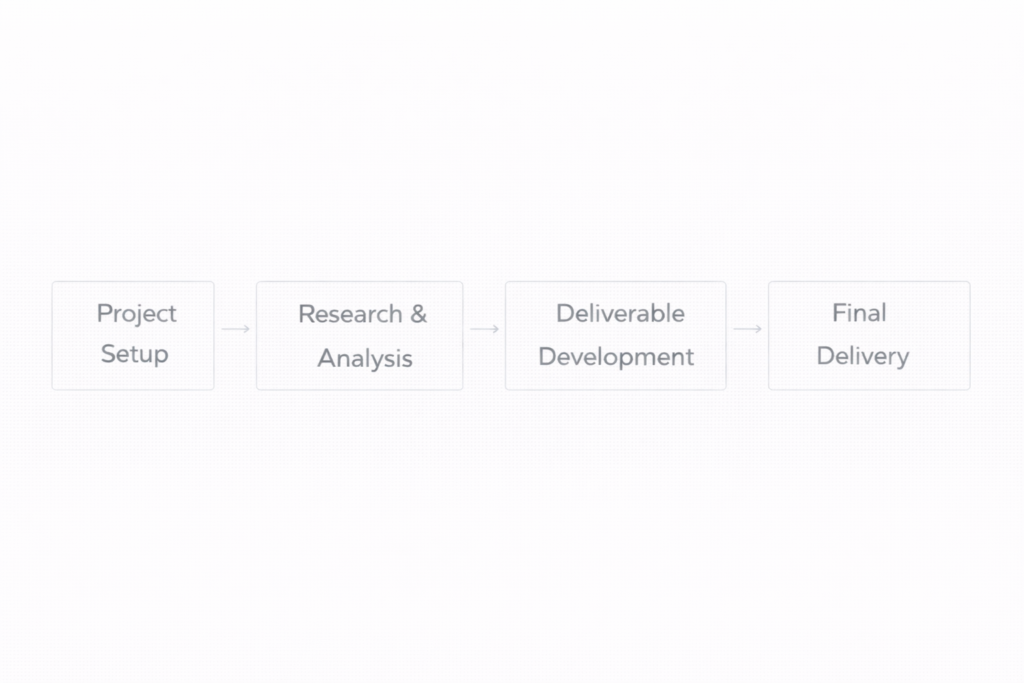
A structured delivery workflow system typically includes five operational stages.
1. Project Preparation
Before execution begins, the project must be prepared operationally.
Preparation may include:
- organizing project documentation
- confirming deliverables and milestones
- preparing research materials
Preparation ensures that the delivery process begins with clear structure.
2. Research and Analysis
Many consulting engagements involve research, analysis, or data evaluation.
This stage may include:
- reviewing client materials
- analyzing data or business processes
- identifying insights or recommendations
This phase establishes the analytical foundation for deliverables.
3. Deliverable Development
Once analysis is complete, deliverables are created.
Deliverables may include:
- reports
- presentations
- strategic frameworks
This stage transforms analysis into actionable outputs.
4. Review and Revision
Before final delivery, deliverables should pass through review stages.
Review may involve:
- internal quality checks
- client feedback sessions
- revision cycles
Structured review improves deliverable quality and ensures alignment with client expectations.
5. Final Delivery
The final stage involves delivering the completed work to the client.
This stage may include:
- presenting findings or recommendations
- transferring documentation
- confirming project completion
Final delivery marks the conclusion of the workflow sequence.
Operational Impact
Implementing delivery workflow systems improves several operational aspects of freelance consulting businesses.
Greater Delivery Consistency
Projects progress through repeatable execution stages.
Improved Task Sequencing
Freelancers follow structured workflows rather than switching tasks randomly.
Clearer Project Visibility
Workflow stages reveal the current status of a project.
Higher Deliverable Quality
Structured review stages improve output consistency.
Workflow systems therefore improve both efficiency and delivery reliability.
System-Level Impact Across Processome
Delivery workflows improve coordination across the Processome operating architecture.
Client Pipeline System → project expectations translate clearly into delivery workflows
Capacity Planning System → workload allocation aligns with workflow stages
Profit Tracking System → margin visibility improves through efficient delivery processes
Delivery & Operations System → execution stability through structured workflows
Operational workflows ensure that consulting engagements progress predictably from initiation to completion.
Common Failure Patterns
Freelancers often experience delivery inefficiencies because workflows remain informal.
Several patterns frequently appear.
Improvised Task Sequencing
Work begins without defined execution stages.
Missing Review Processes
Deliverables are sent to clients without internal review.
Reactive Work Habits
Freelancers switch tasks based on incoming messages rather than structured workflows.
Unclear Project Status
Project progress becomes difficult to evaluate.
These behaviors reduce operational efficiency and increase delivery risk.
Strategic Outcome
When delivery workflow systems are implemented effectively, freelance consulting operations become significantly more organized.
Instead of managing projects through scattered tasks, freelancers guide work through defined operational stages.
This produces several advantages.
Predictable execution
Projects progress through structured workflows.
Improved efficiency
Clear task sequencing reduces unnecessary context switching.
Higher deliverable quality
Structured review stages improve output reliability.
Stronger operational discipline
Freelancers maintain consistent execution processes.
Delivery workflows transform project execution into a structured operational system.
Final Perspective
Freelancers often focus heavily on planning and client communication while overlooking the structure of daily project execution.
However, delivery success depends on how consulting work progresses through operational stages.
Within the Processome operating model, the → Delivery & Operations System ensures that consulting engagements follow structured workflows rather than improvised task sequences.
Workflows turn complex projects into manageable operational processes.