Upselling Consulting Services
Introduction
Many freelance consulting engagements begin with a clearly defined project scope. The client requests a specific deliverable, the consultant proposes a solution, and the engagement proceeds toward completion.
However, consulting projects often uncover additional opportunities. During delivery, new problems may become visible, strategic questions may arise, or implementation challenges may appear.
When these opportunities remain unaddressed, both the consultant and the client may miss valuable extensions of the engagement.
Within the Processome operating model, upselling belongs to the → Delivery & Operations System, the operational framework responsible for maintaining long-term client relationships and identifying additional consulting opportunities after initial projects have begun.
Upselling does not mean selling aggressively.
It means identifying situations where additional consulting work can create meaningful value for the client.
Well-structured upselling improves both client outcomes and revenue stability.
The Core Problem
Freelancers often treat consulting engagements as isolated projects.
Once the agreed deliverables are completed, the engagement concludes even if new opportunities have emerged during delivery.
This approach creates several operational limitations.
Missed Consulting Opportunities
Additional strategic or operational needs may remain unexplored.
Short-Term Engagement Cycles
Relationships remain transactional rather than evolving into longer collaborations.
Revenue Volatility
Freelancers rely heavily on acquiring new clients to replace completed projects.
Underutilized Expertise
Consultants may possess knowledge that could address additional client challenges but never propose further work.
These issues rarely result from lack of expertise.
They typically reflect the absence of a structured approach to identifying expansion opportunities.
Concept Explanation
Upselling consulting services is the process of identifying and proposing additional consulting work that extends an existing engagement.
Unlike traditional sales activities, upselling occurs after a working relationship has already been established.
This creates several advantages.
The consultant:
- understands the client’s business context
- has established credibility
- can identify new opportunities during delivery
Upselling opportunities often emerge when:
- new strategic questions arise
- implementation challenges appear
- additional analysis becomes necessary
Upselling therefore focuses on expanding the scope of value delivered to the client.
This concept connects closely with:
→ Client Retention Strategies for Freelancers
→ Managing Client Expectations
Strong relationships and aligned expectations create the foundation for successful upselling.
Consulting Upsell Framework
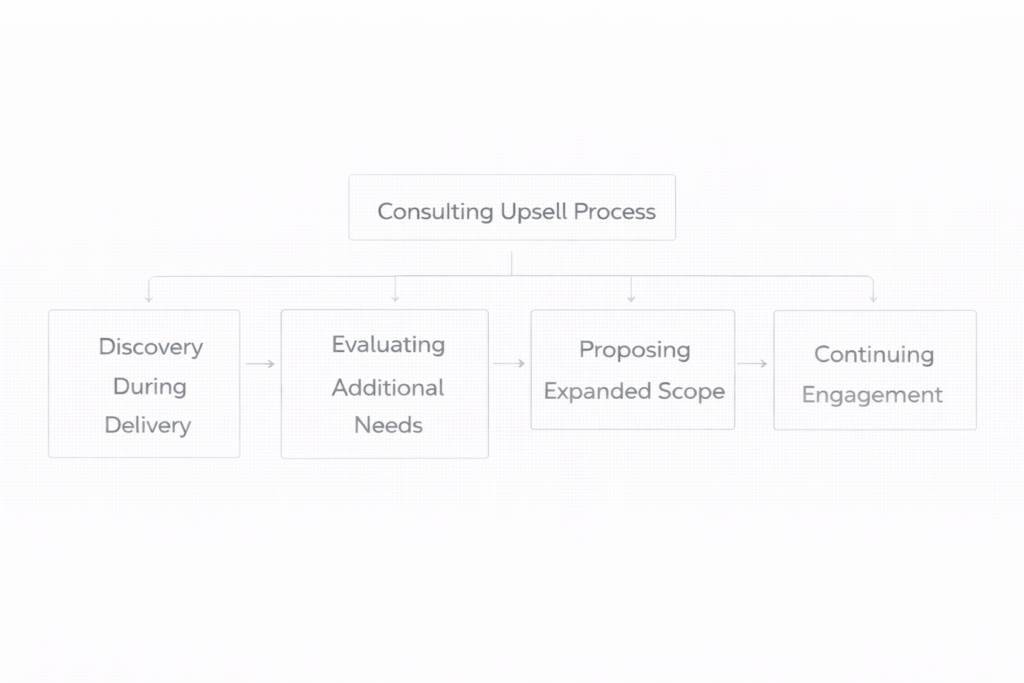
A structured upselling framework typically includes four operational stages.
1. Insight Discovery During Delivery
Consulting work often reveals additional areas where the client could benefit from further analysis or implementation support.
Examples may include:
- operational inefficiencies uncovered during analysis
- strategic questions emerging from project findings
- implementation challenges following recommendations
These insights create the foundation for potential upsell opportunities.
2. Opportunity Evaluation
Not every observation should lead to additional consulting work.
Freelancers should evaluate whether:
- the issue is significant enough to justify further work
- the consultant has the expertise to address the challenge
- the client would benefit from deeper engagement
This ensures that upselling remains aligned with client value.
3. Expansion Proposal
When an opportunity is identified, the consultant may propose additional work.
Proposals may include:
- follow-up consulting projects
- implementation support
- expanded strategic analysis
The proposal should clearly explain the additional value provided.
4. Engagement Continuation
If the client accepts the proposal, the engagement continues with expanded scope.
This may involve:
- extending the current project
- initiating a follow-up engagement
- transitioning into a longer-term advisory relationship
Upselling therefore transforms short-term engagements into extended consulting relationships.
Operational Impact
Structured upselling improves several operational aspects of freelance consulting businesses.
Higher Client Lifetime Value
Existing client relationships may generate multiple engagements over time.
Reduced Client Acquisition Pressure
Revenue growth becomes less dependent on acquiring new clients.
Stronger Client Relationships
Consultants deepen their understanding of the client’s business.
Greater Revenue Stability
Extended engagements reduce project-to-project revenue volatility.
Upselling therefore complements both client retention and revenue growth strategies.
System-Level Impact Across Processome
Upselling strategies influence coordination across the Processome operating architecture.
Client Pipeline System → existing clients generate new opportunities within the pipeline
Capacity Planning System → extended engagements improve workload predictability
Profit Tracking System → long-term clients often produce higher profitability
Delivery & Operations System → strong delivery relationships enable engagement expansion
Upselling connects delivery success with future consulting opportunities.
Common Failure Patterns
Freelancers often overlook upselling opportunities because they focus primarily on completing the current project.
Several patterns frequently appear.
Project Completion Without Opportunity Review
Consultants finish engagements without discussing potential next steps.
Hesitation to Propose Additional Work
Freelancers may avoid proposing new work out of concern for appearing overly sales-oriented.
Missed Strategic Insights
Opportunities discovered during delivery are not formalized into consulting proposals.
Short-Term Engagement Thinking
Consulting work remains limited to individual projects rather than evolving into ongoing collaboration.
These patterns reduce the long-term value of client relationships.
Strategic Outcome
When structured upselling systems are implemented, freelance consulting engagements become more strategically valuable.
Instead of ending once deliverables are completed, successful projects evolve into expanded consulting opportunities when appropriate.
This produces several advantages.
Higher engagement value
Clients receive deeper consulting support.
Stronger relationships
Freelancers become trusted advisors rather than one-time service providers.
Improved revenue stability
Ongoing engagements reduce reliance on constant client acquisition.
Greater strategic impact
Consultants contribute to broader business challenges.
Upselling therefore transforms project-based consulting into evolving advisory relationships.
Final Perspective
Freelancers often view sales and delivery as separate activities.
However, the strongest consulting opportunities frequently emerge during project execution.
Within the Processome operating model, the → Delivery & Operations System ensures that delivery insights translate into structured consulting opportunities.
Upselling is not about selling more work.
It is about recognizing when additional consulting can create meaningful value.