Sales Process for Freelancers (How to Turn Leads Into Clients)
Sales Process for Freelancers (How to Turn Leads Into Clients)
Introduction
Client acquisition in freelance consulting rarely happens in a single interaction. Instead, it unfolds through a structured sequence of stages that move potential clients from initial contact to signed engagement.
Without a defined system, this process becomes inconsistent—conversations are unstructured, proposals vary in quality, and opportunities are not tracked reliably.
This is why a sales process for freelancers is essential.
Within the Processome operating model, the sales process belongs to the → Client Pipeline System, the system responsible for organizing how opportunities enter, develop, and convert.
Importantly, a sales process is not designed to “convince” clients. It is designed to evaluate and filter opportunities—ensuring that only viable engagements move forward.
When structured correctly, the sales process provides visibility, consistency, and control—turning informal conversations into a predictable client acquisition system.
What Is a Sales Process for Freelancers?
A sales process for freelancers is a structured sequence of stages that guide opportunities from initial contact to signed engagement.
Each stage represents a decision point that determines whether an opportunity should move forward.
Instead of handling every deal differently, freelancers apply a consistent process to evaluate:
- opportunity viability
- client fit
- engagement feasibility
This ensures that all opportunities progress logically through the pipeline.
Typical stages include:
- lead generation
- discovery
- qualification
- proposal
- closing
These stages connect multiple systems within Processome:
→ Freelance Lead Generation System
→ Discovery Calls for Freelancers
→ Structuring Freelance Proposals
The Core Problem
Many freelancers operate without a defined sales process.
Common patterns include:
- responding to leads without qualification
- moving directly to proposals
- failing to track opportunities
- allowing deals to stall
These behaviors create structural issues.
Pipeline Opacity
It is unclear where deals stand.
Inconsistent Qualification
Low-quality opportunities move forward.
Low Conversion Visibility
Freelancers cannot identify where deals fail.
Revenue Uncertainty
Forecasting becomes unreliable.
Without a structured freelance sales process, client acquisition remains unpredictable.
The Freelance Sales Process Framework
A structured sales process for freelancers can be organized into five core stages.
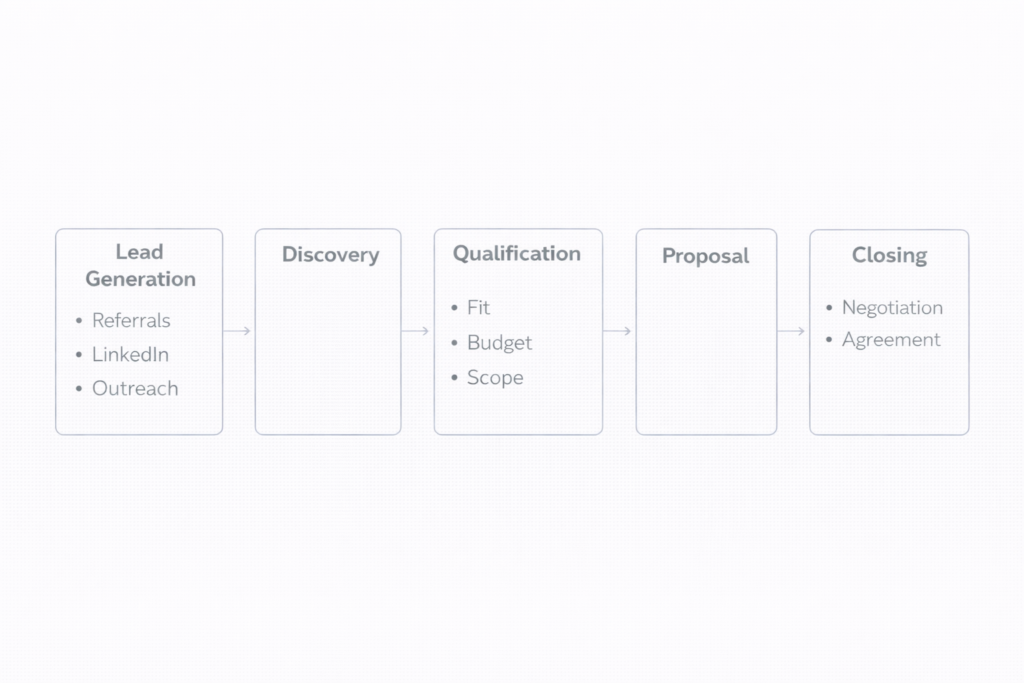
1. Lead Generation
This stage introduces opportunities into the pipeline.
Sources include:
- referrals
- networks
- inbound leads
- outbound outreach
→ Where Freelancers Find B2B Clients
→ Referral Systems for Consultants
Lead generation determines pipeline volume and directly influences future revenue potential.
2. Discovery
Discovery evaluates the client’s situation and problem.
This stage focuses on:
- understanding the problem
- clarifying goals
- identifying constraints
Discovery also acts as an early filter. Misaligned opportunities can be identified before significant time is invested.
→ Discovery Calls for Freelancers
3. Qualification
Qualification determines whether the opportunity should proceed.
Criteria typically include:
- expertise alignment
- scope feasibility
- client commitment
This stage protects time and ensures that only viable opportunities move forward.
→ Client Qualification Framework for Freelancers
→ How to Qualify Freelance Leads Strategically
4. Proposal
The proposal defines how the engagement will be executed.
It includes:
- problem definition
- solution structure
- scope and deliverables
- pricing
A well-structured proposal reduces uncertainty and enables faster decision-making.
→ Structuring Freelance Proposals
5. Closing
Closing converts the opportunity into a signed engagement.
This stage may include:
- clarifications
- negotiations
- agreement finalization
Once complete, the opportunity exits the pipeline and moves into delivery.
How Opportunities Progress Through the Sales Process
Each stage in the sales process reduces uncertainty.
- Early-stage leads carry high uncertainty
- Qualified opportunities become more defined
- Proposal-stage deals have higher probability
- Closed deals represent confirmed revenue
As opportunities progress:
- weak deals are filtered out
- strong deals move forward
- pipeline quality improves
This progression is what allows the pipeline to function as a decision system rather than a list of conversations.
Operationalizing the Sales Process
A sales process only works when applied consistently.
Freelancers should:
- track every opportunity
- update pipeline stages after each interaction
- define next actions
- remove or requalify stalled deals
This requires structured tracking systems:
→ Deal Tracking Systems for Freelancers
→ Simple CRM Setup for Freelancers
You can explore supporting tools here:
→ Client Pipeline System Tools
Operational Impact
A structured sales process for freelancers improves several operational areas.
Pipeline Visibility
All opportunities are clearly tracked and categorized.
Revenue Forecasting
Structured stages allow freelancers to estimate expected revenue based on pipeline data.
→ Weighted Revenue Forecasting for Freelancers
Conversion Optimization
Freelancers can identify weak stages and improve performance.
→ Pipeline Velocity for Freelancers
Capacity Planning
Upcoming work becomes more predictable as deals progress through later stages.
System-Level Impact Across Processome
The sales process connects:
- Client Pipeline System → deal progression
- Capacity Planning System → workload forecasting
- Profit Tracking System → pricing decisions
- Delivery & Operations System → onboarding
A structured process improves coordination across all systems.
Common Failure Patterns
Skipping Qualification
Leads to poor-fit projects and wasted effort.
Inconsistent Tracking
Reduces pipeline visibility.
Weak Stage Definitions
Creates ambiguity in decision-making.
Lack of Discipline
A defined process is not applied consistently.
Strategic Outcome
When freelancers implement a structured sales process:
Clear Pipeline Visibility
Every opportunity is visible and trackable.
Higher Conversion Rates
Better qualification improves outcomes.
Predictable Revenue
Forecasting becomes reliable.
Stronger Operational Control
Acquisition aligns with delivery capacity.
Over time, the sales process becomes a core operating system within the business.
Final Perspective
Freelance sales often appear informal, but effective consulting businesses rely on structured systems.
A defined sales process for freelancers ensures that opportunities move consistently from lead to client.
Within the Processome operating model, this process transforms the Client Pipeline System into a predictable revenue engine.
Without structure, sales remain reactive.
With structure, they become controllable.